publication / March 17, 2026
Working with Partners Policy
World Vision’s Working with Partners policy sets principles and practices for equitable, accountable partnerships that advance child well‑being.
publication / March 9, 2026
Policy Insights in Ending Child Hunger and Malnutrition
This policy brief introduces the ENOUGH Campaign in East Africa and invites you to be part of a practical response rooted in bold hope to end child hunger and malnutrition. It explains the challenge clearly, highlights what is working, and sets out actions that governments, donors, businesses, civil society, communities and friends of children can take together. The goal is simple and urgent: to make sure every child has ENOUGH of the right food to grow well, learn in school and thrive.
publication / March 24, 2026
ENOUGH Campaign Report 2025 - West Africa Region
World Vision’s ENOUGH Campaign Report 2025 highlights progress on child nutrition, school feeding, and policy change across West Africa.
publication / March 2, 2026
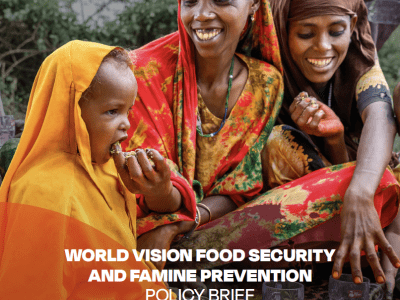
Policy Brief | Famine Prevention & Food Security
Policy Brief | Famine Prevention & Food Security
publication / February 4, 2026
East Africa Region Policy Brief on Ending Female Genital Mutilation (FGM) 2023
World Vision is influencing the adoption and implementation of policies relating to FGM in Kenya, Sudan, Somalia and Sudan. The policy brief highlights strategic policy recommendations targeting national governments, regional institutions donors faith and community leaders.
publication / March 12, 2026
2025 Child‑Friendly Impact Report
Children are at the heart of everything we do, their voices, dreams, and well-being drive our mission. We are excited to share that amid the ever-growing humanitarian needs we reached 16.4 Million children in the East Africa Region.

publication / March 18, 2026
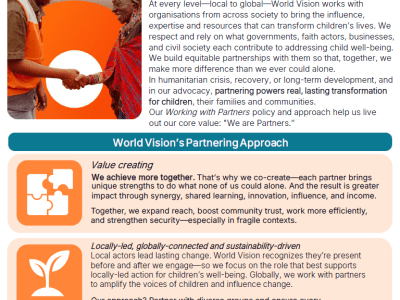
Working with Partners Policy - Summary
World Vision’s approach to working with partners promotes locally led, equitable collaboration to deliver lasting impact for children and communities.
publication / March 4, 2026
Lebanon Response Sitrep 2026 #1
The current escalation follows prolonged instability and military activity despite the 27 November 2024 cessation of hostilities. Since the ceasefire came into effect, more than 10,000 air and ground violations have been recorded, resulting in at least 335 people killed and 973 injured as of 5 January 2026. Reported incidents have included airspace incursions, cross-border fire, and military activity in Baalbek, Hermel, and southern areas, alongside the continued presence of foreign military forces in five border villages. Prior to the renewed escalation in March 2026, an estimated 62,000 to 90,000 people remained internally displaced from earlier conflicts, underscoring the protracted nature of the crisis and the heightened humanitarian vulnerability across affected regions.
Over the weekend, regional tensions escalated following developments involving the United States and Iran, with hostilities expanding into the country to the south of Lebanon and Lebanon on 2nd of March. Airstrikes were reported across multiple areas, including the southern suburbs of Beirut, Bekaa, Baalbek-Hermel, and South Lebanon. According to Disaster Risk Management (DRM) Unit sources, an estimated more than 81,791 internally displaced persons (IDPs) including 9,000 children, have been recorded thus far, primarily in Beirut & Mount Lebanon (BML), Bekaa, Baalbek, and southern governorates. So far, over 60 people have been reported killed and at least 154 injured, with figures continuing to evolve. Warnings have been issued to evacuate over 200 towns across Lebanon, contributing to significant population movement from border areas and high-risk locations, while shelter data remains fluid due to continued secondary displacement and movement between collective sites.

press release / March 5, 2026
Position Statement for International Women’s Day 2026
This year, World Vision Ghana stands with women and girls across the nation under the theme: “Empowered Women, Thriving Communities.”

publication / March 9, 2026
Policy Overview | Famine Prevention & Food Security
Famine is not a natural disaster and can be prevented. Across the world’s hunger hotspots, early warnings are clear, yet governments continue to act too late – or not at all. Conflict, blockades, and the denial of humanitarian access, not food scarcity, are driving a deepening hunger crisis, with children suffering first and longest. As aid budgets are cut, the gap between need and response is widening fast. This is a false economy: preventing famine costs far less than responding once lives are already lost. World Vision warns famine can be predicted and prevented – but only if leaders act early, protect civilians, and put children at the centre of hunger prevention.