publication / March 17, 2026
World Vision's Approach to Localisation
World Vision’s localisation approach promotes locally led development and humanitarian action through equitable partnerships, shared power, and community leadership.
publication / January 20, 2026
Safe Returns Project, Ninawa Iraq (Fact Sheet)
A fact sheet highlighting the Safe Returns Project in Ninawa, Iraq, showcasing key outcomes, MSME impact, cost-benefit analysis, and lessons learned from a DFAT-funded initiative implemented by World Vision Iraq.
publication / March 9, 2026
Lebanon Response Sitrep 2026 #2
According to Lebanon’s Ministry of Public Health (MoPH), attacks between 2 and 8 March have resulted in 394 people killed and 1,130 injured, with figures Increasing daily.
Displacement orders issued in the last days, including renewed orders affecting areas south of the Litani River and the entirety of Beirut’s southern suburbs, have triggered further population movements and repeated displacement for many households.
As of 8 March, the Disaster Risk Management (DRM) Unit reports 117,228 displaced individuals residing in 538 collective shelters. The Government of Lebanon has launched a national self-registration platform for internally displaced persons, with over 517,000 people, indicating the potential scale of displacement beyond those recorded in collective shelters.
Recent days have seen hostilities expand beyond traditional frontline areas, including blanket evacuation orders affecting Beirut’s southern suburbs, warnings and subsequent strikes targeting branches of the Al-Qard- Al-Hassan Association. Airstrikes have also impacted locations outside the declared warning zones, including a hotel in central Beirut and an earlier strike on a hotel in Hazmieh, both situated outside the primary red-zone areas. These incidents highlight the widening geographic scope of the conflict and the continued risks to civilians and humanitarian operations across areas.
publication / March 16, 2026
Lebanon Response Sitrep 2026 #4
The escalation of hostilities in Lebanon has now entered day 15, while regional tensions linked to the wider conflict continued for 17 days, with no immediate indication of de-escalation. Evacuation orders continue to expand across South Lebanon, Beirut, Mount Lebanon, and the Bekaa Valley, with warnings issued by the country to the south instructing residents to evacuate and indicating that return will not be permitted until further notice. Reports state that entire families who chose to remain in their homes in some affected areas have been killed during strikes, highlighting the severe protection risks facing civilians.
In recent days, strikes have increasingly targeted critical infrastructure and transport routes, including two key bridges connecting major towns in South Lebanon, further disrupting civilian movement and humanitarian access. Trucks transporting goods are reportedly warned not to move along the southern coastal road, further constraining assistance delivery. Airstrikes also impacted central Beirut and residential areas in Mount Lebanon, reflecting the continued expansion of hostilities beyond traditional frontline zones.
Meanwhile, displacement continues to rise, and shelter capacity remains under severe strain. With collective shelters overcrowded or at full capacity, many displaced families have been forced to seek alternative arrangements, including unfinished buildings, informal shelters, and makeshift tents along the coastal Corniche from Saida to Beirut. Recent heavy rainstorms and falling temperatures have further worsened conditions, destroying displacement tents and flooding temporary sites, leaving displaced households exposed to harsh weather and heightened risks. The prolonged escalation is also contributing to pockets of civil unrest, as well as heightened social tensions in several areas, with growing fears among communities that prolonged displacement and political polarization could increase the risk of localized sectarian tensions.
publication / March 16, 2026
Annual Impact Report 2025
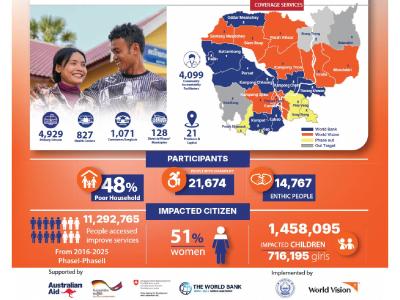
World Vision International in Cambodia’s 2025 Impact Report highlights a year of resilience, adaptation, and collective action amid significant humanitarian and development challenges. In a rapidly changing context shaped by sector‑wide disruptions and escalating border‑related conflict, World Vision Cambodia worked closely with government authorities, partners, communities, and donors to respond to urgent needs while sustaining long‑term development efforts. In 2025, World Vision Cambodia reached 5.4 million people, including 3.1 million children, nearly one third of Cambodia’s population. Humanitarian response remained a critical priority, supporting over 144,000 displaced people across 100 displacement sites, including children and people with disabilities, through life‑saving assistance such as water, sanitation, food and non‑food items, cash assistance, education, health and nutrition services, protection, and psychosocial support. Beyond emergency response, progress was achieved across education, child protection, WASH, nutrition, livelihoods, climate action, social accountability, and inclusive programming. The year also marked 55 years of World Vision’s long‑term commitment in Cambodia, reflecting sustained partnership and a shared vision for every child to experience life in all its fullness.
press release / February 26, 2026
"Decisions About Us, Made With Us": The New Era of Child Participation at the Asia Pacific Forum on Sustainable Development 2026
From Participation to Partnership: At APFSD 2026, child leaders from World VIsion programmes in 13 countries are moving beyond symbolic roles, inviting regional leaders into a shared co-design process and proposing "Innovation Labs" to bridge the gap between policy and the lived realities of their communities.
publication / March 17, 2026
BUILDING RESILIENCE THROUGH NEXUS PROGRAMMING
Nexus drives impact in fragile contexts by linking aid, development, and peacebuilding to save lives, strengthen systems, and build lasting resilience.
press release / February 25, 2026
“Our Rights, Our Future”: Strengthening Safe Civic Spaces for Child Participation at the Asia Pacific Forum on Sustainable Development 2026
At APFSD 2026, children and regional leaders unite to close the 88% SDG progress gap. Explore how child-centred innovation and direct negotiation are shaping a resilient future for communities across the Asia-Pacific.
article / February 26, 2026
"Decisions About Us, Made with Us": The New Era of Child Participation at the Asia Pacific Forum on Sustainable Development 2026
• From Participation to Partnership: Child leaders from 13 countries at APFSD 2026 are moving beyond symbolic roles, inviting regional leaders into a shared co-design process and proposing "Innovation Labs" to bridge the gap between policy and the lived realities of their communities.