publication / February 12, 2026
Surviving the Freezing Cold Under Fire: How Winter Disrupts Education and Mental Health Support for Ukrainian Children
As winter hardship intensifies in Ukraine, 100% of surveyed families report extreme conditions where a lack of heat, electricity, and education is pushing children to a breaking point. This briefing outlines the urgent need for flexible funding and support to protect families from a cumulative humanitarian crisis.
article / January 17, 2026
Under Fire, They Rescued Their Bees
After fleeing eastern Ukraine, a displaced couple saves their beehives and rebuilds livelihoods with World Vision’s support, restoring income and hope amid war.
publication / March 4, 2026
Lebanon Response Sitrep 2026 #1
The current escalation follows prolonged instability and military activity despite the 27 November 2024 cessation of hostilities. Since the ceasefire came into effect, more than 10,000 air and ground violations have been recorded, resulting in at least 335 people killed and 973 injured as of 5 January 2026. Reported incidents have included airspace incursions, cross-border fire, and military activity in Baalbek, Hermel, and southern areas, alongside the continued presence of foreign military forces in five border villages. Prior to the renewed escalation in March 2026, an estimated 62,000 to 90,000 people remained internally displaced from earlier conflicts, underscoring the protracted nature of the crisis and the heightened humanitarian vulnerability across affected regions.
Over the weekend, regional tensions escalated following developments involving the United States and Iran, with hostilities expanding into the country to the south of Lebanon and Lebanon on 2nd of March. Airstrikes were reported across multiple areas, including the southern suburbs of Beirut, Bekaa, Baalbek-Hermel, and South Lebanon. According to Disaster Risk Management (DRM) Unit sources, an estimated more than 81,791 internally displaced persons (IDPs) including 9,000 children, have been recorded thus far, primarily in Beirut & Mount Lebanon (BML), Bekaa, Baalbek, and southern governorates. So far, over 60 people have been reported killed and at least 154 injured, with figures continuing to evolve. Warnings have been issued to evacuate over 200 towns across Lebanon, contributing to significant population movement from border areas and high-risk locations, while shelter data remains fluid due to continued secondary displacement and movement between collective sites.
publication / March 12, 2026
Lebanon Response Sitrep 2026 #3
The escalation of hostilities in Lebanon is intense and rapidly expanding, resulting in nearly 820,000 forcibly displaced people - more than 200,000 of them children - in less than two weeks. Evacuation orders are expanding, with the country to the south launching the ‘South of Zahrani River’ initiative. Evacuation orders now encompass the entire region south of the Litani River, triggering waves of mass displacement as well as repeated displacement among already vulnerable families.
In several Christian-majority towns in the South, residents initially resisted leaving their homes, but were ultimately evacuated under the escort of UNIFIL for civilian protection. Hostilities are increasingly affecting areas beyond the ‘traditional’ frontline zones, a troubling trend that points to a more aggressive escalation than that of 2024. Recent airstrikes hit the neighborhoods of Haret Saida, Tyre, Aramoun, Ramlet El Bayda, areas deemed safer, in one case targeting a car nearby displaced families staying in tents. Targeting of central Beirut is new - with strikes on hotels and residential buildings that inevidably affect civilians in the surrounding areas. An estimated have been killed, with 81 children killed since March 1. UNICEF estimates that 10 children per day are killed.
Lebanon’s Ministry of Social Affairs reports 822,600 internally displaced people self-registered on the Government’s digital platform, indicating that overall displacement is significantly higher than that captured through collective shelter reporting. In addition, almost 84,000 Syrians and more than 8,000 Lebanese have crossed into Syria since 2 March.
Violations to International Humanitarian Law continue, with frontline responders at great risk. To date, 14 paramedics were killed, including one member of the Lebanese Red Cross, underscoring the growing risks faced by emergency personnel.
publication / February 18, 2026
Annual Report 2025: Standing With Children Through Four Years of War in Ukraine
As the Ukraine Crisis Response enters its fifth year, the war continues to devastate millions of lives, particularly children. Over the past four years, World Vision Ukraine has reached more than 2.3 million people, including over 1 million children, providing critical support in education, mental health, protection, cash assistance, livelihoods, basic needs services and winterisation.
article / February 26, 2026
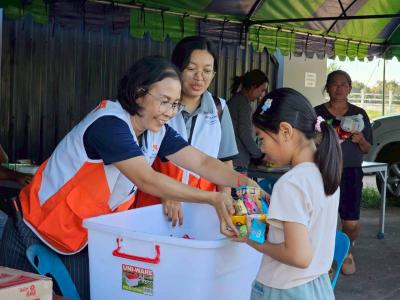
Between Borders and Uncertainty: Families Rebuild Hope After the Cambodia–Thailand Conflict
Along the border between Cambodia and Thailand, the sound of conflict may have faded, but for thousands of families, the consequences are still unfolding, quietly, deeply, and every day.
video / March 4, 2026
Partnerships for Progress: Strengthening Rural Health Through Collaboration
In this video, World Vision’s Vice President for Water and Health highlights the transformative power of partnerships in bridging the gap between remote communities and quality healthcare. While WASH services provide the foundation for safety, strategic collaborations bring the specialised resources necessary to sustain a modern medical environment. By aligning the expertise of non-profits with the strengths of the private sector, rural health infrastructure is upgraded from basic survival centres to comprehensive medical hubs capable of delivering long-term impact.
article / March 12, 2026
From crisis to care: Community nutrition hearths help mothers fight malnutrition in Narang
In Narang, World Vision nutrition hearths equip displaced mothers with skills and local foods to prevent malnutrition and help children thrive.
publication / March 2, 2026
Disaster Management Capacity Statement
The Middle East and Eastern Europe region faces some of the world’s most complex and long-lasting humanitarian crises, driven by conflict, climate shocks, and economic decline. Despite insecurity, limited funding, and access challenges, World Vision has sustained and expanded its humanitarian response in the region for over 50 years.
publication / March 4, 2026
Building Gender Empowerment and Climate Resilience through Natural Farming Systems
Monash University and World Vision study reveals how natural farming drives financial independence and climate resilience for women and their communities in Bangladesh and Sri Lanka.