

Duplication in aid is not an accident. It is a choice.
Amos Doornbos, the Technical Director, Humanitarian Digital Adoption and Literacy, Disaster Management at World Vision International, emphasises that duplication in humanitarian aid is not a failure of technology but the predictable result of systems designed around projects, donors, and organisational control rather than people. Aid recipients are forced to repeatedly register and navigate opaque systems, a burden that wastes time, erodes dignity, and shifts costs onto those least able to bear them. The author argues that centralised “technical fixes” concentrate power and fail, while people‑centred, collectively governed data stewardship models have already proven viable. The real barrier is not feasibility but political will: meaningful coordination requires sharing power, investing in governance, and funding collective action as core infrastructure.
After every major crisis, humanitarian organisations repeat a familiar mantra: no single agency can meet all needs alone. Coordination is essential. Information matters. We must know who is doing what, where and for whom. All of this is true. And yet, for the people navigating humanitarian systems, coordination often feels invisible. For decades, the humanitarian sector has relied on tools designed to map activities at a high level. These systems help planners and donors understand coverage and gaps. What they rarely address is the lived experience of overlap and the human cost of duplication for those seeking assistance.
People do not experience crises in neat, sector-based siloes. Families move. Needs change. Circumstances shift. People interact with multiple organisations over time, often without clarity about who will actually deliver support. Our information systems, however, remain stubbornly static, oriented around projects, not people. The very data meant to improve efficiency like personal details, vulnerabilities and assistance histories, is almost entirely controlled by organisations. People cannot access it, correct it, or reuse it.
 A system built around projects, not people
Over the past thirty years, humanitarian organisations have built a dense ecosystem of internal information systems to manage projects and satisfy donor requirements. Some are sophisticated like advanced digital platforms; others are deliberately simple, like paper or Excel spreadsheets.
Built around organisations and projects, these systems are optimised for reporting on how specific funds were used. They are not designed to understand people’s journeys through a response, let alone the response as a whole. Most global data protection laws, including rights to access one’s own data or portability, were adopted after these systems were entrenched. As a result, the data collected is about people, controlled by organisations, and rarely accessible to the individuals themselves.
The result is predictable. Individuals are asked to register again and again: for each organisation, each project, each sector. Sometimes multiple times within the same agency. Duplication is an inevitable outcome of this design. The time people spend queueing, registering, and repeating their stories is not counted as a cost.
When “duplication” is rational
In Ukraine, households told World Vision staff they registered with as many organisations as possible because they had no way of knowing who would actually deliver. From their perspective, this was rational behaviour in an opaque system.[1]
From the system’s perspective, it was labelled duplication or worse, fraud. But duplication is rarely malicious. It is the predictable outcome of a humanitarian architecture designed around projects rather than people.
The myth of the technical fix
Faced with persistent duplication, the sector often reaches for technical solutions: a single shared system, a central registry, a new platform everyone must use.
These efforts almost always fail for the same reason: they concentrate power. Centralised systems place one organisation or one donor at the centre of decision-making. They assume coordination can be enforced through technology, rather than built through trust and shared accountability. These approaches are actually fragile as they rely on one actor to continue to exist and continue to behave benevolently.
 A different way of working together
If people were genuinely at the centre, systems would look very different. An alternative is not hypothetical; it has been tested.
In response to commitments made under the Grand Bargain, a group of 14 international NGOs, including World Vision, came together, under the Collaborative Cash Delivery network (CCD), to explore how they could work better together in cash assistance. The question shifted from “what system should we all use?” to “how can we work together without giving up autonomy or people’s rights?”
That shift changed everything. Instead of designing a system, organisations agreed on principles:
- Deduplicate individuals, not households
- Share the minimum data necessary
- Let organisations choose their own tools
- Identify duplicates digitally, resolve them humanely
- Reject biometrics as a requirement
- Prioritise governance over technology
What followed was slow, unglamorous work. Negotiating legal interpretations across jurisdictions. Agreeing on minimum datasets. Confronting power dynamics no software could solve. It was mostly meetings. And friction. And learning how differently organisations interpret data, risk, responsibility, and trust.
But it worked.
Collective governance works
The real breakthrough happens when we recognise duplication is not primarily a technical problem but a governance problem.
- Who decides what data is shared?
- Who sets the rules?
- Who resolves disputes?
- Who is accountable when things go wrong?
When those questions are answered collectively rather than unilaterally, something changes. Power flattens, slightly. Trust becomes possible. Coordination becomes something people choose, not something imposed. From this work emerged what we came to call the data stewardship approach, a framework for collectively governed data sharing and shared accountability, that puts people closer to the centre. We formalised our thinking into what became known as the governance stack, a practical framework to support structured discussions about data sharing, regardless of context.
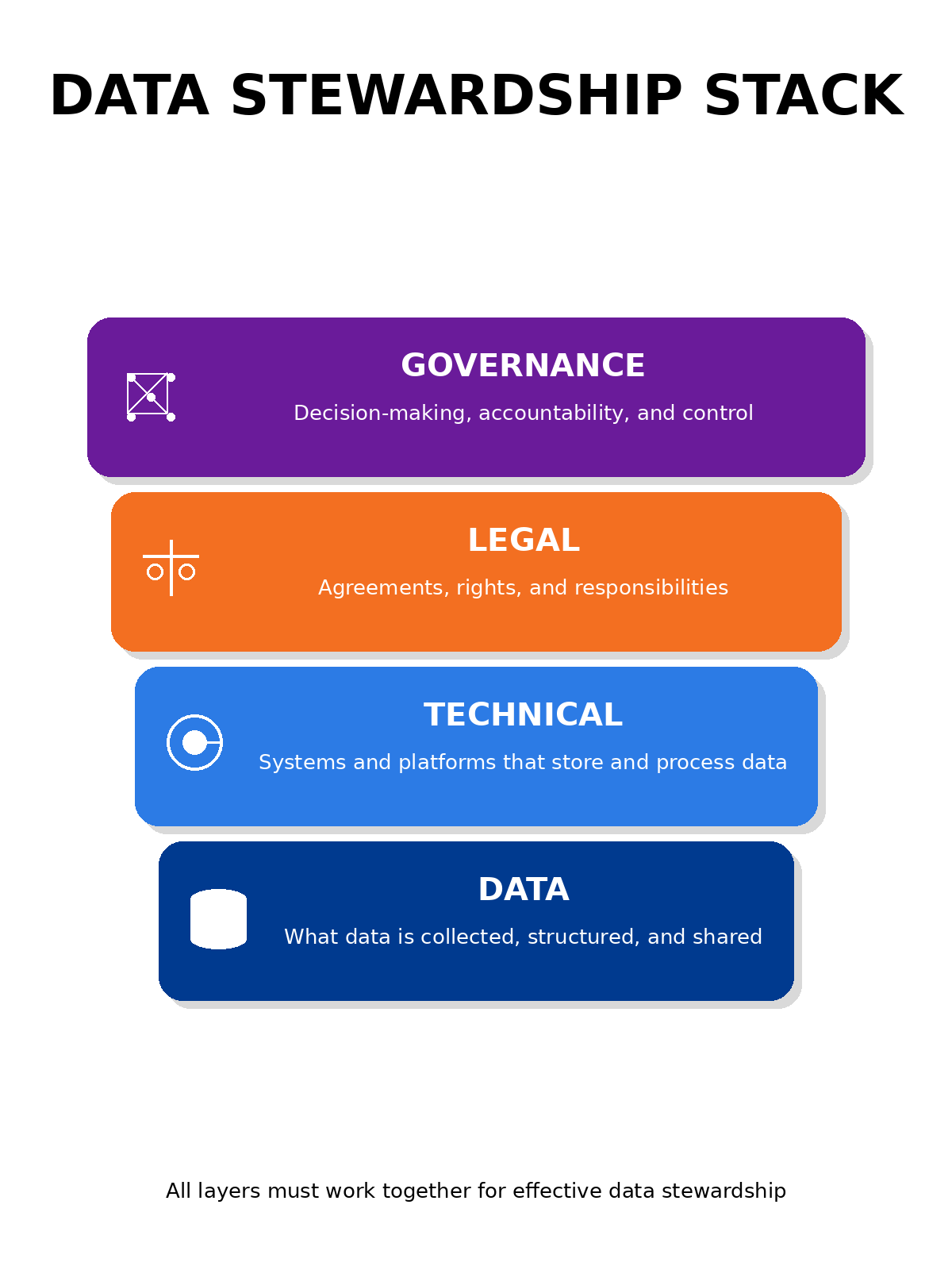
This later evolved into a publicly available toolkit, including:
- Open-source software for collectively governed deduplication and referrals
- Templates for data standards and multi-party data-sharing agreements
- Governance and adjudication frameworks
- Training resources on data governance and digital rights
When organisations invest in collective action, time, facilitation, and patience, it works. We have seen it work. When they don’t, it doesn’t.
In South Sudan, Ukraine, and the occupied Palestinian Territories (oPT), more than 3,000 practitioners from over 50 organisations collectively selected the Data Stewardship approach for deduplication and referrals. They preferred shared accountability over concentration of power. However, coordination and collective action proved difficult. Some powerful actors withdrew from coordination mechanisms rather than participate. Donor support was inconsistent. What we learnt was simple: people want a collective approach, but no one wants to pay for it.
Good governance and good collective action require investment for facilitation and time, but also for developing systems that are designed for inclusivity and participation. Coordination is ultimately about people and power. It is a skill that is widely acknowledged as essential.
Do we have the will to invest in collective action?
A people-centred approach to deduplication and referrals already exists. The tools, templates, training, and open-source software are out there. Designing systems that allow people to access the data we hold about them has also been done.
What we need now is willingness. Many organisations want collective solutions, yet these efforts are rarely valued or funded adequately. We need all stakeholders, donors and organisations, to treat these costs as core investments or infrastructure.
Without investment, coordination collapses into competition. Some actors will always walk away rather than share power. Some donors quietly support centralisation because it feels controllable. These are not technical constraints. They are political ones. Political challenges require persistence, perseverance, negotiation and time. This requires investing in skilful people who can stick around and keep working on both the advocacy and the implementation of the alternative way.
Duplication in humanitarian aid is not an accident. It is a design choice.
And the question facing the sector now is no longer whether we can design systems that treat people as participants rather than products. The real question is whether we are willing to share power, invest in coordination, and accept collective accountability even when it is uncomfortable.
Are we willing to be inclusive, equitable, and invest in collective action?
About the author:
Amos Doornbos is the Technical Director, Humanitarian Digital Adoption and Literacy, Disaster Management at World Vision International. He has over 20 years of strategic and operational humanitarian response experience in fragile, conflict-and natural disaster-affected contexts in Africa, Asia, and the Middle East, Eastern Europe, within large and small INGOs, creating new innovative NGOs, and consulting and coaching. He often contributes to global and regional humanitarian industry conferences, panels and publications on innovation, digital transformation, coordination, and collaboration with a particular focus on making the lives of frontline project teams and project participants easier.
[1] For more perspectives of aid recipients, please see these two research papers: 1. Balancing Aid and Privacy: Perceptions of Data Protection Policies for Cash Assistance and 2. Perceptions, Experiences, and Understanding of Data Rights in Cash and Voucher Assistance Programs in Ukraine
Subscribe to see more content like this
Related Resources

DRC: Mobilizing Faith Leaders to Curb the Spread of Ebola Through Channels of Hope

I Only Lost My Shoe. They Lost Their World.
