
ESG’s Strategic Edge: Human-Centred Investment as a Business Imperative

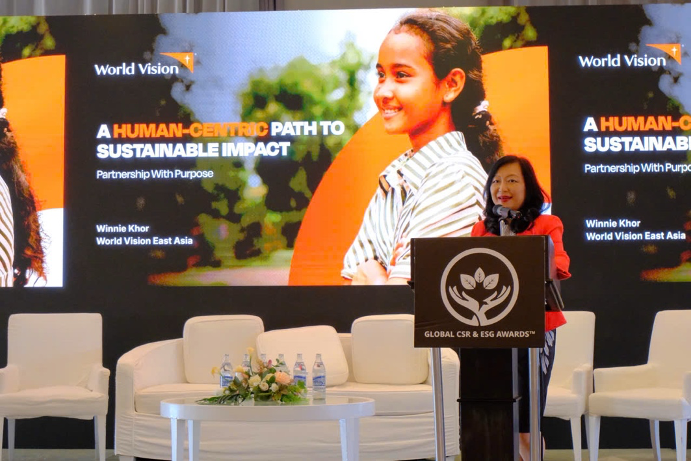
As ESG continues to evolve into a key driver of long-term business resilience and value creation, organisations are placing greater emphasis on delivering meaningful impact. In this article, Winnie Khor, Senior Regional Advisor (Resource Development) at World Vision East Asia, reflects on the importance of placing people and communities at the heart of ESG investments. She explores how lasting impact depends on solutions being grounded in lived realities and co-created with the communities they seek to serve. Through collaboration between businesses, communities and development partners, she highlights how more measurable and sustainable outcomes can be achieved.
In corporate boardrooms, ESG has become both more sophisticated and more central to long-term strategy. Data is sharper, reporting frameworks are more rigorous, and artificial intelligence is accelerating how companies measure risk and performance. Yet across much of East Asia, where climate volatility and economic exposure intersect, a fundamental question remains unresolved: how can ESG strategies translate more consistently into durable, real-world outcomes?
The answer may lie in an important opportunity for ESG’s evolution. While it has become highly effective at measuring systems, there is growing recognition of the need to further strengthen the human dimensions those systems rely on. Increasingly, this is seen not as a theoretical consideration, but as a material factor in delivering sustained impact and long-term value.
According to global risk assessments, Asia-Pacific consistently accounts for a disproportionate share of disaster-related economic losses, driven by the region’s exposure to floods, storms and rising temperatures[1]. These shocks do not operate in isolation. They cascade through supply chains, disrupt labour markets and erode long-term growth prospects. For companies embedded in these markets, resilience is not simply an environmental concern; it is a core business priority.
And yet, many ESG strategies are still evolving beyond a strong foundation in compliance and reporting toward a deeper focus on the underlying conditions that enable businesses to anticipate, withstand, and adapt to disruption.
Where ESG Is Evolving
The evolution of ESG, from compliance to performance to impact, has been well documented. Progress, however, has varied across dimensions. A growing number of companies can now quantify emissions, track resource use and disclose social indicators. The next phase is demonstrating how these investments strengthen the systems that underpin operations and resilience.
Risk extends beyond corporate boundaries – it extends across the ecosystems in which businesses operate. It sits in flood-prone agricultural communities supplying raw materials, in informal labour markets vulnerable to public health shocks, and in water systems under increasing stress from climate change. When these systems falter, the consequences are immediate and measurable. Production slows, costs rise, and reputational exposure intensifies. What is less visible, but more consequential, is that many ESG interventions may fall short not because of insufficient funding or technology, but because they are insufficiently grounded in local realities.
The Case for Human-Centred Design
A more effective approach is emerging, one that places communities at the centre of ESG strategy rather than at its periphery. Human-centred design begins with a simple premise: solutions are more likely to succeed when they are shaped with the people who use them. In Cambodia’s Tonle Sap Lake, this principle has proved decisive. Communities there live on water, with homes, schools and livelihoods intricately tied to the lake’s ecosystem. Conventional development models might prioritise relocation to land-based infrastructure, viewing it as safer or more modern. In practice, such approaches often fail. They overlook cultural identity, economic dependencies and social cohesion. An alternative model, developed in partnership with local communities, focused instead on improving living conditions in situ. Floating sanitation systems were co-created to address health risks without disrupting the community’s way of life. The result was not simply improved infrastructure. It was higher adoption, sustained usage and stronger community ownership, outcomes that are frequently elusive in more top-down interventions. For businesses, the lesson is clear: ESG effectiveness depends not only on what is delivered, but on whether it is adopted, trusted and sustained.
From Community Stability to Business Resilience
The implications for corporate strategy are significant. Communities are not peripheral stakeholders; they are integral components of economic systems. Their stability shapes workforce reliability, supply chain continuity and market development. Investments that strengthen community resilience, whether through climate adaptation, water systems or disaster preparedness, have direct and measurable business returns. They reduce operational volatility, protect productivity and enhance long-term market viability. This reframes ESG as a catalyst for long-term business resilience and sustainable value creation.
A Key Driver of Future Value
One area where this shift is particularly evident is in youth engagement. Across East Asia, younger populations are already experiencing the effects of environmental and economic change. They are also increasingly active in shaping responses to these challenges, from local climate initiatives to community-led research. For companies, engaging with this demographic is an investment in future workforce capability, innovation and consumer markets. In a region defined by demographic transition and rapid urbanisation, this represents a critical, and often underutilised, source of long-term value.
The Role of Partnerships
Delivering this kind of impact requires complementary capabilities that are best achieved through collaboration. Businesses bring capital, scale and operational expertise. Communities bring contextual knowledge and ownership. NGOs contribute long-term presence, trust and implementation capacity. When these elements are aligned, ESG strategies become more than a set of commitments. They become mechanisms for sustained, system-level change. This is particularly important in complex environments, where isolated interventions are unlikely to hold under stress.
A Defining Test for ESG
The next phase of ESG will be defined less by the rigour of reporting frameworks and more by their ability to translate into resilience. In an era of compounding risks, the most relevant question for corporate leaders is no longer how ESG performance is measured, but how effectively it strengthens the environments in which businesses operate. This requires a shift in perspective - from internal optimisation to investment in the broader systems, including communities, that enable business continuity and growth. Ultimately, the durability of any business depends on the stability of the ecosystems that surround it. And those ecosystems at their core, are human.
About the Author
Winnie Khor, Senior Regional Advisor, Resource Development, World Vision East Asia
Winnie Khor brings over 20 years of leadership experience across major multinational corporations, including PepsiCo Inc., Johnson & Johnson, Nike, The Coca-Cola Company, and Colgate-Palmolive. She has led global and regional teams, delivering market growth while building cross-cultural fluency through roles across Asia and the United States. Transitioning from the private sector, Winnie now serves with World Vision, a global humanitarian organization focusing on sustainable, community-driven development. She partners with diverse stakeholders to address complex challenges such as climate change, food insecurity, and economic vulnerability.