
After the men have gone
By Jonathan Bundu
In Belel Koyle, southern Mauritania, the women stand together, shredding old cartons and putting them in a rubber bucket. With no grass left, these shredded paper boxes will be fed to the few remaining cattle.
Aminata Boye leads the group.
“All the men in Belel Koyle have left,” Aminata says. “We the women have now become bread winners.”
The men, all farmers, left with the majority of the cattle. The few cattle that are left behind are for the women and children to sell, in case things get worse.
 The herdsmen left after they couldn’t risk losing any more cattle as the drought worsens. There are little or no grazing areas in Belel Koyle for their cattle to feed on. Above all, most water points have dried up.
Migrating to save cattle
With the migration, the farmers hope to save the rest of their cattle. When push comes to shove, they will have cows to sell and get other basic necessities.
“If they don’t go it will be bad for us, it’s hard for us the women, but we have no choice,” Aminata says. For the women, it’s understood that the men have to leave, but for children like Kadjata, her daughter, it’s a nightmare.
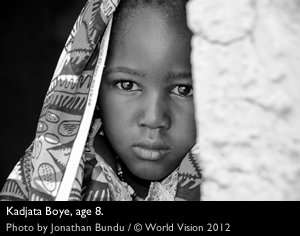
Eight-year-old Kadjata sits quietly in front of their kitchen door, her hands on her cheeks. She looks sadly at the women as they work.
Kadjata’s father, Amadou Ousmane, a 59-year-old cattle farmer left Belel Koyle with the other men, crossing the river into neighbouring Senegal.
“I’ve not had any milk since my father left with our cows,” Kadjata sadly says. For Kadjata, like any Fulani rural child, cow’s milk is a staple food. Kadjata used to drink cow’s milk in the morning as breakfast and in the evening with couscous for dinner, before going to bed. Cow’s milk is life for Fulani children; it nourishes them and keeps them healthy.
Kadjata longs for the cattle and especially for her father to return as since she was born, she has never spent a day without a calabash filled with milk. “I always drink it joyfully,” she says. As she yearns for her father, Aminata tries very hard to comfort her daughter, but she is daddy’s little ‘Bewdo’ (Fulani equivalent for Princess).
The men and the milk are missed
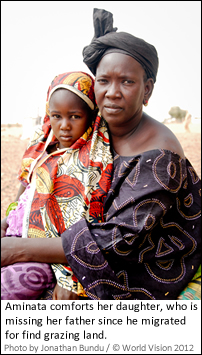 Sitting on her mother’s lap, Kadjata is offered porridge, but she takes only a spoon and puts it aside. Her mother sighs, collects it and says, “She is not used to eating porridge without milk, it is hard for me, but I’ve to encourage her to eat, so I normally cajole her that the rain is going to fall soon and her Gido [Fulani equivalent for beloved father] will be back. With that, she eats her porridge.”
Aminata and the other mothers are worried about their children. “If the drought persists, my little Kadjata may be malnourished and sick. I was even thinking today to go to Boghe District and take a little money from what her father left for us, to buy some powdered milk and see if Kadjata accepts to drink it.”
The food bank, which had only eight bags of rice in December, has received a modest increase since then, with seven additional bags. This is hoped to feed more than 200 households. To raise money to purchase the seven bags was a huge sacrifice. Each household had to sell their biggest bull and give part of the money to buy the rice while the rest was left with the wives to manage until the men return.
With the men and cattle gone, the women are worried for the time when the money runs out. Hunger and starvation could turn into malnutrition, or worse.