
Children Bear the Brunt of Conflict in South Sudan
By Michael Arunga
Inside a health clinic in South Sudan, two-year-old Majong Manywer grimaces, groans and wriggles.
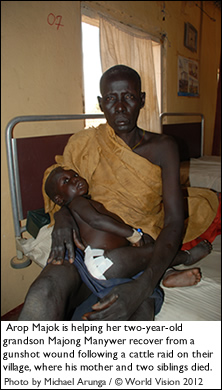 The young patient’s elderly grandmother, Arop Majok, chokes with emotion. The boy was shot, she says. Her daughter and two other grandchildren were killed.
Arop sympathetically looks at the buttocks of the young child that is heavily bandaged as a result of bullet wounds.
“Why shoot such a toddler, robbing him of a mother’s breast milk, at a time when there is no food. It is very unfortunate that this boy lost his mother, his brother and sister,” Arop says as she digests the magnitude of her loss.
About 100 people were killed in the recent ethnic conflicts in South Sudan. The attackers struck, killed and maimed to steal 17,000 head of cattle that they drove away.
The hospital’s doctor, Jimmy Kivumbi, states that they admitted 32 patients, 14 of them children.
Dr. Kivumbi says that after the attack, they worked non-stop for three days losing only one patient who was critically injured.
“The patients were not only shot, they also had deep cuts inflicted by weapons such as machetes and spears,” he says.
Angela Cheboriot, the acting project manager of Comitato Collaborazione Medica (CCM) in Tonj area, witnessed the scene a day after the conflict.
“There was this innocent boy who carried his little sister’s corpse, singing a lullaby and believing she was only badly injured and would be healed. Their parents had been killed in the attack,” she sadly narrates. CCM and World Vision are the two non-governmental organisations working in the area.
Grandmother Arop says she will take responsibility of looking after baby Majong in spite of her old age. The boy’s father, who survived the attack, needs to look for food for the two surviving children who face starvation.
“Despite the great loss that included all our cattle, I am thankful to this hospital and agencies such as World Vision who support patients such as young Majong to access drugs and other necessities. He would have been dead without such support,” she says.
Attacks on children
The county commissioner for Tonj East, Gai Manyuon Malok, describes the attacks on children as very sad, adding that women and children were usually spared in the past. He appeals to agencies to step up development projects in the area and other initiatives that can help the people.
“In spite of the challenges we face, we know World Vision and the work they do. They have been in this location since 1993, during our days of the armed struggle and have helped us a lot,” adds Tonj East’s deputy governor Yeal Mayar Mareng .
World Vision South Sudan served more than two million beneficiaries in South Sudan through various interventions during 2011. As well, 94 health facilities received support. It continues to operate in the health care sector, ensuring that women and children have access to quality health care through supporting the government effort to delivery of primary health care services, building the capacity of County Health Departments, recruiting and training of health personnel, providing essential drugs and medical supplies, and helping build health care infrastructure.
Since South Sudan’s independence on July 9, 2011, inter-ethnic conflict has continued and led to the deaths of hundreds of people including children. Reports indicate that over 350,000 were displaced in 2011 as a result of inter-ethnic and armed conflict.