
Eight drivers conclude Fleet Training of Trainers workshop in Kono

Given the unique role drivers and fleet across World Vision (WV) partnership play in especially field operations, WV Partnership is seeing the need for fleet safety awareness.As such a first wave of Fleet safety training of trainers workshop was held in Kono District, Eastern Sierra Leone, for eight WVSL drivers (Bala Jawara, Aminata Munu, Ansumana Karimu, Sulaiman Kabba, Joseph Caulkool, Mohamed Sheriff and Ishmael Lamboi) representing all the Bases and the National Office in Freetown.
Other key and senior staff from Admin/Logistics ( Palmira Cummings, Administration Coordinator and Security Officer, Woodi Samai, Fleet Coordinator and Franklin Koroma, Fleet Supervisor) also participated in this training whose main objectives were:
- to provide trainers with essential training skills and information to be able to conduct driver training
- improve practical FWD driving skills
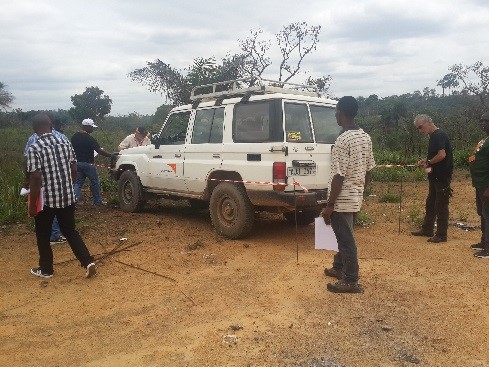
The five-day training were in two folds, both theoretical and practical sessions with a focus on equipping trainers on fleet safety and its importance. Aminata Munu, (the only female driver in World Vision Sierra Leone) is quoted as saying, '' I appreciate the opportunity World Vision gave me to be part of this training.I have never been opportuned to be part of a training ; like the one we had in Kono, where expert on Fleet safety could train us. The training revealed a lot of things we did not know as drivers.I did not know the importance of a seat belt until a video was shared that showed how putting on a seat belt protects both drivers and passengers from many dangers.''
The training was co-facilitated by Popko Kuiper, WVI Global Fleet Safety Manager and Cor Hendriks, service provider contracted by WVI from Toyota Gibraltar Stockholdings.
Our lifes are always entrusted in the hands of drivers. Sometimes passengers fall asleep while the drivers play the magic of reaching safe to a known destination.But even though the driver has the responsibility of driving or taking passengers safe to their destinations, the passengers do also have a role to play in order to stay safe — the strict adherance to certain seemingly minute things like fastening the seat belt.
The following were among key recommendations for a roburst WVSL's Fleet Safety management:
- · WVSL’s leadership to revisit its Vehicle Use Policy or its Fleet Policy to minimize/reduce the number of staff that can drive a WVSL vehicle. At present any WVSL staff that has a driving license and has signed the Vehicle Policy is eligible to drive without a test. The policy needs to specific who is eligible to drive a WVSL vehicle preferably by function.
- · All approved WVSL staff who drive WVSL vehicles MUST be trained to use the vehicles effectively.
- · That drivers consult the vehicle manuals for details on the exact specifications and details to maintain the vehicles.
- · When considering procurement of vehicles, landcruisers are the best suitable vehicles for our terrains
- · Daily vehicle checklist should be in all WVSL vehicles to be used by drivers on a daily basis
- · Indemnity Forms should also be in all WVSL vehicles
- · Bull bars should no longer be ordered with vehicles because it has been proven that bull bars increase the fatality rate when accidents occur
- · Tyres on WVSL vehicles should be examined and replaced as specified in the vehicle manuals
- Managers/budget holders needs to be educated in this area to ensure the correct specifications are adhered to.
- · Coolant should be used in ALL WVSL vehicles instead of water. Coolants clean the radiator and prevents rust and damage.
- · Thermostats should never be removed from the vehicles when they arrive in-country
- · Managers/Budget holders should budget for safety trainings to ensure all staff are adequately informed and trained on safety requirements
- · Vehicle spare parts including tyres should be ordered with new vehicles
- · Vehicles with kilometer reading of over 150,000km and that have been used for 5 to 7 years maximum should be disposed of. If not the repair and maintenance cost will increase on these vehicles. Projects/departments should take this into cognizance in the budget preparations stage and plan to replace vehicles every 5 – 7 years maximum.
- · Bushings on vehicles wear out very quickly and MUST be changed on a WEEKLY/FORTNIGHTLY basis as the need arises.
- · WVSL vehicles should drive with lights on at all times for visibility. According to the experts this has no effect on the power or battery life of the vehicle.
- · WVSL Motorcycle users must be equipped the right apparel to ensure visibility and safety. The right apparel includes; a full covered helmet, gloves, visible jacket and the appropriate covered shoes.
- · All passengers in WVSL vehicles MUST fastened their seatbelts and the Security Guards should ensure everyone does so before the vehicles leaves WVSL premises.
- · Drivers of WVSL vehicles MUST not drive more than 10 hours a day.
1.