
Garden of Eden in El Salvador

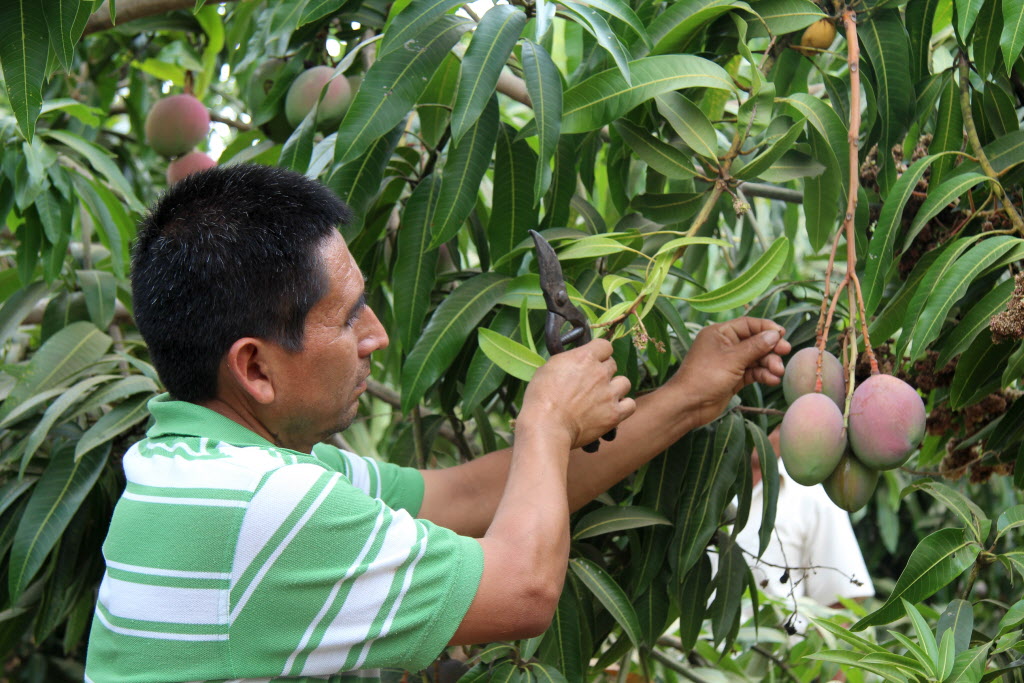
A variety of guava and mango are the popular products of the 300 farmers associated to the Community Development Association of Tacuba (CDATAC for its initials in Spanish), supported by World Vision from 2003 to 2011.
The partners were trained on diversified cropping practices, leadership, organization, management and administration of projects; also they received support on the establishment of a fruit parcel, negotiation of the piece of land through a 30-year loan with the city hall, delivery of trees and agricultural supplies, among others.
World Vision awakened my interest to learn more and taught me a new way
“I didn´t know anything about sowing. I am 50 years old and I practiced the traditional crop almost all my life. World Vision awakened my interest to learn more and taught me a new way,” assures Julio, who holds in his hands the Taiwanese juicy guavas he has sown together with a team of friends.
Tacuba Program benefited around 4,000 boys and girls and 1,500 families from 26 communities of the Tacuba municipality. One of its greatest impacts was to leave men and women well organized and trained on how to create strategic partnerships.
The Community Development Association of Tacuba is an example of community organization; each partner has a defined role, they earned the status of being active partners with scheduled work shifts and a small monetary contribution. The Board of Directors is in charge of injecting passion to other partners who are harder to engage.
The role of women is key
It is amazing to know that some partners walk up to 16 kilometers from their houses to get to the fertile parcel. Moreover, the role of women is key. Many of them have no impediment to do strong agricultural work as sowing or carry water to irrigate the trees.
“It is not easy to prepare oneself to walk this far every day, to leave their children alone, and to stop the housework to come and accomplish the work the parcel requires. What encourages me is the satisfaction to see the trees very healthy, to see the fruits that are bringing income to us and the hope that soon we are going to sell more,” says Angela Ascencio, one of the members of the Association which involves nine communities: San Rafael, Los Pinos, Loma Larga, Barrio Chilapa, El Rosario Centro, El Carrizal, El Jícaro Centro, El Sincuyo, and El Calvario.
“The CDAT has life; We are the fruit of Tacuba Program; We want [to] make the Canadian sponsors proud,” are some statements made by the members of the Board of Directors of this association. Juan Vasquez, Secretary; Aristides Contreras, Treasurer; Julio Sabas, President; Tránsito Moran, Trustee and Nehemías Monzón, partners’ representative are the group who leads this successful initiative.
Enough to sell at market
Juan, the secretary, lives with his family in the parcel, he is in charge to do a 24-hour monitoring of the around 1,225 trees: 240 Taiwanese guavas, 350 Jade and Tommy mangoes, 210 annona cherimola, 450 Washington and Valencia oranges and 80 banana plants.
Ahuachapán is the market where this group of families commercializes the fruit. They sell each mango for approximately US$0.25 and the guava for US$ 0.20 which are the fruits of the season. Each mango tree is producing up to 200 mangoes, and 30 guavas per tree.
The group is well known in Ahuachapán because they are the only large-scale producers of tropical fruits in the area. “We are proud to be producers of fruits that are well regarded in the area. We make a big sacrifice to maintain this parcel, but it is worthwhile,” says Juan.
“World Vision started with the sponsorship of our children. That was the first approach we had. But due to our good organization, they invested time and resources on us. We can now show you with happiness that their investment was worthwhile,” says Juan smiling with pride while he looks at the beautiful parcel.
The new generation
Dalila, one year old, is Juan’s daughter. Michelle, one year and a half old, is his granddaughter. Seeing them walk among the plantation he says: “All my effort is for the new generation. Boys and girls of the people associated should be good leaders because they will give follow up the crops and fruit commercialization… so that CDATAC never dies.” There are 150 girls and 200 boys from 0 to 18 years old benefited from this Association.
A future full of dreams
The most significant achievements of CDATAC since 2011 when World Vision left the area are the following: rent of a place in downtown Tacuba for the administrative office of the association (US$1,200 per year); lunch for the partners who make their daily shift; purchase of agricultural supplies; negotiation with other associations as National Center of Agricultural Technology and Forest (CENTA, initials in Spanish), IICA FRUTALES, World Food Programme, local city hall to receive fertilizers and herbicides as well as trainings for all the members. Also, in order to reduce their expenses, they have decided to build the administrative office of adobe (mud and bamboo) in the parcel.
Juan says: “We live good times with World Vision. It is an organization that believed in us. Tacuba Program left motivation, hope, and fulfillment; these things that are not common in all organizations. Now, the partners are convinced that this project has future, and that we will succeed.”
The group of farmers and micro entrepreneurs has many dreams. “We want to negotiate support to get water and electricity which will make our work easier and we will produce better since we currently do irrigation manually and with water that we get during the rainy season,” Juan comments. “Our short-term projects are to sell natural refreshments in schools and small shops; to reach more customers in the local market and to make the parcel a training center where farmers from all the area come to learn,” he ends.
The group also expects to become suppliers to the AGROTROPICAL Plant that World Vision has established 6 kilometers away from their parcel. The plant aims production and commercialization of fruits and vegetable to improve the diet and economic condition of the poorest families of this area.