
Sold To The Highest Bidder

Crack, crack, crack, that is how the candlenut sounds under the sun.
The cracking sound comes from its thick skin, which also cracks the silence of one village in Titihena, Flores Timur, NTT.
Who knew that candlenuts can “sing”? Their songs serenade the farmers’ voices who now dare to speak up and make changes for a better living.
This story begins with unity.
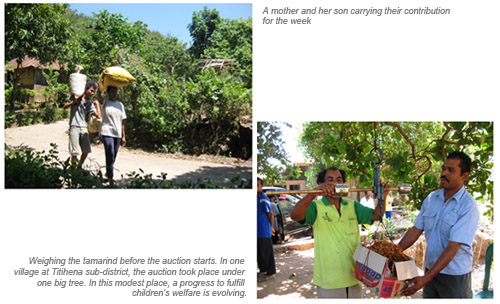
“Here is my share of the week,” said a mother who came to storage room in Titihena, East Flores. She brought a sack full of cashew nuts on her head, while her son carried another two sacks behind her.
They are just one out of 100 families who joined the Farmer Union in Titihena sub-district. This initiative is a form of refusal towards the loan sharks who dominate their villages.
World Vision Indonesia facilitated and supported the operation of sixteen farmer unions like this across East Flores. Through market facilitation, buyer and seller can trade fairly.
“Back then, we could only say yes to the price offered by loan sharks, even though it is very low. We had to sell our commodities because we never know whether there would be another buyer coming to the village or not,” said Emilia Emar, 49, one of the market facilitation cadres.
Her story was commonly found in remote villages like hers where access to traditional markets is difficult, information is hard to get, and price clarity is unknown. They could only rely on loan sharks who came door to door to buy candlenuts, cashew nuts, cacao, tamarind, and copra – the five major commodities of East Flores.
These buyers did not have any transparency or an agreed price standard. The price instability meant income instability, which led to uncertainty for families.
In 2009, World Vision Indonesia along with several change agents, initiated the collective selling system through Farmers Union. Interested buyers would now have to buy from the union through weekly auction. The commodities’ rightful owner is the buyer who dares to pay more than the others.
“Each week, all the union members bring the fruits of their labor to one storage room and weigh it in front the union’s caretakers. The number is written in a log book and compiled with the other farmers’ contribution to be auctioned on Friday. Once the unions receive the money from buyers, caretakers will distribute it to each farmer according to their contribution,” said Chrisman Siregar, Community Development Coordinator World Vision Indonesia, East Flores Office.
The auction is an interesting process to watch. Marsellino Hayon, the Farmer Union leader still remembers the first auction in his district. He said it was very tense, thrilling, and exciting at the same time. He remembers how the loan sharks did not like it at all as well as he remembers the joy felt after they received their first fair price. Another challenge is to gain trust from their fellow farmers who don’t understand the auction concept yet and refused to join the union back then.
Entering its fifth year, the Farmer Unions has developed into solid communities with clear organizational structure, profit sharing mechanisms, as well as administrative order. They also use technology, in this case, text messaging, to set the opening price for weekly auction. Today, there are three serious buyers who keep coming back to Titihena district and agree with the auction concept.
“This auction feels like a game to me. It’s a fun play where the winner can bring home all the commodities. I keep coming back to this sub-district and participated in the bidding process because the Farmer Unions maintain a good quality of their products. It also makes my job easier because I don’t have to spend more time going door to door to find products in small amount with different qualities and quantities. Here, everything is already organized,” said Fredi, one of the regular buyers at Titihena sub-district.
Trust is the key to this activity and it is also one out of three other factors which became the motto of this Farmer Union. We can now be sure that unity strengthens one community and their capacity to support their children.
(Story and Photos by Shintya Kurniawan, Media Relations officer, World Vision Indonesia)