
"Decisions About Us, Made With Us": The New Era of Child Participation at the Asia Pacific Forum on Sustainable Development 2026
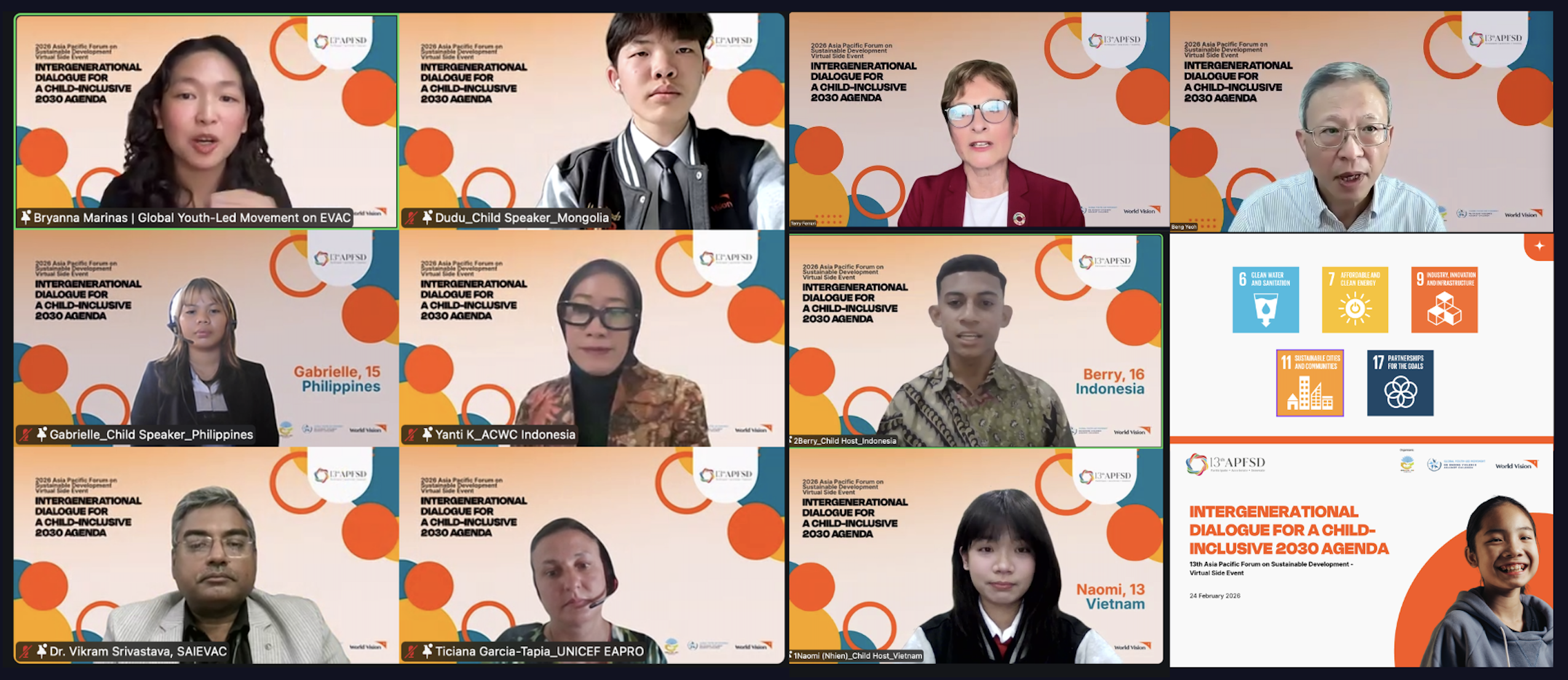
- From Participation to Partnership: Child leaders from 19 countries at APFSD 2026 are moving beyond symbolic roles, inviting regional leaders into a shared co-design process and proposing "Innovation Labs" to bridge the gap between policy and the lived realities of their communities.
- Closing the 88% Progress Gap: With the region set to miss significant SDG targets, World Vision and stakeholders are pivoting and integrating child-centred insights to address urgent needs in climate action and digital inclusion, ensuring that the vision of children reaches decision makers and power bearers to protect the 1.9 billion children currently at risk of being left behind.
BANGKOK, 25 February 2026 — During the APFSD 2026 virtual side event, "Intergenerational Dialogue for a Child-Inclusive 2030 Agenda," child leaders from 19 countries partnered with World Vision, UNICEF, ASEAN Commission on the Promotion and Protection of the Rights of Women and Children (ACWC), and South Asia Initiative to End Violence Against Children (SAIEVAC) to demand a seat at the decision-making table. Rejecting "tokenistic" inclusion, they urged regional leaders to co-design Global Goals solutions alongside them, prioritising livable cities, clean energy, safe water, and purposive partnerships for their communities.
Terry Ferrari, World Vision Regional Leader in East Asia, opened the landmark dialogue: "It is no longer a question of whether children should be included; the question is whether we are ready to create the enabling environments where every child can safely contribute, lead, and influence decisions."
Breaking Down the Barriers: Lived Realities vs. Policy Goals
Across the Asia-Pacific, children in remote communities face severe barriers to basic rights, including unaffordable clean energy, unstable internet, and a lack of safe water or street lighting. These physical and financial hurdles are compounded by "tokenistic" engagement, where young people are rarely given the consistent feedback or genuine power needed to influence the government decisions affecting their lives.
The forum highlighted the gaps between high-level development goals and the daily lives of children. Dudu, a 15-year-old child leader from Mongolia, addressed cultural barriers to youth participation, noting that the traditional "respectful silence" of children often results in adults planning without necessary insight. Recommendations included establishing "Children’s Listening Days" at the local government level and creating "Innovation Labs" where young people can shape new technologies.
Gabrielle, a 15-year-old child leader from the Philippines, noted that while governments focus on "big projects," children are often left without necessities like dry schools during floods or functional toilets. "These are not just simple problems," Gabrielle stated, "they are children’s rights issues.”
Bryanna Mariñas, Founder of the Global Youth Movement, shared, "The leadership shown by these children proves that they are ready to navigate complex global challenges. Our role is to provide the platform; their role is to provide the vision."
Institutional Responses and Commitment to Action
Regional stakeholders responded with a commitment to systemic change. Yanti Kusumawardhani, Indonesia Representative from the ASEAN Commission on the Promotion and Protection of the Rights of Women and Children (ACWC), praised the brave call for accountability and better management of public funds. UNICEF East Asia and Pacific Adolescent Development Manager, Ticiana Garcia-Tapia, echoed this, noting that meaningful participation requires sharing power and moving beyond merely raising voices to providing safe spaces for youth leadership.
Dr. Vikram Srivastava, Regional Technical Advisor from the intergovernmental body, South Asia Initiative to End Violence Against Children (SAIEVAC), shared, "It's always better to listen to children to get their new perspective. We continue our commitment to acting as a facilitative platform where their voices are heard directly by people in power."
Closing the event, Dr. Beng Yeoh, World Vision Regional Leader in South Asia and the Pacific, emphasised that the work does not stop at the conclusion of APFSD 2026. “We hear you, and our responsibility is clear: to ensure that our children’s voices reach the walls of power. Behind these missing percentages are real children—the ones represented by the goals we haven't met. They are waiting to be heard, and they are waiting for action. Not tomorrow, but right away."
The urgency of this dialogue is underscored by the UNESCAP Asia-Pacific SDG Progress Report 2026, which warns that the region is set to miss a staggering 88% of its SDG targets. While child mortality has decreased, UNESCAP highlights that these gains are being erased by 'alarming regression' in climate action and persistent inequality, leaving children in remote communities behind in the transition to clean water, safe energy, and digital inclusion.
END -
For arrangements with media:
Aaron Aspi | aaron_joseph_aspi@wvi.org
Corporate Communications Adviser
World Vision South Asia and Pacific
Yuventa (Ms.) | yuventa@wvi.org
Communications & Public Engagement Senior Adviser
World Vision East Asia