
Making a difference in his community

As a 12-year-old World Vision Rwanda registered child’s outstanding achievements have shown, one is never too young to make a difference.
Born in a poor family with three siblings, two elder sisters and one brother, young Raphael Duhazeyesu never knew he would get a chance to go to school like other children in his village. Today, he is a 12-year-old activist from a remote village of Kunini, Mushubati sector Rutsiro district in the Western Province of Rwanda. He is dedicating his time and energy to advocate for the rights of other children in his community.
The seriousness on Raphael’s face, his body expressions and his stunning responses to various issues can easily make you wonder if he is really 12. You will however be persuaded by the innocence in his little but loud enough voice and his small body size. He physically looks 11, is a good listener and wisely answers one question at a time. Then he remains quiet to attentively wait for another question.
Raphael started advocacy work last year and he was later joined by 10 other friends, all from the same village and school. Through their eye-catching activities, 20 more children in his community have so far been registered and many others supported differently by World Vision Rwanda through its Ubumwe Area Development Programme (ADP).
He says he started advocating for the rights of other children after realising that child abuse cases were increasing in his and neighbouring villages.
“Many children were dropping out of school. There were many cases of child abuse and corporal punishments such as excessive caning, slapping and some children were being kicked out of their house to spend a night outside in the cold as punishment,” Raphael explains.
With 10 other children, Raphael formed a group to defend the rights of their fellow children. He calls it “Ishirahamwe”, literally translated as an association. The group is made up of four girls and six boys, between the ages of 10 and 13.
Being members of the group does not stop them from doing well in school. They do their activities after school and during the weekend. Raphael was 12th out of 50 children in his class during the last academic term.
“I strongly believed every child has a right to education, health care, rights to play, get food, shelter, education and safe water. Children in this community still have many challenges. We decided to work alongside World Vision because we live in this community and we are always the first people to know whenever our fellow children are mistreated,” Raphael explains.
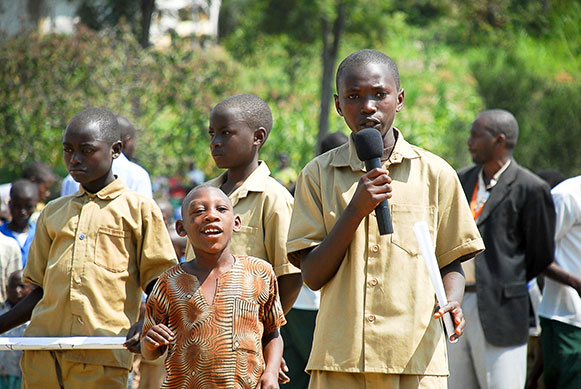
Raphael gives a speech during the day of the African Child celebration, June 16, 2012. Photo by Martin Tindiwensi
Raphael recalls the first child he helped. “Jean Claude. We were in the same class, we used to read together and he was a very bright child. He then stopped coming to school. His parents could no longer afford paying for him. I went to visit him three days after and he told me the whole story. He looked sad. I tried to convince his parents but they said were too poor to keep him in school,” he explains.
Raphael then went and told the story to Ubumwe ADP manager and Jean Claude was supported to go back to school.
“Jean Claude was from a poor family just like me. The fact that World Vision was supporting me, made me feel like they would help him to and they did,” he says.
According to Jean Claude, he now has hope for a better future.
“I thought I would never go back to school. I thank World Vision for supporting me and Raphael for identifying and speaking out on my behalf,” he says.
Raphael lives with his two elder sisters, their mother Anonciata Uwajambo and his father Francois Ndagwa in a small thee roomed muddy house. He shares a small bedroom with his 15-year old sister Jeanine. His younger brother died of kwashiorkor, a disease caused by severe malnutrition. This was before World Vision Rwanda started supporting him and his family. His parents depended on small scale subsistence farming on a small piece of land, approximately one hectare.
He has been supported by World Vision Rwanda since 2010. He is one of the children from very poor households that have been supported with school fees, and scholastic material such as uniform, shoes, books and pens. In addition, World Vision has provided his family with an exotic cow, which provides milk and manure. The presence of the cow has improved the nutritional standards in his household.
According to Ubumwe ADP manger Denis Bideri, Raphael’s initiative has changed the lives of many children in his village.
“We were shocked by Raphael’s intelligence the first time he and his friends came to our ADP office. He was the leader of the group; he confidently explained their initiative. It was their own idea. They outlined challenges faced by some of the children in their village and wanted to work as a team to identify those children. They wanted partnership. Their role would be identifying them and reporting child abuse cases and including school dropouts because even financially able parents would sometimes get their children out of school to do household work,” Denis explains.
Since then, Raphael’s team has worked hard to report all sorts of child abuse cases done in their village. According to Raphael, the team has followed up on children that drop out of school.
“We visit children after they dropped out of school and ask them why. Some tell us they get out of school due to lack of scholastic material; we then call upon World Vision to provide support. We have in some cases lent them our own extra scholastic material to get them to school, as we waited for World Vision’s support. Some children say their parents take them out of school to do household work such as farming,” he says.
Raphael’s mother thinks her son could be a politician in future.
“I get surprised when I see him engage and speak to older people about child rights. Sometimes I wonder where he gets all this information and confidence,” she says.
According to Damascene Ndagigimana, one of the residents of Kunini village in Mushubati sector, Raphael has supported many children in his village. “The kids are making a big difference. Parents have greatly reduced harsh punishments to their children in fear of these kids. They will not hesitate to report such cases to local leaders,” he says.
The kids have developed an approach to reach out to other children.
“Whenever we identify children in our community with a problem, we get closer to them; we invite them to play with us, mostly football. By the time we finish the game, we are already friends. We sit and ask them questions and they open-up and talk to us. We have talked to street children into quitting drugs and many have gone back to their guardians,’’ he says.
“We recently helped a child that had been mistreated and sent away from home by his new step-mother. He was always harshly caned for no good reason, sometimes he was starved, called names, and many other sorts of insults. His father had divorced his mother and married another wife who did not like the child. We reported the case to World Vision and to a local leader, who visited and counseled his step-mother. The boy is now back home and feels safer,” Raphael explains.
Raphael has been invited several times by the local authorities and Ubumwe ADP to air advocacy massages through poems during community events.
According to Ubumwe ADP manage Denis Bideri, the effectiveness of Raphael’s initiative in identifying vulnerable children has inspired the ADP to do household mapping, whereby households are put into groups of 25 for easy child monitoring and advocacy.
“It’s amazing to see that after investigations, we find that almost all child abuse cases reported to us by these children are always true. They have in many cases helped us to even identify children with severe malnutrition in theirs and neighbouring villages. Through partnering with Raphael and his team, we have changed lives of many more children in Mushubati sector. I now strongly believe that kids can make a difference in their respective communities, even those as young as Raphael,” Denis says.