
From Herding Animals to the Classroom: Two Boys’ Journey Back to School

By Lebohang Takane , Graphic Design and Communication Officer
In a rural community in Mohale''s Hoek, two young boys once watched their education slip away as they were sent to herd their families’ animals. Today, they are back in school, with renewed hope for the future.
For many children, the school day begins with books, uniforms, and the sound of classmates walking to class. But for Sekonyela, 12, and Tlotla, 13, school was interrupted by a responsibility too heavy for their age. Instead of sitting in a classroom, both boys were sent to look after their families’ animals. What may have seemed like a normal family duty slowly became a child protection concern, affecting their education, safety, and dreams.
In many rural communities, livestock is an important source of livelihood. Families depend on animals for income and survival, and children are sometimes expected to help when adults are unavailable. However, when children are required to miss school, travel long distances, and stay in isolated shepherds’ outposts, the practice becomes harmful.
This was the reality for Sekonyela and Tlotla. Their absence from school affected their learning, and both boys failed Grade 3, forcing them to repeat the same grade.
Sekonyela missed school for two months while his family was trying to find a herd boy. During that time, his grandmother had to work in the fields cultivating produce, leaving him responsible for looking after the goats.
“I was angry and sad that I had to leave school to herd the goats because I love education and I have dreams of working at World Vision one day,” Sekonyela said.
For Sekonyela, leaving school was painful because education represented more than lessons and books. It represented a future he still believed in.
Tlotla’s experience was similar. He stopped going to school after his father told him to herd sheep for three months. At first, he did not understand the danger of missing school because herding animals was common in his community. But as time passed, he began to realize that his dream was at risk.
“At first I did not see the problem with going to the shepherd’s outpost because it was a norm in my village, but it saddened me because I knew that my dreams of becoming a nurse would fail if I stopped going to school,” Tlotla said.
Both boys said they felt safer and happier when taking care of animals near home. Being close to their families and other people made the responsibility feel less frightening. But the shepherds’ outposts were different.
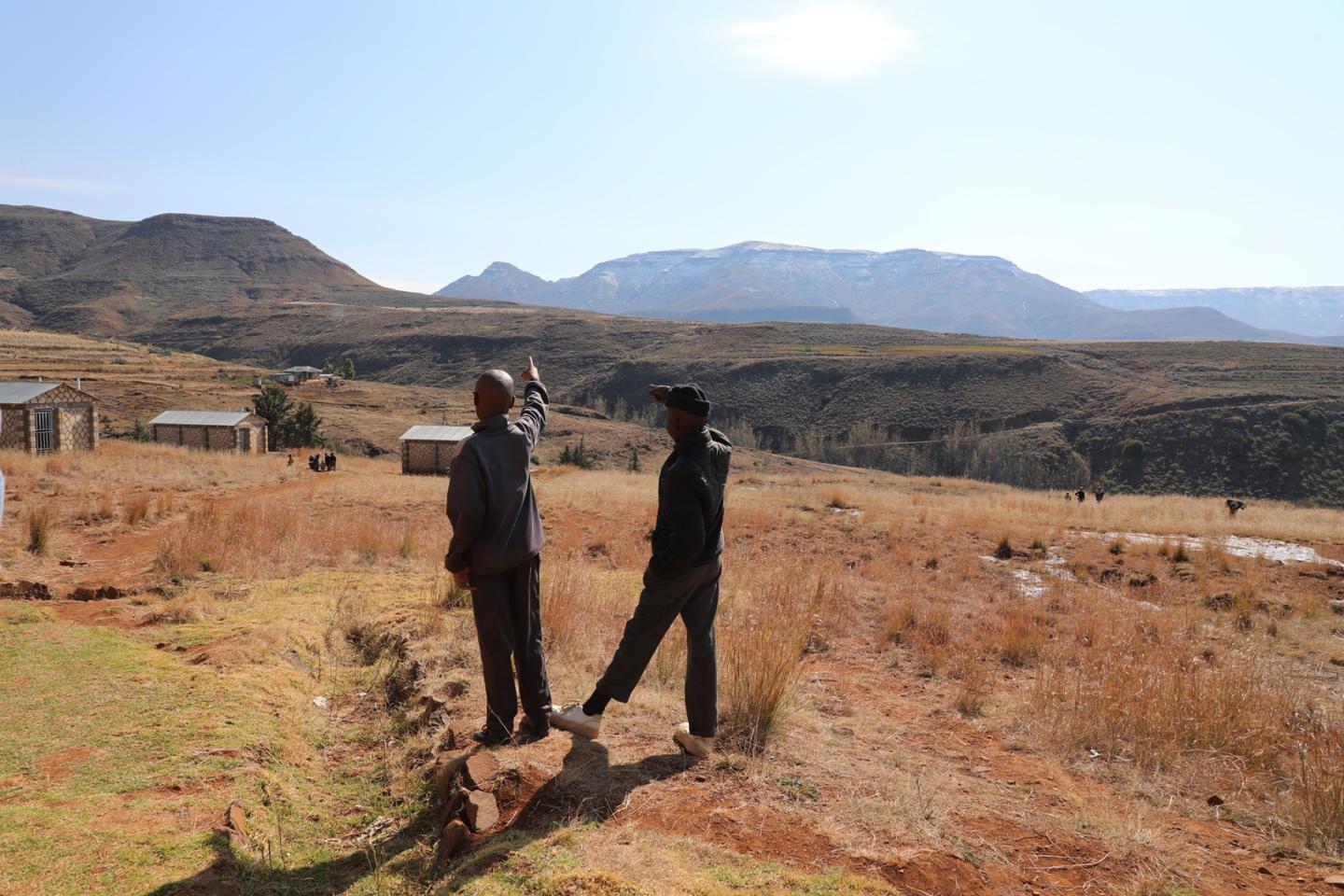
Tlotla and Sekonyela point towards the mountains they once climbed while herding animals, reflecting on the difficult journey that kept them away from school
The boys had to travel for more than three hours to reach the outposts, sometimes under difficult weather conditions. The places were far, isolated, and surrounded by no nearby villages. Some days, they had to sleep alone at the outposts, with only the animals around them. For children of their age, this was the scariest part of the experience.
“The scariest part was sleeping alone at the shepherd’s outpost. It would just be me and the animals, with no villages or people nearby. Sometimes we also had to travel through the rain when we had to go back to school the following day,” Sekonyela said.
Their teacher, Ms. Lineo, said sending children to herd animals affects their school performance, upbringing, and safety, especially in areas where stock theft is common. She said children may be exposed to dangerous situations while protecting livestock from thieves, and may also be negatively influenced when some of the people involved in theft are relatives or people known to them.
“It is a huge concern when parents send children to herd animals because it affects their performance in school. They cannot catch up well after the gap, hence they have to repeat the same grade. It also affects their upbringing because most of the people involved in stock theft are relatives to these children, and this may influence them to grow up thinking such behavior is normal,” Ms. Lineo said.
For Ms. Lineo, the boys’ situation was not only about poor school attendance. It was a child labour case that required action.
Through World Vision International Lesotho’s European Union-funded Accelerating Action for Eliminating Child Labour and Forced Labour Project, Ms. Lineo received training on child labour. The training helped her understand how to identify child labour cases and respond through the right community structures.
After noticing the impact on the boys’ education, she raised the matter during a parents’ meeting and advocated for their return to school. Her action became an important step in ensuring that the boys were not left behind. Real change followed through the involvement of World Vision’s EU-funded AECFL Project, the Lesotho Mounted Police Service, the Ministry of Gender, Youth and Social Development, and community child protection structures. Through these joint efforts, the boys were supported to return to school.
When Sekonyela and Tlotla were told that they could go back to school, they both felt happy and relieved. For them, returning to class meant more than continuing their lessons. It meant being with other children again, carrying books instead of herding ropes, and having another chance to focus on their future.
“I felt happy because I was going to be with other children again and continue learning. I no longer had to spend my days worrying about the animals at the outpost,” Sekonyela said.
For Tlotla, going back to school restored his confidence and gave him hope that his future was not lost.
“I was excited to go back because I missed being in class and learning with my classmates. I felt like I had been given another chance to do better in school,” Tlotla said.
According to Ms. Lineo, before the intervention, about 30% of children in the area would drop out of school to herd animals. Today, that number has reduced to around 5%, with most current dropout cases no longer directly linked to child labour. This change, she said, shows the importance of continued awareness and training on child labour. When teachers, parents, and community members understand the risks, they are better able to protect children and keep them in school.
Ms. Mabatloung, Auxiliary Social Worker Ministry of Gender, Youth and Social Development, said the boys’ situation also improved after meetings and follow-up efforts capacitated by the Ministry of Gender, Youth and Social Development, the CCCPT (Community Council Child Protection Team) and World Vision Lesotho. She explained that although both boys were receiving grants, the support was not fully benefiting them before the intervention, as the money was often used for other family matters. As a result, the boys lacked adequate support for their school needs.
The intervention helped bring attention to the boys’ circumstances and strengthened the support around them. It also showed how coordinated child protection systems can help identify children at risk and connect them with the right services.
Today, Sekonyela and Tlotla are back in school, and their return is a reminder that child labour can quietly take children away from learning, safety, and opportunity. Their story also shows that when communities are trained, when teachers speak up, and when protection systems work together, children can be brought back to where they belong. For Sekonyela and Tlotla, going back to school is not only about returning to the classroom; it is about restoring hope, protecting their childhood, and giving them another chance to walk towards their dreams of working at World Vision and becoming a nurse.