
A refugee mother’s journey from dependence to self-reliance

Every month, Alice’s life revolved around a single date, the 18th.
On that day, as a refugee and single mother of four caring for her younger sisters in Nyabiheke Refugee Camp, she received her food assistance cash transfer. It was the lifeline that kept her family going.
But as soon as the money arrived, a deeper worry would quietly begin to grow.
How long would it last? How would she afford soap or replace her children’s worn-out shoes and clothes?
One evening after dinner, Alice sat beside her food supplies. The same thought returned with urgency. If nothing changed, survival would remain uncertain.
That night, something shifted. She decided to try something she had never done before.
She went to a mobile money agent and asked for an advance on her upcoming cash transfer so she could start a small trading activity.
He refused.
But Alice did not give up.
She returned the next day, and again the next. On the third visit, he finally agreed.
With that breakthrough, Alice invested RWF 8,000 (about USD 5) in tomatoes, onions, dried fish, and groundnuts, arranging them on a small market stall.
To her surprise, everything sold quickly.
Encouraged, she expanded her working hours, staying at the market until evening. At home, her younger sister helped care for the children, allowing her to focus on growing her business.
As her sales increased, she noticed customers often asked for items she did not have in stock. Over time, she saw this as a sign of growing demand.
“My biggest challenge was finding capital,” she says.
It was around this time that Alice learnt about Dukore Twigire (Work for self-reliance), a World Vision project funded by the European Union in Nyabiheke Camp, aimed at strengthening refugee livelihoods.
The programme began with training sessions focused on mindset change, confidence building, and business skills such as identifying opportunities and managing income.
After her first training, Alice asked herself: what does self-reliance really mean?
“For me, self-reliance means the freedom to solve my own problems,” she says. “It means earning, providing for my family, and planning for tomorrow without waiting for someone else to decide my future.”
She continued attending trainings while running her business.
“I learnt that change begins with vision,” she says. “I gained confidence to dream bigger.”
She also learnt bookkeeping, expense tracking, and business management.
One lesson stood out: saving.
“At first, I thought saving was useless,” she admits. “I wondered how someone struggling to survive could save instead of spend.”
But she started small, saving RWF 2,000 per week, later increasing it to RWF 10,000. This discipline helped her access a loan of RWF 80,000, which she reinvested into her business.
At the end of the programme, she also received start-up capital of RWF 1,092,661 (USD 745).
The impact was visible. From a roadside stall, she moved into a shop.
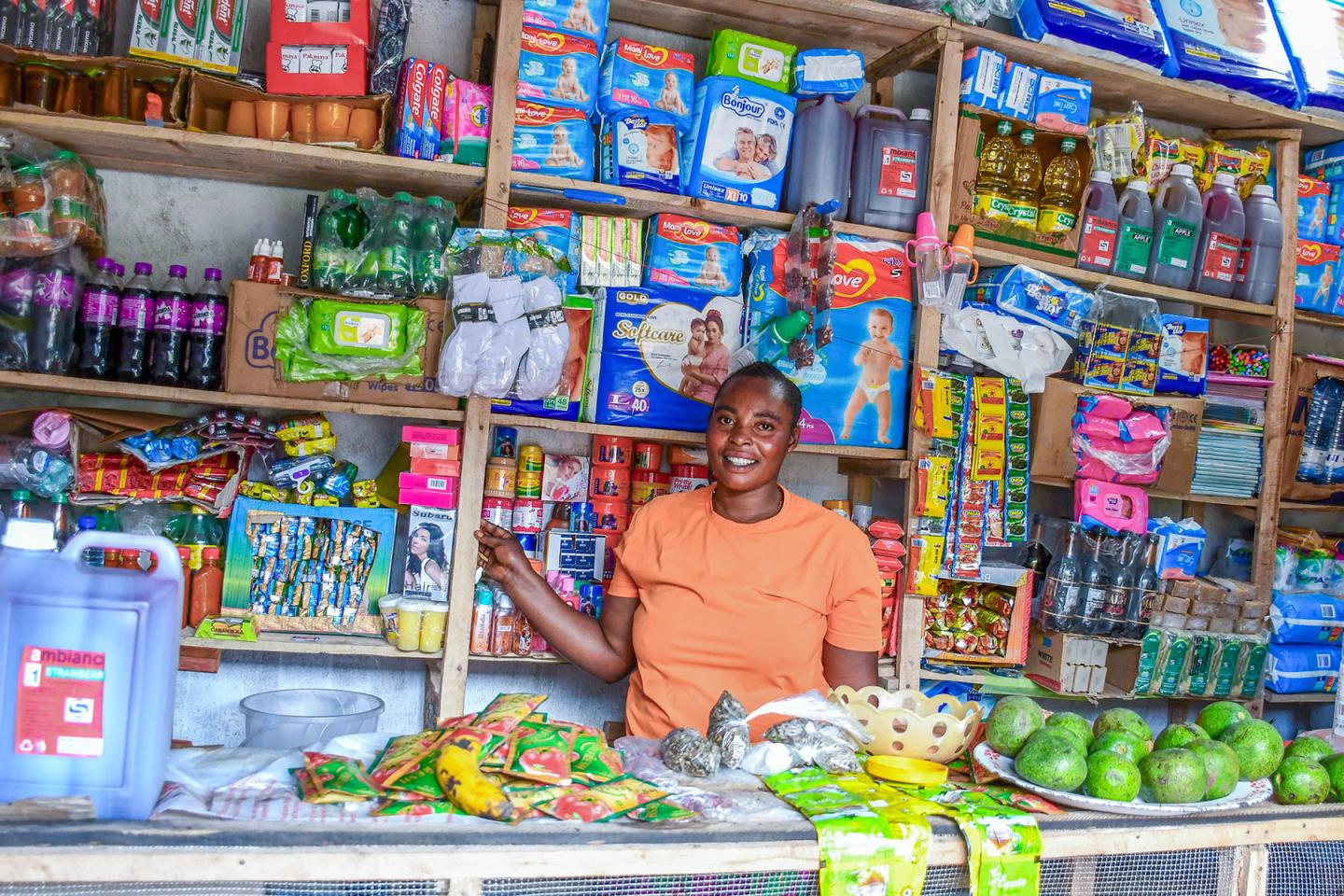
“Now I own a big shop,” she says proudly. “I sell sugar, cooking oil, body lotions, juices, diapers, stoves, and many other household items.”
Her income has grown significantly.
“When I started, I made barely RWF 5,000 profit a month. Today, I earn at least RWF 50,000 monthly,” she says. “I can feed my family properly and plan for the future.”
For the first time in years, Alice is no longer focused only on survival. She is looking ahead.
“My dream is to own a larger shop in the city center,” she says with a smile. “I also want to travel to China and buy goods directly from manufacturers.”
The Dukore Twigire project, funded by the European Union and implemented by World Vision Rwanda with Caritas Rwanda and RODI, supports 2,133 households in refugee and host communities across four camps. It promotes integrated livelihoods, with 70 per cent refugee and 30 per cent host community participation.
By Raissa Anne Iradukunda, Communications Officer