
The Little Girl of Tulagi: A Glimpse of Leadership the World Must Not Overlook

In the lead-up to Women Deliver 2026, Asuntha Charles — National Director for World Vision in the Solomon Islands and Vanuatu — explores how we can build more resilient communities by centring the voices of women and children this International Women’s Day, 08 March 2026.
The sea around Tulagi (in the Central Islands of the Solomon Islands) has its own character, sometimes gentle, often fierce, always honest. On the day I travelled there, it was at its fiercest. Rain hammered the water, the waves rose sharply, and our journey from Honiara tested everyone on the boat. By the time we were preparing to return, the weather had grown even more unpredictable. The few of us waiting on the shore knew one truth: no one argues with the Pacific Ocean when it’s angry.
As we watched the restless water, something struck me.
The sea was empty.
Not a single fisherman ventured out.
Not a single boat challenged the waves.
And then — where no one else dared — I saw her.
A little girl, perhaps six or seven years old, paddling alone in a handmade wooden canoe. Her small frame moved with purpose, her hands gripping a paddle almost as tall as she was. The sea pushed her back, the wind fought her, and the waves rose around her. Yet she pressed on fearlessly, focused, determined.
Her strokes cut through the chaos with a kind of confidence that left me breathless. She moved not with the hesitation of a child, but with the instinct of someone who had already learned how to survive. And when she reached the shore, she stepped out of her canoe quietly, as if conquering rough seas was a normal part of her day.
In that moment, I realised I wasn’t just watching a child.
I was witnessing a leader in the making.
Her Courage Reflects a Region the World Never Fully Sees
This little girl’s courage wasn’t loud. It wasn’t staged.
It wasn’t shared on social media or applauded by a crowd.
It was natural.
It was inherited.
It was lived.
And that is the story of so many Pacific girls. They grow up reading the sky and the tides.
They grow up navigating uncertainty with calm hearts. They grow up adapting—quickly, skillfully—because climate change gives them no choice. Their resilience is not theoretical. Their leadership is not motivational.
It is real, practical, and shaped by challenges the world rarely acknowledges.
She remains nameless to me, but her actions spoke with a clarity no title could provide. She represents the millions of girls navigating the frontlines of a changing climate with the same steady hands and unshakable hearts.
A Story the World Needs as We Head Toward Women Deliver 2026
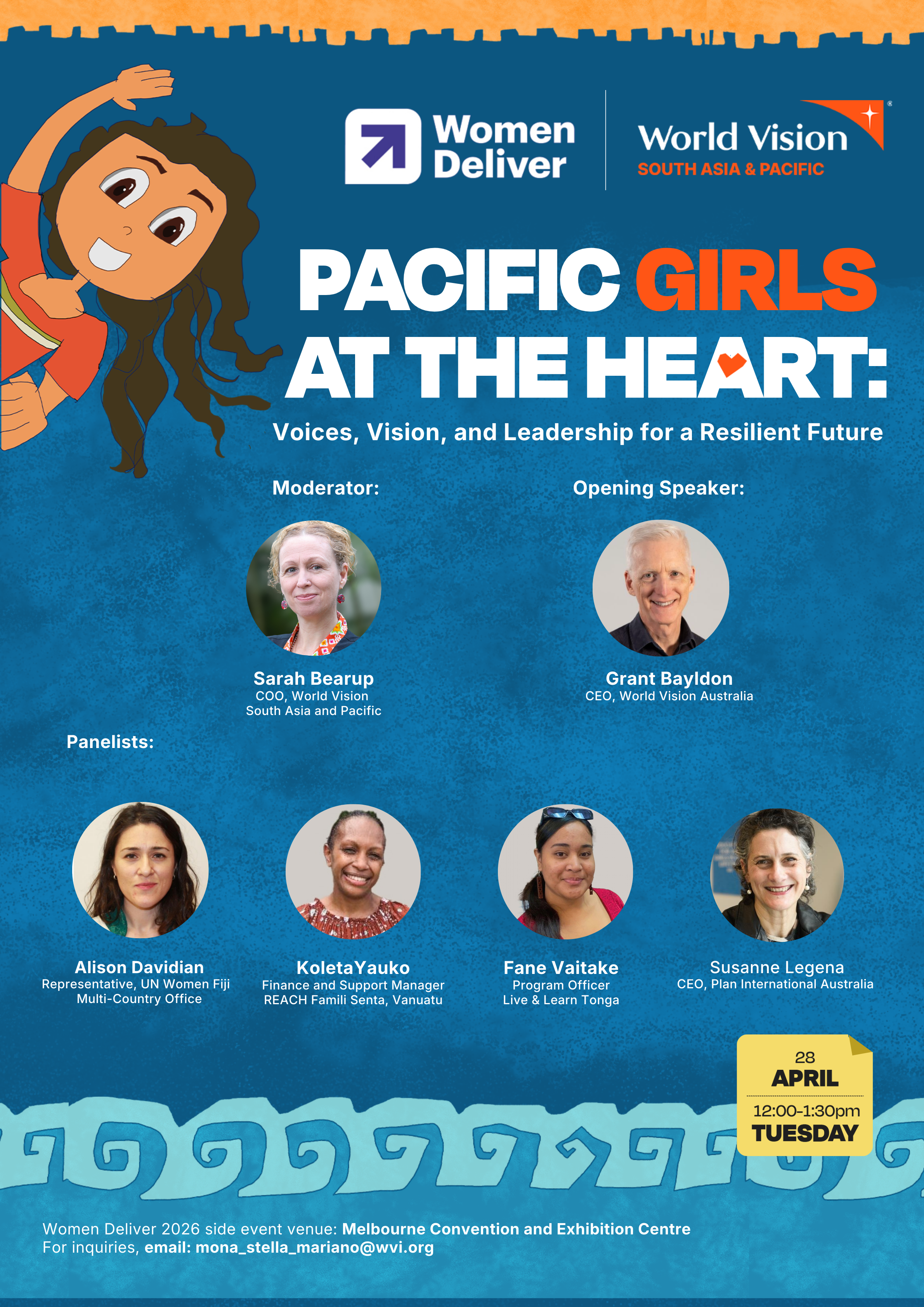
From 27–30 April 2026, the world will gather in Narrm (Melbourne) for Women Deliver 2026, the first time the Oceanic Pacific is hosting this global conference. And what a powerful message that sends.
For the first time, the lived realities of women and girls across our region will sit at the centre of a global conversation on gender equality, climate justice, and leadership.
As we move toward this historic gathering, I keep returning to the image of that little girl on the rough sea.
She represents everything Women Deliver hopes to amplify:
- Girls who lead not because they are told to—but because life shapes them into leaders.
- Communities where bravery is learned in childhood.
- A region that has long stood on the frontline of climate change, yet continues to rise with strength and dignity.
- The untapped potential of girls who are already demonstrating courage far beyond their years.
Her story is not just mine to tell.
It is a message to the world: Look at the Pacific. Look at its girls. Look at what leadership truly looks like when it grows from resilience, not privilege.
Local Voices Must Lead Local Futures
Women Deliver 2026 is also a call to shift power— to allow Pacific people, especially girls and women, to shape the solutions their communities need.
Because who understands the Pacific better than those who ride its tides?
Who understands resilience better than children who paddle through storms?
Who understands climate justice better than those who face its first impact?
Her little canoe was more than a boat. It was a reminder of the leadership we must nurture.
A reminder that localisation is not a development model—it is deep respect for the wisdom and courage already present in our communities.
A Leadership Lesson for All of Us
The world often defines leadership through speeches, titles, and visibility.
But leadership can also be a tiny girl in a handmade canoe, steering herself through rough waters with grace and grit.
Her story should not fade.
It should inspire us.
As the global community prepares to gather in Melbourne, I hope we carry her courage with us—not as a touching story to remember, but as a call to rise. Because that little girl in Tulagi has already shown us the essence of Bolder Hope:
Leadership begins in the quiet courage to move forward when the waves rise.
Resilience is formed in small, steady acts of bravery.
And hope grows strongest when we recognise leaders in places the world rarely looks.
If we can honour that truth—if we can invest in her potential, amplify her voice, and learn from her determination — then Women Deliver 2026 will become more than a gathering.
It will become a milestone in our journey toward Bolder Hope— a moment where the world chooses to believe in courage, act with purpose, and build a future worthy of every girl who dares to paddle through the storm.