
Under Fire, They Rescued Their Bees

When fighting reached their village near Pokrovske, 68-year-old Dmytro and his wife, 56-year-old Liubov, tried to stay as long as possible. But by August 2024, it became clear that remaining was no longer safe.
“We saw everything,” Dmytro says quietly. “The flashes, the artillery turning toward the village. We came under fire more than once. The second-to-last time, it was cluster munitions. We saw people fall… people diving into ditches. You can’t describe that in words. It was brutal. Just pain, complete pain.”
On the day they left, they walked through what was left of their community one last time.. “Our three-story school, the new one, was already destroyed. Shells were landing near the village. But even then, it didn’t feel like we were leaving forever.”
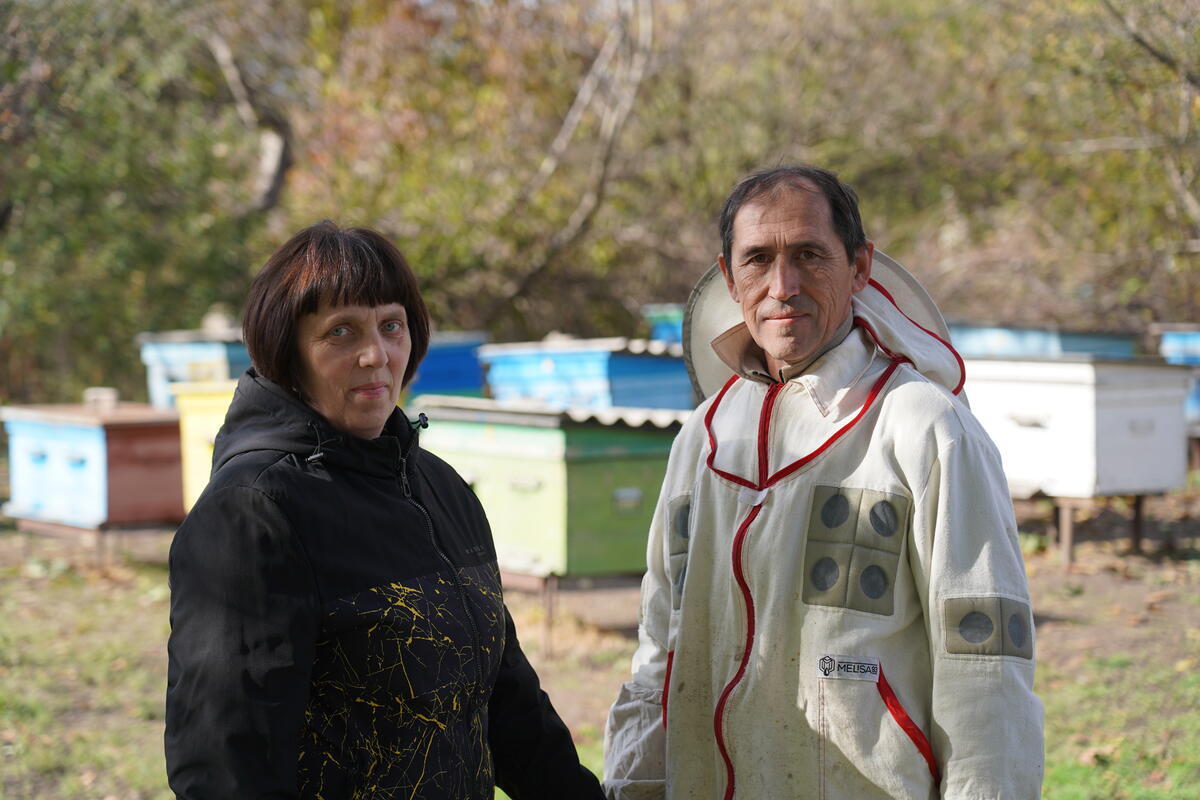
The couple fled west with only what they could carry. One of their biggest concerns was their apiary – a source of income and purpose.
“We wanted to hire transport and move everything at once,” Dmytro explains. “But it cost 2,000 hryvnias [US$47] per load – too expensive for us. So we used our small trailer and transported four hives at a time.”
Every trip was grueling. “At night, we prepared the hives. At three in the morning, we loaded them. Every minute mattered. And it wasn’t thirty kilometers… it was 350. That says something.”
They repeated this journey four to five times each month. By April and May, after receiving permission to live in a small house and finally having electricity, they managed to bring over what remained of the apiary. Their original goal was to relocate everything in four weeks, but they also had to move furniture, clothes, and basic items needed for winter. Even so, saving the bees remained their priority.
In their new home near Dnipro, the couple began to rebuild.
“The land here was overgrown,” Dmytro says. “We cleared it and prepared space for the hives. First on a small plot, then on a larger one where nothing disturbed the bees. It turned out to be a good place for an apiary.”
To help families like theirs restart their livelihoods, World Vision, funded by Aktion Deutschland Hilft (ADH), provided vocational and business training.
“The training helped a lot,” Dmytro says. “It gave us confidence again.”
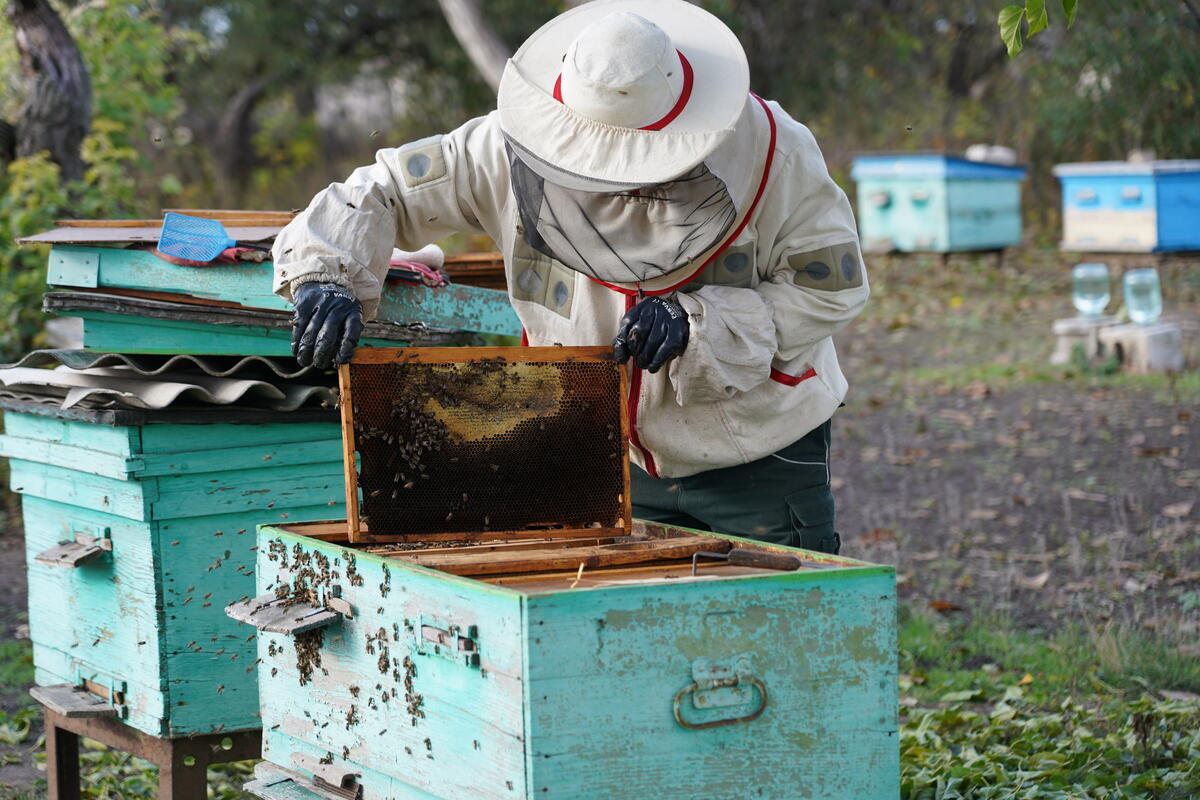
Liubov participated in the beekeeping course and received a small scholarship. The family used the support to purchase essential supplies. “With each payment, we bought something we needed for the apiary – tools, protective clothing, all the small things,” Dmytro explains.
At the end of the course, participants developed business plans. “At first, the business plan scared us,” he admits. “We had never written one. But we thought – we had no help before, and now someone is offering to support us. So we tried.”
Their plan was approved, and they received a World Vision livelihoods grant.
“With that money, we bought the equipment we didn’t have – a honey extractor, a work table… things I could never afford on my pension,” he says. “We made a list and bought everything.”
“The financial support gave us hope,” Dmytro says. “It helped us believe we could rebuild our life.”
This year’s honey harvest was poor. Spring frosts destroyed fruit trees, the acacia didn’t bloom, and buckwheat yields were low. “We planned for at least a ton of honey,” he explains. “We got only about a third. And we must leave enough honey for the bees for winter. Many people feed syrup, but honey is their natural food.”
In a typical season, one hive produces around 80-100 kilograms of honey, though the yield varies widely. “A strong hive can give two buckets, another only one,” he says. “One family gives 100 kilograms, another 50 - that’s beekeeping.”
For now, the apiary is not yet their primary income, but that is the goal. “We’re not fully back on our feet yet,” Dmytro says. “But we plan for the apiary to become our main source of income.”