
They Bombed the Hospitals. Now the Clinics Are All That's Left.

People queue to receive ready-to-use therapeutic food at El Ferduouse clinic, South Darfur, where hunger is among the most acute challenges facing a population that has seen little outside aid since UN agencies withdrew from direct operations in the area.

People queue to receive ready-to-use therapeutic food at El Ferduouse clinic, South Darfur, where hunger is among the most acute challenges facing a population that has seen little outside aid since UN agencies withdrew from direct operations in the area.

In Darfur, Sudan’s war has not just killed people. It has dismantled the systems that kept them alive. Now, the women left behind are trying to save their children with almost nothing.

MARSHING, South Darfur — Inside the clinic in Marshing, a deep red curtain hangs across the window, blocking the sun and the heat. Iman Issa Abdulgani sits on a plastic chair in the dim room, a baby asleep across her lap.

The baby is not hers. She belongs to Iman’s sister, who died in childbirth — the youngest of seven children. She died before the baby had a name. The mother bled out in a private pharmacy because there was no hospital to take her to. 

Now Iman makes the two-hour walk each way to this clinic, every week. She has to. The infant cannot be breastfed because her mother is gone, and the nutritional supplement that keeps her alive is rare, hard to find, distributed here in small quantities to the mothers and caregivers who know to come. The baby is malnourished. Without the supplement, she would get worse.

“She was following up with the midwife,” Iman says, her voice steady in the way of people who have already done their grieving. “But then she started hemorrhaging. We took her to a pharmacy — there was nowhere else to go. She died there.”

She adjusts the child on her lap. Iman has two children of her own, and now has seven new mouths to feed.

“If there were no center here,” she says, “I was going to suffer a lot with the baby. There is no one who would support us. We don’t have milk to give her.”

There was no hospital to go to. There hadn’t been for some time.

Iman Issa Abdulgani, 7th child of her late sister in arms, at World Vision's stabilisation clinic in Marshing, South Darfur, Sudan.

Iman Issa Abdulgani, 7th child of her late sister in arms, at World Vision's stabilisation clinic in Marshing, South Darfur, Sudan.

Iman Issa Abdulgani, 7th child of her late sister in arms, at World Vision's stabilisation clinic in Marshing, South Darfur, Sudan.

Iman Issa Abdulgani, 7th child of her late sister in arms, at World Vision's stabilisation clinic in Marshing, South Darfur, Sudan.

Sudan is home to what the United Nations has called the world’s largest humanitarian crisis. Nearly three years into a civil war between the Sudanese Armed Forces and the paramilitary Rapid Support Forces (RSF), the country’s healthcare system has not simply struggled — it has been targeted, looted, and systematically destroyed.

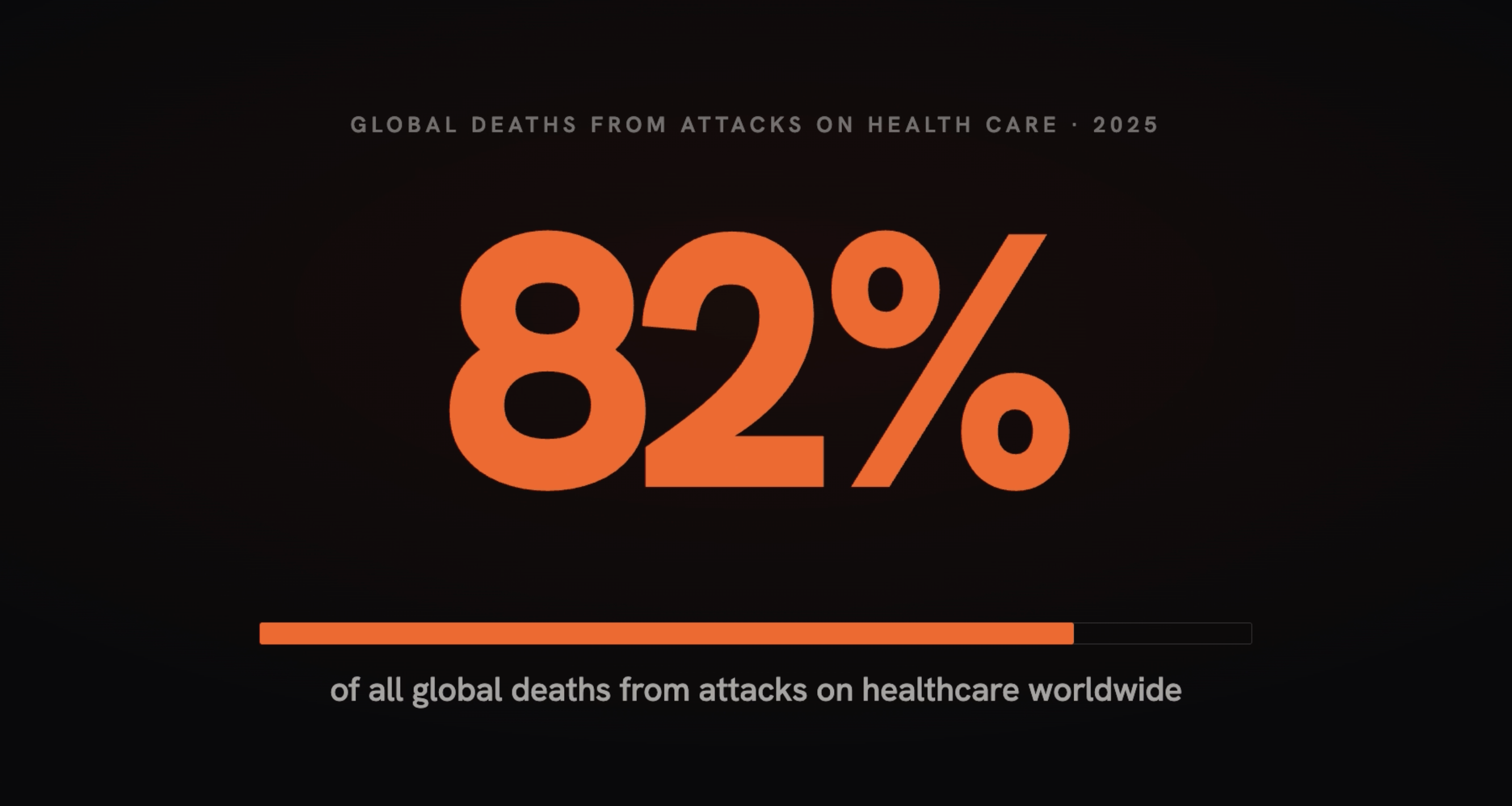
In the three years since conflict began, WHO has verified 217 attacks on healthcare in Sudan, resulting in 2,052 deaths and 810 injuries. In the first quarter of 2026 alone, 13 attacks were verified, killing 184 people. By 2025, Sudan accounted for 82 percent of all global deaths from attacks on healthcare, according to the World Health Organization. 
The hunger crisis runs alongside it. UNICEF projects that across Sudan in 2026, 825,000 children under five will suffer severe acute malnutrition — 25 percent higher than pre-conflict levels. In North Darfur alone, nearly 85,000 children were admitted for treatment of severe acute malnutrition between January and November 2025 — one child every six minutes. According to the Integrated Food Security Phase Classification, acute malnutrition among children in parts of Darfur has now exceeded famine thresholds. Famine has been confirmed in El Fasher.

A woman waiting to receive ready-to-use therapeutic food at El Ferduouse clinic, South Darfur, where hunger is among the most acute challenges facing a population that has seen little outside aid.

A woman waiting to receive ready-to-use therapeutic food at El Ferduouse clinic, South Darfur, where hunger is among the most acute challenges facing a population that has seen little outside aid.

A severely malnourished baby asleep in El Ferduouse clinic, South Darfur.

A severely malnourished baby asleep in El Ferduouse clinic, South Darfur.

Women queue to receive ready-to-use therapeutic food (RUTF) at El Ferduouse clinic, South Darfur, where hunger is among the most acute challenges facing a population that has seen little outside aid since UN agencies withdrew from direct operations in the area.

Women queue to receive ready-to-use therapeutic food (RUTF) at El Ferduouse clinic, South Darfur, where hunger is among the most acute challenges facing a population that has seen little outside aid since UN agencies withdrew from direct operations in the area.

Staff conduct health screenings, vaccinations, reproductive health consultations, and nutritional assessments at El Ferduouse clinic, South Darfur.

Staff conduct health screenings, vaccinations, reproductive health consultations, and nutritional assessments at El Ferduouse clinic, South Darfur.

A young boy crying as he waits with his mother to receive ready-to-use therapeutic food (RUTF) at El Ferduouse clinic, South Darfur, where hunger is among the most acute challenges facing a population that has seen little outside aid since UN agencies withdrew from direct operations in the area.

A young boy crying as he waits with his mother to receive ready-to-use therapeutic food (RUTF) at El Ferduouse clinic, South Darfur, where hunger is among the most acute challenges facing a population that has seen little outside aid since UN agencies withdrew from direct operations in the area.

A woman waiting to receive ready-to-use therapeutic food at El Ferduouse clinic, South Darfur, where hunger is among the most acute challenges facing a population that has seen little outside aid.

A woman waiting to receive ready-to-use therapeutic food at El Ferduouse clinic, South Darfur, where hunger is among the most acute challenges facing a population that has seen little outside aid.

A severely malnourished baby asleep in El Ferduouse clinic, South Darfur.

A severely malnourished baby asleep in El Ferduouse clinic, South Darfur.

Women queue to receive ready-to-use therapeutic food (RUTF) at El Ferduouse clinic, South Darfur, where hunger is among the most acute challenges facing a population that has seen little outside aid since UN agencies withdrew from direct operations in the area.

Women queue to receive ready-to-use therapeutic food (RUTF) at El Ferduouse clinic, South Darfur, where hunger is among the most acute challenges facing a population that has seen little outside aid since UN agencies withdrew from direct operations in the area.

Staff conduct health screenings, vaccinations, reproductive health consultations, and nutritional assessments at El Ferduouse clinic, South Darfur.

Staff conduct health screenings, vaccinations, reproductive health consultations, and nutritional assessments at El Ferduouse clinic, South Darfur.

A young boy crying as he waits with his mother to receive ready-to-use therapeutic food (RUTF) at El Ferduouse clinic, South Darfur, where hunger is among the most acute challenges facing a population that has seen little outside aid since UN agencies withdrew from direct operations in the area.

A young boy crying as he waits with his mother to receive ready-to-use therapeutic food (RUTF) at El Ferduouse clinic, South Darfur, where hunger is among the most acute challenges facing a population that has seen little outside aid since UN agencies withdrew from direct operations in the area.

On the night of March 20, 2026 — the first day of Eid al-Fitr — a drone struck the Al-Daein Teaching Hospital in East Darfur. According to the World Health Organization and Sudan’s Ministry of Health, at least 64 people were killed, including 13 children and healthcare workers, with 90 others severely injured. As the primary referral hospital for the entire state, its destruction rendered it completely non-functional, cutting off paediatric, maternity, and emergency services for the region. The hospital was hit by three drone-fired rockets; the third struck as rescue workers were trying to help victims from the first.

One week later, I walked through what remained of it. The infrastructure had collapsed entirely. Shards of broken glass and discarded medical supplies were scattered across the floors. Outside, the trees and bushes surrounding the building were threaded with scraps of clothing — blown there by the force of the blasts, left there by the absence of anyone to remove them. Beneath the rubble, there were still remnants of flesh. The smell made the scale of what had happened impossible to abstract.

Into the void left by bombed-out hospitals and shuttered clinics, a sparse network of NGO-supported health centers has become, for many families, the only option left. World Vision operates several of them. They are not equipped to carry this weight. But they carry it anyway.

“Before the war, these communities had functioning hospitals, vaccination programs, prenatal care,” says Anass Adam Ahmed, World Vision’s Project Officer for Health and Nutrition in East Darfur. “What we are running now are not replacements. They are what is left. And still, the needs are outpacing what we can provide.”

El Dein teaching hospital was attacked March 20, 2026 where 64 people - including 13 children, two nurses and a doctor - had died in the strike and 89 others had been wounded.

El Dein teaching hospital was attacked March 20, 2026 where 64 people - including 13 children, two nurses and a doctor - had died in the strike and 89 others had been wounded.

El Dein teaching hospital was attacked March 20, 2026 where 64 people - including 13 children, two nurses and a doctor - had died in the strike and 89 others had been wounded.

El Dein teaching hospital was attacked March 20, 2026 where 64 people - including 13 children, two nurses and a doctor - had died in the strike and 89 others had been wounded.

El Dein teaching hospital was attacked March 20, 2026 where 64 people - including 13 children, two nurses and a doctor - had died in the strike and 89 others had been wounded.

El Dein teaching hospital was attacked March 20, 2026 where 64 people - including 13 children, two nurses and a doctor - had died in the strike and 89 others had been wounded.

El Dein teaching hospital was attacked March 20, 2026 where 64 people - including 13 children, two nurses and a doctor - had died in the strike and 89 others had been wounded.

El Dein teaching hospital was attacked March 20, 2026 where 64 people - including 13 children, two nurses and a doctor - had died in the strike and 89 others had been wounded.

El Dein teaching hospital was attacked March 20, 2026 where 64 people - including 13 children, two nurses and a doctor - had died in the strike and 89 others had been wounded.

El Dein teaching hospital was attacked March 20, 2026 where 64 people - including 13 children, two nurses and a doctor - had died in the strike and 89 others had been wounded.

El Dein teaching hospital was attacked March 20, 2026 where 64 people - including 13 children, two nurses and a doctor - had died in the strike and 89 others had been wounded.

El Dein teaching hospital was attacked March 20, 2026 where 64 people - including 13 children, two nurses and a doctor - had died in the strike and 89 others had been wounded.

El Dein teaching hospital was attacked March 20, 2026 where 64 people - including 13 children, two nurses and a doctor - had died in the strike and 89 others had been wounded.

El Dein teaching hospital was attacked March 20, 2026 where 64 people - including 13 children, two nurses and a doctor - had died in the strike and 89 others had been wounded.

El Dein teaching hospital was attacked March 20, 2026 where 64 people - including 13 children, two nurses and a doctor - had died in the strike and 89 others had been wounded.

El Dein teaching hospital was attacked March 20, 2026 where 64 people - including 13 children, two nurses and a doctor - had died in the strike and 89 others had been wounded.

Muaza Saihe is one of the hundreds of thousands of families displaced from El Fasher as famine and violence tightened its grip on North Darfur. She fled Khartoum when the war reached her neighborhood — leaving so fast she didn’t stop to take her documents — and made her way south, losing her father in Nyala along the way. When the fighting reached her again, she kept moving. She is now seven months pregnant, living in the Otash IDP camp outside Nyala, with nine daughters and a husband who returned to Khartoum and was arrested by the Sudanese army. She has not heard from him since.

“Right now we have more time,” she says, a phrase that in translation carries the particular weight of people who have stopped expecting anything to resolve. “We don’t know where he is.”

This is what displacement looks like from the inside: not a single dramatic rupture, but a series of them, each one pushing a family further from whatever home used to mean.

Muaza Saihe watches as her daughter is measured at World Vision's nutrition centre in Otash IDP camp, Nyala.

Muaza Saihe watches as her daughter is measured at World Vision's nutrition centre in Otash IDP camp, Nyala.

Mothers bring their children to be screened, measured, and treated at one of three World Vision nutrition centres in Otash IDP camp, Nyala, South Darfur — home to 56,000 displaced people.

Mothers bring their children to be screened, measured, and treated at one of three World Vision nutrition centres in Otash IDP camp, Nyala, South Darfur — home to 56,000 displaced people.

Mothers bring their children to be screened, measured, and treated at one of three World Vision nutrition centres in Otash IDP camp, Nyala, South Darfur — home to 56,000 displaced people.

Mothers bring their children to be screened, measured, and treated at one of three World Vision nutrition centres in Otash IDP camp, Nyala, South Darfur — home to 56,000 displaced people.

Children under five who are found to be acutely or moderately malnourished receive 3kg of ready-to-use supplementary food (RUSF), a peanut-based therapeutic paste supplied by the World Food Programme, and return every two weeks for monitoring.

Children under five who are found to be acutely or moderately malnourished receive 3kg of ready-to-use supplementary food (RUSF), a peanut-based therapeutic paste supplied by the World Food Programme, and return every two weeks for monitoring.

Muaza Saihe watches as her daughter is measured at World Vision's nutrition centre in Otash IDP camp, Nyala.

Muaza Saihe watches as her daughter is measured at World Vision's nutrition centre in Otash IDP camp, Nyala.

Mothers bring their children to be screened, measured, and treated at one of three World Vision nutrition centres in Otash IDP camp, Nyala, South Darfur — home to 56,000 displaced people.

Mothers bring their children to be screened, measured, and treated at one of three World Vision nutrition centres in Otash IDP camp, Nyala, South Darfur — home to 56,000 displaced people.

Mothers bring their children to be screened, measured, and treated at one of three World Vision nutrition centres in Otash IDP camp, Nyala, South Darfur — home to 56,000 displaced people.

Mothers bring their children to be screened, measured, and treated at one of three World Vision nutrition centres in Otash IDP camp, Nyala, South Darfur — home to 56,000 displaced people.

Children under five who are found to be acutely or moderately malnourished receive 3kg of ready-to-use supplementary food (RUSF), a peanut-based therapeutic paste supplied by the World Food Programme, and return every two weeks for monitoring.

Children under five who are found to be acutely or moderately malnourished receive 3kg of ready-to-use supplementary food (RUSF), a peanut-based therapeutic paste supplied by the World Food Programme, and return every two weeks for monitoring.

The World Vision clinic in El Ferdous has five departments: medical assistance, pharmacy, nutrition, reproductive health, and a nursery. Tuesday is market day in El Ferdous, when people from across the locality come into town — it is also the day the clinic runs its nutrition session, which means the line outside is longest then. On other days, sixty to eighty people still arrive.

Khalthoum Yousuf Ibrahim has worked here as a midwife long enough to know what the week’s worst cases will look like before she sees them. Pregnant women in hemorrhage. Mothers who cannot stop bleeding because they are anemic and malnourished and have been hauling water and washing other people’s clothes throughout their pregnancies because stopping means the family doesn’t eat.

“The reason the women are bleeding is because they are suffering,” she says. “Especially the refugees. Especially because of nutrition. They work very laborious jobs while pregnant.”

The day she was interviewed, the clinic had run short of IV fluids and a critical obstetric medication used to control hemorrhage.

“The mother is already malnourished,” she says. “And as a result, their babies are also malnourished.”

Jihad Hassan Ahmed is one of the women Khalthoum sees. She came from South Sudan to El Ferdous in 2016 and has been a refugee here for almost a decade. Her daughter, eight months old, was recently diagnosed with severe malnutrition. Jihad works as a laundress when there is work — a ninety-minute walk each direction into town. She is anemic herself, had complications after her last delivery. The last time her family received food assistance was three months before we spoke.

“I am afraid,” she says. “I don’t have hope. I can’t work, so my children won’t have anything to eat.”

She pauses, then adds: “The children who have low blood levels have died. I have seen it.”

Both of her children have now been malnourished. Her firstborn son recovered. She watches her daughter improve at the clinic each week — each visit a small negotiation between what the child’s body needs and what the system can provide.“Sometimes we fin medication,” she says. “Sometimes we don’t. When we don’t, I wash clothes to buy it at the market

Khalthoum Yousuf Ibrahim, midwife at World Vision's health clinic for refugees in El Ferdous, South Darfur.

Khalthoum Yousuf Ibrahim, midwife at World Vision's health clinic for refugees in El Ferdous, South Darfur.

The landscape surrounding El Ferduouse clinic, South Darfur, a remote locality bordering South Sudan where 245,000 households depend on a crumbling health system.

The landscape surrounding El Ferduouse clinic, South Darfur, a remote locality bordering South Sudan where 245,000 households depend on a crumbling health system.

People queue to receive ready-to-use therapeutic food (RUTF) at El Ferduouse clinic, South Darfur, where hunger is among the most acute challenges facing a population that has seen little outside aid since UN agencies withdrew from direct operations in the area.

People queue to receive ready-to-use therapeutic food (RUTF) at El Ferduouse clinic, South Darfur, where hunger is among the most acute challenges facing a population that has seen little outside aid since UN agencies withdrew from direct operations in the area.

Staff conduct health screenings, vaccinations, reproductive health consultations, and nutritional assessments at El Ferduouse clinic, South Darfur, where World Vision delivers the full spectrum of primary healthcare to a population of around 3,500 households.

Staff conduct health screenings, vaccinations, reproductive health consultations, and nutritional assessments at El Ferduouse clinic, South Darfur, where World Vision delivers the full spectrum of primary healthcare to a population of around 3,500 households.

People queue to receive ready-to-use therapeutic food (RUTF) at El Ferduouse clinic, South Darfur, where hunger is among the most acute challenges facing a population that has seen little outside aid since UN agencies withdrew from direct operations in the area.

People queue to receive ready-to-use therapeutic food (RUTF) at El Ferduouse clinic, South Darfur, where hunger is among the most acute challenges facing a population that has seen little outside aid since UN agencies withdrew from direct operations in the area.

Jihad Hassan Ahmed holds her eight-month-old daughter at El Ferduouse clinic, South Darfur, where she has brought her three times a week for treatment after the infant developed severe malnutrition, diarrhea, and dangerously low blood levels.

Jihad Hassan Ahmed holds her eight-month-old daughter at El Ferduouse clinic, South Darfur, where she has brought her three times a week for treatment after the infant developed severe malnutrition, diarrhea, and dangerously low blood levels.

Khalthoum Yousuf Ibrahim, midwife at World Vision's health clinic for refugees in El Ferdous, South Darfur.

Khalthoum Yousuf Ibrahim, midwife at World Vision's health clinic for refugees in El Ferdous, South Darfur.

The landscape surrounding El Ferduouse clinic, South Darfur, a remote locality bordering South Sudan where 245,000 households depend on a crumbling health system.

The landscape surrounding El Ferduouse clinic, South Darfur, a remote locality bordering South Sudan where 245,000 households depend on a crumbling health system.

People queue to receive ready-to-use therapeutic food (RUTF) at El Ferduouse clinic, South Darfur, where hunger is among the most acute challenges facing a population that has seen little outside aid since UN agencies withdrew from direct operations in the area.

People queue to receive ready-to-use therapeutic food (RUTF) at El Ferduouse clinic, South Darfur, where hunger is among the most acute challenges facing a population that has seen little outside aid since UN agencies withdrew from direct operations in the area.

Staff conduct health screenings, vaccinations, reproductive health consultations, and nutritional assessments at El Ferduouse clinic, South Darfur, where World Vision delivers the full spectrum of primary healthcare to a population of around 3,500 households.

Staff conduct health screenings, vaccinations, reproductive health consultations, and nutritional assessments at El Ferduouse clinic, South Darfur, where World Vision delivers the full spectrum of primary healthcare to a population of around 3,500 households.

People queue to receive ready-to-use therapeutic food (RUTF) at El Ferduouse clinic, South Darfur, where hunger is among the most acute challenges facing a population that has seen little outside aid since UN agencies withdrew from direct operations in the area.

People queue to receive ready-to-use therapeutic food (RUTF) at El Ferduouse clinic, South Darfur, where hunger is among the most acute challenges facing a population that has seen little outside aid since UN agencies withdrew from direct operations in the area.

Jihad Hassan Ahmed holds her eight-month-old daughter at El Ferduouse clinic, South Darfur, where she has brought her three times a week for treatment after the infant developed severe malnutrition, diarrhea, and dangerously low blood levels.

Jihad Hassan Ahmed holds her eight-month-old daughter at El Ferduouse clinic, South Darfur, where she has brought her three times a week for treatment after the infant developed severe malnutrition, diarrhea, and dangerously low blood levels.

Haifa Alnail Abdelrhman is nine months pregnant and sitting very still on a bench at the Umrakboa Health Center, her hands folded over her stomach. She is wearing a bright pink dress. She has four children at home.

She has been bleeding on and off since her first trimester. Her blood iron is critically low. Her husband is sick and cannot work. They have no savings, no stored food, no preparation for the birth. Not even the bahoor — the traditional scented wood Sudanese women burn in their final weeks of pregnancy, a ritual of welcome for a new child.

“My home is empty,” she says. “I am about to deliver. I don’t have anything.”

They borrow a neighbor’s donkey to collect firewood to sell. She used to weave traditional crafts, but her body is too anemic to sustain it. Some days there is one meal. Some days there are two.

“The children who are out of the womb need food,” she says. “And the baby who is inside of my womb also needs food.”

“There is no money. There is no food. There is no work. There is nothing to do.”

She is not a refugee. She is part of the host community. The war has reached her anyway.She is not a refugee. She is part of the host community. The

Haifa Alnail Abdelrhman, nine months pregnant with her fifth child, at Umrakboa Health Center, East Darfur.

Haifa Alnail Abdelrhman, nine months pregnant with her fifth child, at Umrakboa Health Center, East Darfur.

Abukarina clinic, East Darfur, where World Vision staff provide free general consultations, vaccinations, reproductive healthcare, nutrition treatment, and pharmacy services to conflict-affected communities.

Abukarina clinic, East Darfur, where World Vision staff provide free general consultations, vaccinations, reproductive healthcare, nutrition treatment, and pharmacy services to conflict-affected communities.

Women waiting to be screened at Abukarina clinic, East Darfur, where World Vision staff provide free general consultations, vaccinations, reproductive healthcare, nutrition treatment, and pharmacy services to conflict-affected communities.

Women waiting to be screened at Abukarina clinic, East Darfur, where World Vision staff provide free general consultations, vaccinations, reproductive healthcare, nutrition treatment, and pharmacy services to conflict-affected communities.

Haifa Alnail Abdelrhman, nine months pregnant with her fifth child, at Umrakboa Health Center, East Darfur.

Haifa Alnail Abdelrhman, nine months pregnant with her fifth child, at Umrakboa Health Center, East Darfur.

Abukarina clinic, East Darfur, where World Vision staff provide free general consultations, vaccinations, reproductive healthcare, nutrition treatment, and pharmacy services to conflict-affected communities.

Abukarina clinic, East Darfur, where World Vision staff provide free general consultations, vaccinations, reproductive healthcare, nutrition treatment, and pharmacy services to conflict-affected communities.

Women waiting to be screened at Abukarina clinic, East Darfur, where World Vision staff provide free general consultations, vaccinations, reproductive healthcare, nutrition treatment, and pharmacy services to conflict-affected communities.

Women waiting to be screened at Abukarina clinic, East Darfur, where World Vision staff provide free general consultations, vaccinations, reproductive healthcare, nutrition treatment, and pharmacy services to conflict-affected communities.

Not every story ends in loss. At the NIPP program at Umrakboa, a different kind of line forms. These are the children who have moved through the worst of it.

NIPP — the Nutrition Impact and Positive Practice programme — works in two stages: children with severe acute malnutrition are first treated intensively at a clinic, and once they stabilize, they transfer to NIPP for ongoing monitoring, supplemental feeding, and nutrition education for caregivers. Being transferred to NIPP means a child has survived the worst.

Hawa Adam is 25 years old. Her daughter Maab is 14 months. At seven months, Maab was diagnosed with severe acute malnutrition — discovered only after Hawa brought her to the clinic, alarmed by vomiting, fever, and diarrhea she couldn’t explain or stop.

“When she got sick, I didn’t know what was happening to her,” Hawa says. “We went to the clinic and found out she was malnourished.”

The early weeks of treatment were frightening. The supplements weren’t working yet. Hawa kept coming back. She had four children, no consistent income, and a war that had taken most of the men in her community.

“In the past, you could do more things to get money,” she says. “Now your options are limited.”

Most of the men in her community are gone. Killed. The women left behind are navigating scarcity alone.

Eventually, Maab stabilized and was transferred to NIPP — the sign that she had made it through.

“I feel hope,” Hawa says. “But I am not quite sure she is completely better.”

She holds her daughter. “My hope is that my children have complete health and well-being.”

Hawa Adam, 25, holds her 14-month-old daughter Maab at Umrakboa Health Center, East Darfur, where Maab was diagnosed with severe acute malnutrition at seven months old.

Hawa Adam, 25, holds her 14-month-old daughter Maab at Umrakboa Health Center, East Darfur, where Maab was diagnosed with severe acute malnutrition at seven months old.

Mothers and children gather at Umrakboa Health Center, East Darfur, as part of World Vision's Nutrition Impact and Positive Practice (NIPP) program — a community-based approach that goes beyond treating malnutrition to addressing its root causes through behaviour change and nutrition education.

Mothers and children gather at Umrakboa Health Center, East Darfur, as part of World Vision's Nutrition Impact and Positive Practice (NIPP) program — a community-based approach that goes beyond treating malnutrition to addressing its root causes through behaviour change and nutrition education.

Mothers and children gather at Umrakboa Health Center, East Darfur, as part of World Vision's Nutrition Impact and Positive Practice (NIPP) program — a community-based approach that goes beyond treating malnutrition to addressing its root causes through behaviour change and nutrition education.

Mothers and children gather at Umrakboa Health Center, East Darfur, as part of World Vision's Nutrition Impact and Positive Practice (NIPP) program — a community-based approach that goes beyond treating malnutrition to addressing its root causes through behaviour change and nutrition education.

Hawa Adam, 25, holds her 14-month-old daughter Maab at Umrakboa Health Center, East Darfur, where Maab was diagnosed with severe acute malnutrition at seven months old.

Hawa Adam, 25, holds her 14-month-old daughter Maab at Umrakboa Health Center, East Darfur, where Maab was diagnosed with severe acute malnutrition at seven months old.

Mothers and children gather at Umrakboa Health Center, East Darfur, as part of World Vision's Nutrition Impact and Positive Practice (NIPP) program — a community-based approach that goes beyond treating malnutrition to addressing its root causes through behaviour change and nutrition education.

Mothers and children gather at Umrakboa Health Center, East Darfur, as part of World Vision's Nutrition Impact and Positive Practice (NIPP) program — a community-based approach that goes beyond treating malnutrition to addressing its root causes through behaviour change and nutrition education.

Mothers and children gather at Umrakboa Health Center, East Darfur, as part of World Vision's Nutrition Impact and Positive Practice (NIPP) program — a community-based approach that goes beyond treating malnutrition to addressing its root causes through behaviour change and nutrition education.

Mothers and children gather at Umrakboa Health Center, East Darfur, as part of World Vision's Nutrition Impact and Positive Practice (NIPP) program — a community-based approach that goes beyond treating malnutrition to addressing its root causes through behaviour change and nutrition education.

The clinics World Vision and its partners operate across Darfur are not replacements for a functioning healthcare system. They are not equipped to be. They run on constrained supplies, stretched staff, and institutional will that persists even when the funding is uncertain and the medicines run low.

But for the women lining up before dawn in Marshing and Umrakboa and El Ferdous — pregnant women with hemorrhages, mothers with malnourished infants, a woman raising her dead sister’s baby on supplements she walks two hours to collect — these clinics are, for now, the whole system.

UNICEF warned in April 2026 that Darfur is repeating its darkest history — that twenty years after the crisis that shocked the world, children are again living through extreme violence, hunger, and displacement, but this time with far less global attention. Famine has been confirmed. Malnutrition rates in parts of Darfur have exceeded 50 percent among children. More than 1,300 children have been killed or maimed in Al Fasher alone since April 2024.

The red curtain still hangs in the window at Marshing when Iman arrives each week. The room is dim. The baby sleeps. And outside, the line is already forming.

World Vision is currently operating health and nutrition programs across East Darfur and South Darfur. To support their work, visit worldvision.org.