
Typhoon Haiyan brings death and destruction to central Philippines

Typhoon Haiyan has caused at least 1,200 deaths in Tacloban City, Leyte Province, and Samar Province, Philippines, according to preliminary numbers released by the Philippine Red Cross to Reuters news agency.
As survivors picked through the rubble of their devastated coastal communities on Saturday, electricity and communications were still cut off, so full details are not yet known.
"I've never seen such a violent force that destroyed everything in its path. It's really large scale. It's immense." Aaron Aspi, World Vision emergency communications
World Vision’s Meldred Matol, a member of the emergency task force dispatched on Saturday to assess the damage, says: “As relief workers it’s really hard to focus because our families are also affected. I hope God will give us strength to face what we see.”
“I’m worrying about my two children. I don’t have any contact with them yet,” says World Vision’s Grace Baloro, whose family was also in the impact zone.
World Vision staff are deploying to Bohol, Samar, Leyte, and Panay Island on Sunday, arriving with the U.N.
"I'm going to Panay tomorrow. I will be taking a boat and then a motorcycle to try to get to the islands. We are racing against time to reach the hardest-hit areas,” says World Vision emergency communications specialist Aaron Aspi.
"We are mobilizing more than 500 local World Vision staff to launch our biggest relief effort ever [in the Philippines], hoping to reach nearly 1.2 million people."
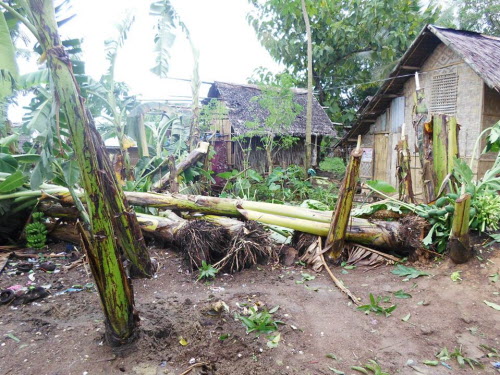
Nine provinces are affected by the super typhoon, including Bohol, where World Vision was already delivering aid to thousands displaced by a magnitude-7.2 earthquake that struck Oct. 15. Typhoon Haiyan’s impact zone includes 19 development project areas where World Vision works with 35,000 sponsored children and their communities.
World Vision’s goal is to help 1.2 million people with food, water, hygiene kits, emergency shelter, and protection for the most vulnerable, including children and women.