
Mauritania: Relying on Food Aid

By Brahim Sidi Baba
The temperature is soaring at 50 degrees Celsius. Trees look like they have been scorched by a fire. There is no green to be seen anywhere.
 The water levels in a lake near this town along the Mali-Mauritania border are at an all-time low. The lake provides water for animals and for women to wash clothes, but it is too unclean for human consumption now.
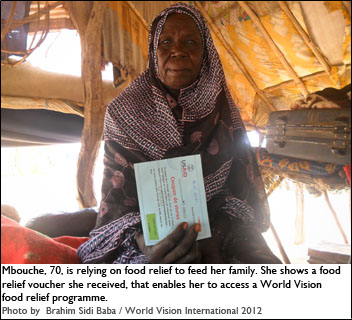
In the midst of this situation is a 70-year-old woman. She is struggling to scrape together enough food for her grandchildren and great-grandchildren.
“Since my daughter passed away I have also to look after my great grandsons as they came here to live with us,” Mbouche says, a 70-year-old grandmother from Hamoud.
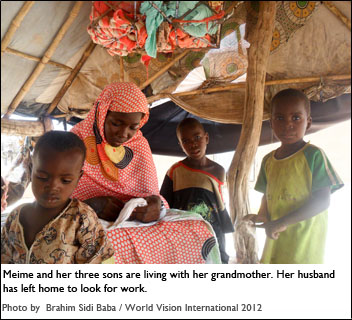
Mbouche’s granddaughter, Meime, and her three sons, are living with her.
“I am doing the daily housework to help my old grandma,” 21-year-old Meime says.
 As Meimi talks, Sidi, her two-year-old son, sits in her lap. The other two boys, who are five and eight, are not yet in school. Instead, they sit inside the hut with their mother and grandmother to avoid the heat.
“We were used to growing plants here, but this year we could not grow anything due to the drought,” Meimi says.
The father of the children, Meime’s husband, was forced to leave her and his children to look for work in a city that is about 1,280km away. He has been away for nearly a year, and sends whatever little money he can. But Meimi admits it’s not enough.
“If it was not the crisis, my husband would have stayed here with us. He would have been planting cereals to feed us,” Meime states.
As such, Meime, her children and her grandmother have to rely on food relief.
World Vision and USAID have created a food distribution programme for families. In this area of Mauritania, known as Kankossa, more than 24,420 people are benefiting from the food aid programme.
“Before these vouchers, we were obliged to ask people for food. Now, this is the second voucher I received. We managed to live on the last voucher for a month, and hopefully this will be the case this month too,” says Mbouche, the grandmother.
The emergency food programme is expected to run for eight months, until the next harvest season.