

Community Support for Breastfeeding Gives Children a Healthy Beginning
We do not need a new breakthrough to improve child survival. Fanuel and Irene argue we need to strengthen what already works: protecting, promoting, and supporting breastfeeding through communities, health systems, and partnerships that help every child thrive.
Breastmilk is a baby's first food, first immunisation, and best opportunity for bonding and healthy brain development. It is also a country's first investment in the human capital that will power its economy for generations to come.
A breastfed child requires no additional water, while households spend less on water, fuel, and breastmilk substitutes. Breastfeeding is a climate-smart, cost-effective intervention that places minimal financial burden on families while protecting children from preventable illness and death. According to UNICEF, breastfed children are at least 14 times more likely to survive in the early months of life than children who are not breastfed.
Within the first hour of birth a mother should be supported to initiate breastfeeding, guided by the baby's instinct to the breast. This is the best start for a newborn and one of the most powerful public health interventions ever discovered.
This year's World Breastfeeding Week theme, "Breastfeeding for a Sustainable Start in Life: Strengthen What Works”, invited us to build on this progress and on exclusive breastfeeding for the first six months, when a child needs nothing else, not even water.
Closing the gap
Six of nine countries in the East Africa Region are on track to meet the World Health Assembly Target for 2030 of 60 percent exclusively breastfed babies by 2030. In Kenya, a decade of collaboration between World Vision, the Ministry of Health, and communities has lifted exclusive breastfeeding from roughly three in ten babies to about six in ten.
This progress reflects the concerted efforts of government, World Vision and other partners, community health promoters, and Baby-Friendly Community Initiatives. Yet the national target of 80% remains out of reach.
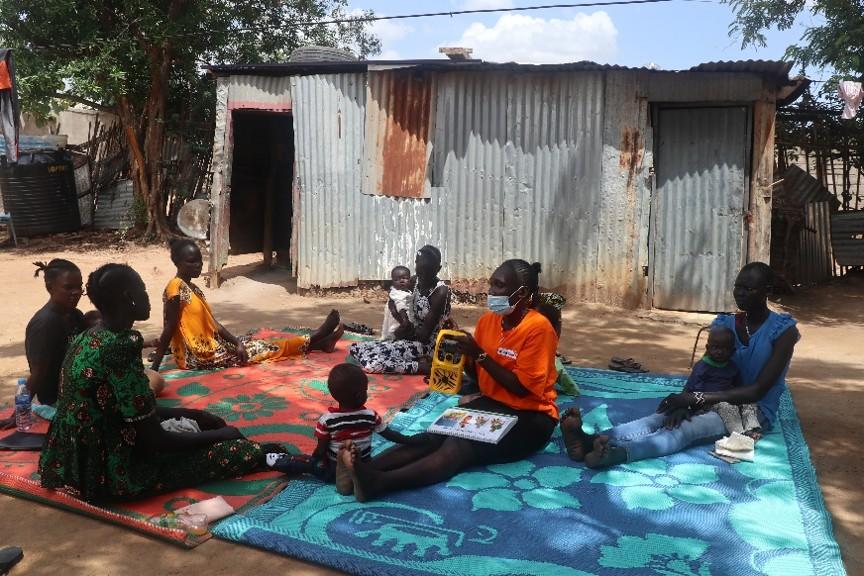
At World Vision, we see what closes that gap: a mother-to-mother support group meeting under a tree, a lactation corner in a market where a trader can nurse between customers, a community health worker trained to counsel mothers rather than simply weighing their babies and sending them home.
Amina: A mother’s story
Consider Amina Abdullahi Yussuf, a mother of seven in Wajir County, Kenya. She attended every antenatal visit and breastfed her daughter Nuseybah faithfully. Yet at three months, the baby’s weight began to falter. Nutritionist Hajira Osman, at Gurar Health Centre, looked past the scale to the pressures behind it: Amina was caring for a toddler and running a small business while her husband worked away in town. Hajira connected her to the Bulaqochu mother-to-mother support group under the Nourish to Thrive project, run by World Vision Kenya with UNICEF and World Vision Australia. There, alongside other mothers, Amina learned better feeding, care, and hygiene practices, and within weeks Nuseybah’s weight climbed from 4.8 to 6.8 kilograms.
“I have faith my child will now grow strong,” Amina says, “and I am glad I can learn and do as we are taught.”
Amina's story is not an exceptional miracle, it is what happens when systems, not just willpower, support a mother. Strengthening what works means paying, training, and equipping every community health worker instead of treating them as volunteers indefinitely. It means holding employers accountable for lactation breaks and spaces as policy, not favour. It means counselling with patience rather than a checklist and resisting the aggressive marketing of breastmilk substitutes that still finds its way into hospitals and homes.
We do not need another breakthrough.
We need to keep doing what we already know saves lives. Protecting, promoting, and supporting breastfeeding among the most vulnerable communities and households we serve.
About the authors:
Fanuel Odhiambo is the Senior Health & Nutrition Advisor for World Vision East Africa. He has over a decade of experience in nutrition and public health across humanitarian and development settings. His expertise includes maternal and child health, emergency nutrition, health systems strengthening, and program design having worked with different international organisations within East Africa and Middle East.
Irene Nyauncho is the Health, Nutrition, and WASH Advisor for World Vision Kenya. She is a Public Health Nutrition Specialist with over 15 years of experience designing and leading maternal, infant, and young child nutrition programmes in both development and humanitarian contexts. Her expertise includes providing strategic leadership in nutrition policy, programming, and multi-sectoral food systems approaches. Irene is Chair of the Kenya Nutrition Information Working Group and a Board Member of the SUN Civil Society Alliance. She is passionate about advancing breastfeeding, maternal and child nutrition, and equitable food systems that improve health outcomes for women and children.
Subscribe to see more content like this
Related Resources

Breastfeeding saves lives

From Fragmentation to Impact: Strengthening Nutrition Financing for Children
