
Give Your Loaves & Your Fish, Harold Segura, 2026
Download
Each year, a piece of art has been created as part of the Weekend of Prayer and Action Against Hunger. In 2026, Harold Segura presented a piece called 'Give Your Loaves & Your Fish.'
Bio: Harold Segura is a Colombian artist based in Costa Rica since 2000. His artistic practice is primarily developed through watercolor and acrylic, exploring simple forms, vibrant colors, and symbols that evoke everyday life and spirituality. His work, intuitive and expressive in nature, seeks to communicate tenderness, humanity, and hope through accessible and evocative compositions.
In addition to his artistic work, he serves as Director of the Department of Faith and Development for World Vision in Latin America and the Caribbean. He is also a university professor, speaker, and writer, with extensive experience in issues related to faith, development, and childhood. He has participated in exhibitions in Lima, Peru; at the University for Peace in San José, Costa Rica; and more recently at Sala Artea in Costa Rica. For him, painting is an exercise in personal recreation and inner balance that dialogues with his vocation and commitment to life.
Artist Statement: "In the Gospel narratives, a child offers five loaves and two fish—a small gesture that, in Jesus’ hands, becomes abundance for many. It was not the quantity that transformed reality, but the willingness to share. This work, Give your bread and your fish, captures that deeply human and spiritual intuition: what is little, when given, ceases to be insufficient.
The hands emerging in the composition do not grasp, but offer; they do not close, but open. The fish and the bread are not depicted as symbols of scarcity, but of possibility. There is a movement in the image that flows from the center outward, as a quiet invitation to break with the logic of hoarding and enter into the economy of gift.
The piece confronts us with a simple yet demanding question: what are we willing to put into circulation for the good of others? It is not only about material resources, but also time, care, attention, tenderness. In a world marked by perceived scarcity and fear of loss, this painting proposes an alternative: to trust that sharing is the beginning of multiplication.
More than depicting a miracle, the work provokes one in the viewer. It invites us to recognize that, very often, the true miracle begins when someone decides not to hold back what they have".
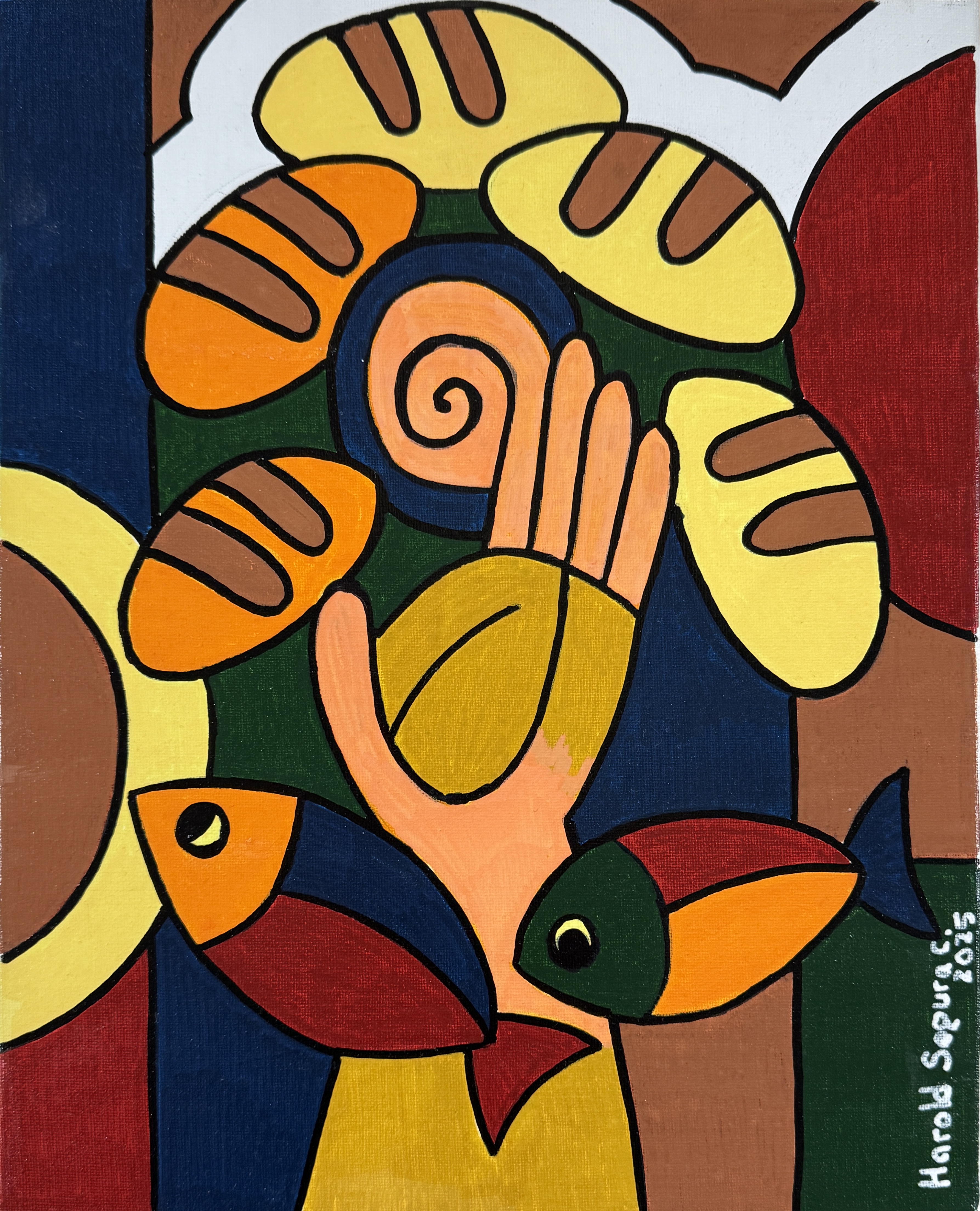
Reflection: Jamie Thomas, Bread for the World
When we reflect on art, we first name what we see. We describe it. Then, we point out inferences, making connections between what we see in the art and what we know of the world. We raise questions, offer interpretations, and follow trains of thought to find meaning. One of my favorite things about art is that no piece is ever one thing – there can be many meanings, many ideas, many ways of seeing the same image.
In this artwork, loaves and fish appear in a circle around an open hand.
What’s happening here? Maybe the loaves and fish are being juggled - lifted, released, and returned in a rhythm we cannot quite see. That possibility suggests another presence beyond the hand itself: an unseen giver, or perhaps a community of giving, keeping the sustenance in motion. The food does not rest; it circulates. It becomes less an object possessed and more a gift (as the artist mentioned in his explanation) exchanged.
Another option is to see the circle not as motion, but meaning - it resembles a halo. Halos mark what is set apart, what participates in the divine. Following that visual logic, the loaves and fish are not merely provisions; they are sanctified. Can we see food itself as bearing holiness? To recognize sustenance as something radiant? This is not far from the language of Christian theology: the Eucharist teaches that ordinary elements – the bread, the wine - can become vessels of grace. When Jesus says, “I am the bread of life,” in the Gospel of John, he links nourishment to presence, hunger to relationship. In that light, the circle of food in this artwork could be more than abundance – it could be communion. Not only the miracle of enough, but the miracle of shared life abundant.
This circle is anchored by an open hand.
Sometimes it helps to define something by what it is not, as much as what it is: this is an open hand, not a closed fist. It is not something clenched, guarded, withheld. It is not about control… it is about offering.
The open hand is deceptively simple. It can be easy to overlook, just as it can be easy to overlook the radical nature of generosity. In a culture shaped by scarcity thinking – by comparison, by competition, by the quiet fear that there will not be enough – our instinct is often to close our hand, to secure what we have, to make rules about who is worthy of receiving.
We see this impulse in the culture of polarization that shapes common life in everything from social media to the news media, to politics, to community meetings, to sports events… when lines are quickly drawn and repeatedly reinforced, people become positions. Neighbors become opponents.
It’s all too easy to move from disagreement to demonization. It is not much of a problem if someone is innocently mistaken about a fact or holds a differing but still valid opinion. The reasonableness of that kind of understanding does not drive the engagement metrics that our communication platforms depend on. But if someone is not just wrong, but also morally bereft for holding a differing opinion, they become a demon who must be put down publicly and harshly. Some people name this public name-calling a rhetorical device, saying it is merely to make a point. But once someone is named the villain, named Wrong, named “not like us,” it is too easy to take the next step and see that someone without complexity, to flatten them into something less than fully human.
When that happens, the closed fist tightens, this time withholding the dignity of wholeness. Hostility can begin to feel like righteousness. Contempt can masquerade as clarity. The act of exclusion can seem justified, even necessary. This dynamic plays out in comment sections, sure – but it is echoed in politics, in institutions, even in our private conversations. We search for who is to blame and bring a readiness to cast them outside the circle.
The open hand resists that current.
The open hand offers what it holds. It does not first demand worthiness; it gives not only food, it gives the benefit of the doubt. It does not calculate who deserves to eat. It does not ask about status, origin, or belonging. It does not participate in the easy naming of enemies.
There is a doubleness to this generosity. First, the material act: what I have is enough for us both. Second, the interior act: I will meet you with openness rather than suspicion. In both, there is risk. In both, there is trust.
The colors of this artwork align with this interpretation: they are bright and primary. Nothing is hidden or obscured. The visual language is elemental and basic, as is the message: food is basic. Giving is basic. Life together, sustained through shared provision, is basic.
Where do we, the viewers, fit in this interpretation? Is the circle something we witness, or something we join? Are we the ones receiving, the ones offering, or the unseen presence keeping the gifts in motion? Do we see the food as ordinary, or as radiant? How do we keep our hand open, in spite of the impulse to guard what could be ours? When we encounter those we have been taught to resist to fear, what happens to our hands?
Art invites reflection and question; there are many ways to see, literal and metaphorical, historical and of-the-moment. This piece of art calls us to history - it echoes the feeding miracles, the Eucharistic table, the long artistic tradition of halos and hands. And it speaks into the present moment, where we make a choice between open and closed – day by day, comment section by comment section, vote by vote – every time we decide what of ourselves that we will offer the world.