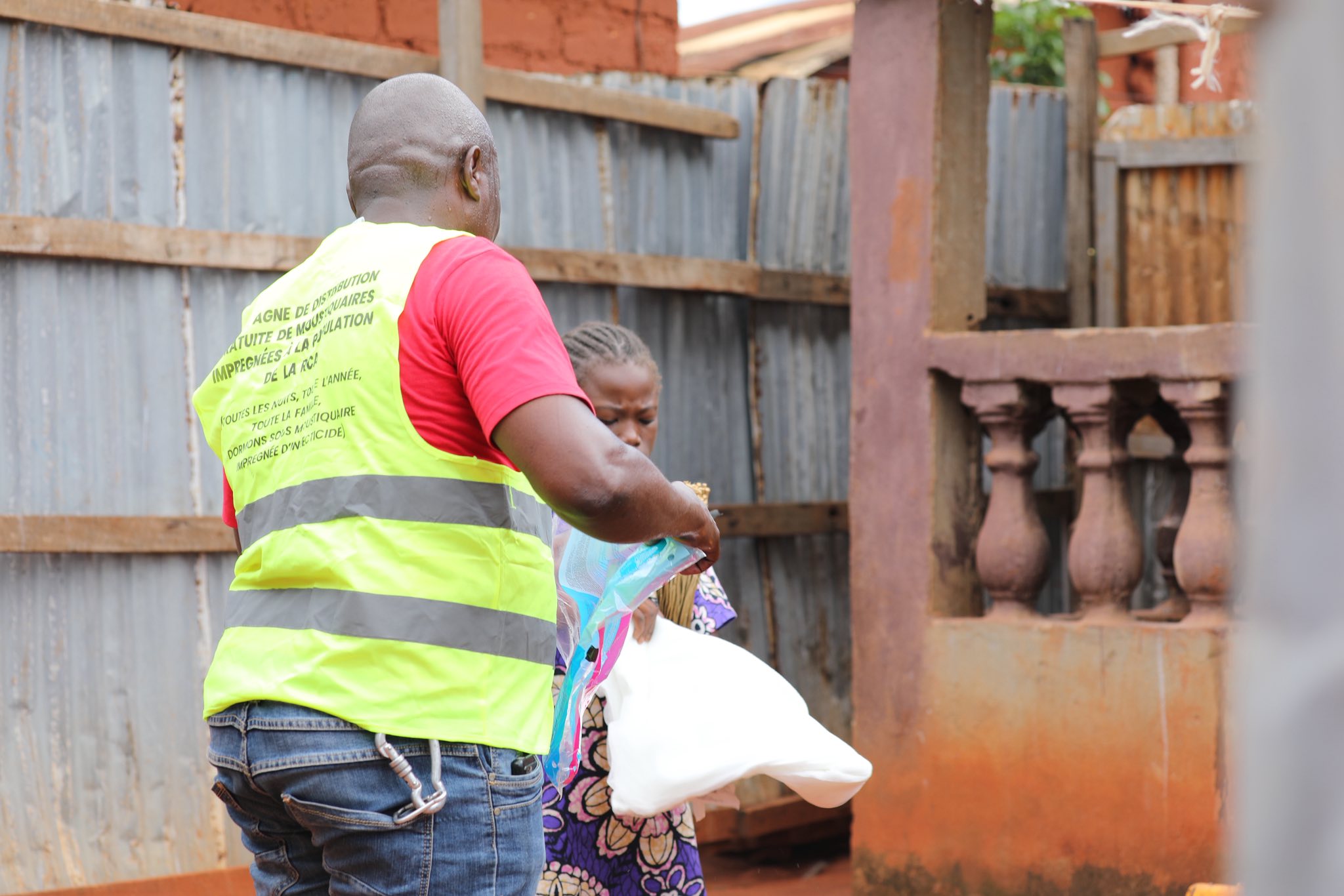
World Vision re-declares a CAT III Sustained Humanitarian Response (SHR) in Central African Republic (CAR) to continue meeting humanitarian needs amid fragility, elections, and funding constraints.

Overview
Central African Republic remains one of the most fragile and neglected crises globally. After more than two decades of coups, armed conflict, and governance crises, the country continues to face protracted insecurity, weak institutions, regional spill-over, and climate shocks. Constitutional changes in 2023 removed presidential term limits and restricted political participation, fuelling mistrust ahead of the December 2025 general elections. The DDR process remains incomplete, and the risk of renewed violence around the electoral period is high. Based on the ongoing complex humanitarian situation and recommendations from the Partnership Response Oversight team, the West Africa Regional Office is redeclaring the World Vision Response in Central African Republic as a CAT 3 Sustained Humanitarian Response.
Context and humanitarian situation
Numerous armed groups and militias operate across large swathes of the territory, undermining state authority and severely constraining humanitarian access. CAR scores 5/100 in Freedom House's 2025 report, placing it among the least free countries in the world, with extremely weak rule of law, accountability, and civic space.
Regionally, instability in Sudan, Chad, and neighbouring states has generated new flows of refugees and returnees into CAR. As of August 2025, more than 442,000 people are internally displaced, while over 668,000 Central African refugees remain in neighbouring countries. Combined with internal displacement, more than one million people now live in displacement-affected settings. In 2024 alone, nearly 20,000 refugees returned to CAR – the highest in seven years – but with IDPs projected to exceed 550,000 by the end of 2025, new shocks such as potential electoral violence and inter-communal clashes continue to drive displacement.
Key humanitarian needs:
- 2.4 million people (38% of the population) are extremely vulnerable in 2025; only 1.8 million are targeted by the HRP.
- 2.2 million people face acute food insecurity (IPC 3+), including 481,000 in Emergency (Phase 4). Around half the population does not eat enough, one of the highest rates worldwide.
- Children face grave protection risks, including recruitment and use by armed groups, gender-based violence, child marriage, trafficking, and exploitation.
- Health, nutrition, education, and protection systems remain collapsed or severely under-resourced, with minimal State capacity in remote areas.
The 2025 HRP (US$326.1 million) is critically under-funded; only around 30% of needs were covered in Q1 2025, forcing programme suspensions and scale-backs in several sectors and locations. The exit of key humanitarian donors such as USAID/BHA, together with contractions in some UN-managed funding streams, has reduced large multi-year envelopes, particularly for resilience and Nexus programming.
Actions and next steps World Vision is taking to respond
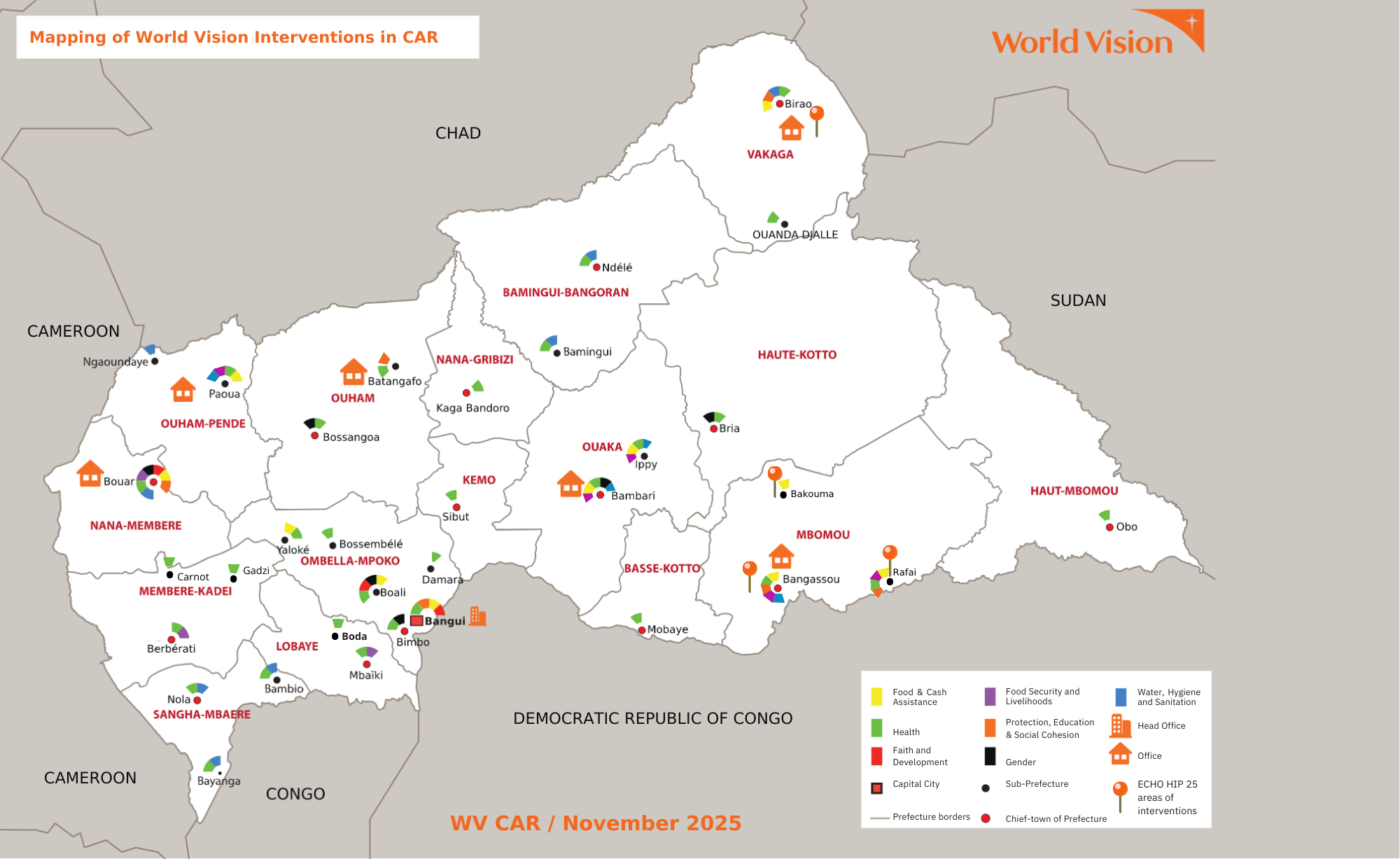
Under the 2021-2025 Country Strategy and the CAT III Sustained Humanitarian Response framework, World Vision CAR has reached a cumulative 4.2 million people through integrated programming in health and nutrition, food security and livelihoods (FSL), WASH, education in emergencies (EiE), child protection, and social cohesion. In 2024 alone, WV CAR reached an estimated 3.1 million people and contributed to improved outcomes for approximately 2.47 million children through policy reforms and systems changes. World Vision has maintained presence in some of the hardest-to-reach and least-served prefectures, where few or no other international actors remain.
Recent milestones include securing the first ECHO grant, finalising an MoU with the CAR Minister of Education, and launching a second Gavi Immunization project.
World Vision's Response Strategy (2026-2030) aims to impact 3.2 million of the most vulnerable children (aged 0-18), ensuring their increased well-being through interventions in the four technical/sectorial response programmes: Child Protection & Education in Emergency; Food Security & Resilience; Health & Nutrition; and WASH. The Response Office has integrated cross-cutting themes including Gender Equality, Disability and Social Inclusion (GEDSI); Faith & Development; Environmental Safeguarding & Climate Adaptation; and Local Partnering. The new strategy aligns with CAT III expectations, focusing on child protection, foundational learning, and child survival, within a Nexus and localisation lens.
How the World Vision Partnership can support
Considering the complex and fragile situation in CAR and the current humanitarian consequences, WV CAR office seeks Partnership support to:
- Pray for the safety and protection of our staff, our partners and the people we serve, particularly the children, and for CAR to experience peace and stability during the electoral period and beyond.
- Continue to raise the visibility of the CAR crisis in light of competing global emergencies and the country's worrying high level of fragility.
- Support mobilisation of additional flexible, institutional, and bilateral funding to meet increased needs, including the refugee/returnee crisis.
- Deploy surge capacities to strengthen the response in key areas such as Education, GESI, Climate Change, Cash/Nexus, and Localisation.
Key response mechanisms and information sites
Updates, situation reports, resources, stories, and other information are posted on WVRelief, StoryHub, and on the WV CAR landing page on wvi.org.
Contacts
WV CAR Response Country Director
Nicole Peter: nicole_peter@wvi.org | Mobile: +236 72 44 04 65
WV CAR Integrated Programmes Director
Stephen Ongom: stephen_ongom@wvi.org | Mobile: +236 75 58 05 90
WV CAR Communications, Advocacy & Campaign Lead
Alexandre Amadou Gassama: alexandre_amadou_gassama@wvi.org | Mobile: +236 72 53 71 77
Interim Regional HEA Director, WARO
Charles Bakhoum: charles_bakhoum@wvi.org
Communications & Public Engagement Director, WARO
Ange Gusenga-Tembo : ange_tembo@wvi.org, Mobile: +221 783 793496
A list of spokespersons can be found via the CAR response site on the World Vision Response Portal.