
From Limpopo Floods to Hope: World Vision and US Distribute Food Aid in Gaza province, Mozambique

“The waters took everything, the food, the crops. We were left without strength.” Sarafina, a woman embodying the pain and resilience of a disaster that deeply scarred Gaza Province in southern Mozambique.
Sarafina speaks slowly, as if still searching for words to describe what she endured. An elderly woman with many stories, she says she had never witnessed such destruction.
The Onset of Disaster
It began on Thursday, 15 January 2026, in Caniçado village. Rain had been falling for days, but that afternoon the water rose suddenly with unexpected force. It was not just rain: the Limpopo River was receiving massive volumes of water from upstream in South Africa and Zimbabwe. It reached about 22,000 m³/s (cubic metres per second) at Massingir Dam and in the lower valley, according to ARA Sul, roughly 70% higher than the 12,973 m³/s peak of the historic 2000 floods at Chókwè, one of the largest events on record.
“The water came with such force. Every second was a danger,” Sarafina recalls, her gaze distant, as if reliving the moment.
Desperate Escape
Panic gripped the village as everyone tried to flee at once. Some managed transport. Others ran to higher ground. But not everyone had that chance.
In the race for survival, only the quickest escaped. Sarafina was left behind. With no alternative, she and her grandchildren climbed onto the roof of their house. That became their only refuge. They took no food. No clothes. Nothing. Days were long and uncertain, marked by rain, cold, and the fear they might never come down alive.
“I’ve never lived through anything like it,” says Sarafina, gripping her granddaughter’s hand tightly, a simple gesture laden with gratitude for still being together.
Recovery and Hunger
For a full week, the roof was shelter, hope, and defiance. When the waters finally receded, the village slowly regained its rhythm. People returned home, tried to clean what remained, and rebuild what they could. But the water had also swept away the machambas. And with them, the food.
Without harvests or income, many families faced a new ordeal: hunger. Some children lacked strength to play. Others stopped going to school.
Relief Arrives
Amid this uncertainty, aid arrived. In the crowd awaiting food distribution, Olga could not hide her emotion as she received her food kit. Weakened by hunger, families found strength to carry bags that meant more than sustenance: they meant hope.
Each family received 50 kg of rice, 10 kg of beans, 5 litres of oil, and 1 kg of salt, a generous donation from the Government of the United States of America, arriving at a critical moment.
“This aid will ease our suffering,” says Olga with a smile blending relief and gratitude. “I had no hope of getting food so soon. The machambas are still empty, with only small crops we’ve just planted.”
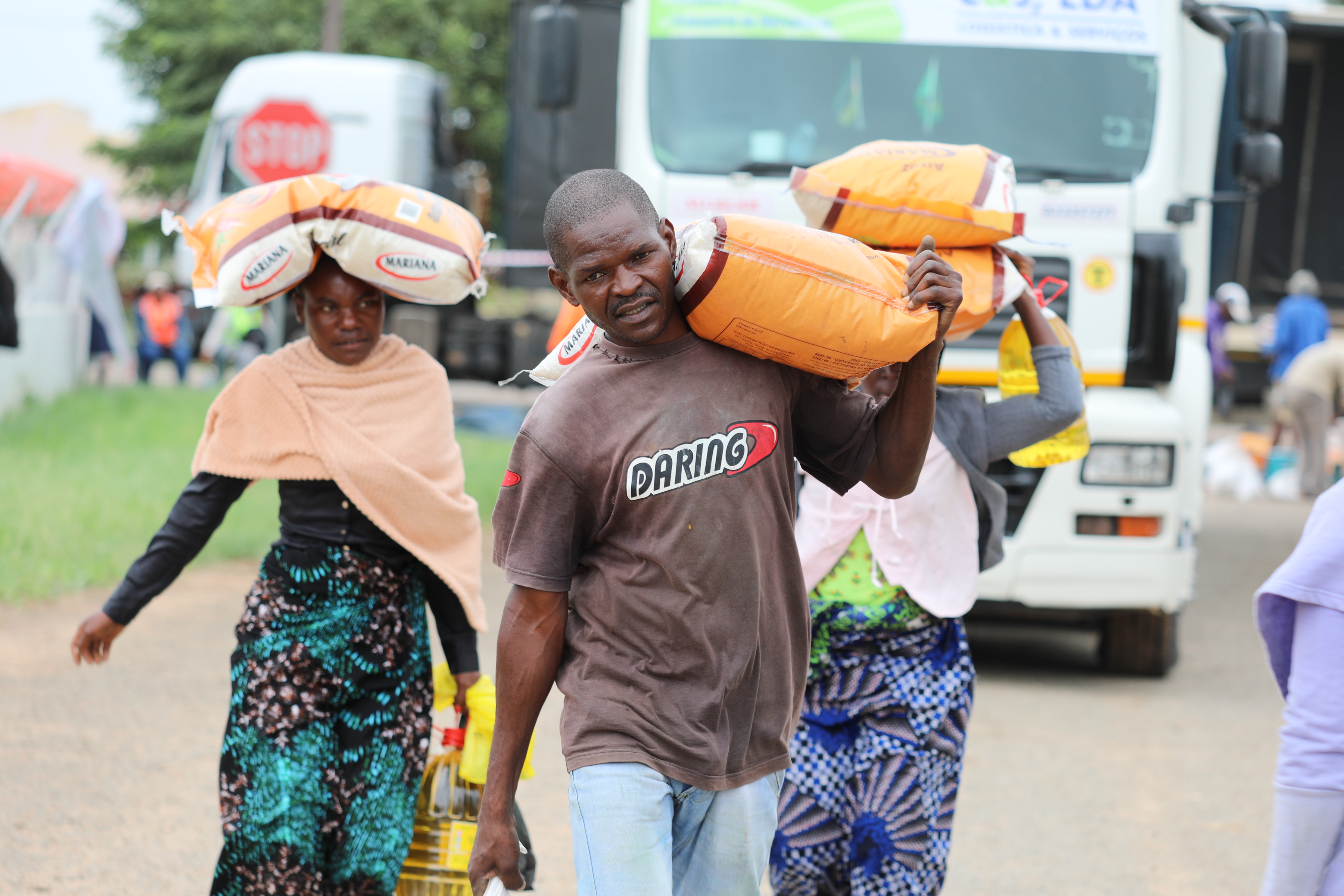
To date, over 2,400 people, equivalent to 480 families, have benefited from food assistance in Guijá District, Gaza Province. The initiative is part of World Vision Mozambique’s response to the floods’ impact on various communities. With US Government support, it aims to reach 15,000 people over the next six months through integrated actions in Food Security, Water, Sanitation and Hygiene (WASH), Shelter, and Protection.
For families like Sarafina’s, each bag of rice means more than food. It is a first step towards starting anew.