
She Found Her Voice. Her Community Found Its Future.

There was a time when Ratha believed her future had already been decided.
After graduating from Grade 12, she returned home with no job, no skills, and little hope. Her father had fallen ill again, pushing the family deeper into hardship. Every day felt the same, filled with uncertainty, fear, and the quiet belief that she had nothing to offer.
"I did nothing after finishing Grade 12," Ratha recalls. "I stayed at home. I was scared. I couldn't talk to anyone, not even the authorities. I hated myself because I couldn't help my family live a better life."
Today, the 24-year-old is a teacher, president of her local youth club, coordinator of children's weekend camps, and a respected community leader. But her transformation did not happen in isolation. It unfolded alongside the remarkable transformation of her entire community.
A community searching for hope
When World Vision began working in Chikreng Area Programme in 2007, the community faced overwhelming challenges. Less than one per cent of households had access to proper toilets. School dropout rates remained high. Families struggled with poor health knowledge and limited access to clean water. Reports of violence against children were common, yet there was little support available to protect them. For vulnerable families like Ratha's, these realities shaped everyday life.
"People faced many health problems and had very little knowledge about hygiene," explains Mr. Taem KimSeng, Commune Council Chairman. "Many didn't trust health services. Clean water was limited, sanitation was poor, and some people didn't even know how to use a toilet."
The challenges were not simply about infrastructure, they affected confidence, opportunity, and people's belief in what was possible.
Finding a voice
Everything changed when Ratha joined World Vision as a youth volunteer. At first, she doubted herself.
"I thought I would never be able to do it," she says. But encouragement from teachers, village leaders, and World Vision staff opened a door she never imagined walking through. Leadership training, life skills, and mediation courses gradually replaced fear with confidence.
"I slowly lost my fear and gained self-confidence. I was no longer afraid to teach young people, coordinate meetings, or speak with local authorities."
What began as personal growth soon became community leadership. Through the youth club, Ratha led initiatives addressing local challenges with support from community members and local authorities. She discovered a passion for teaching while working at a private school before eventually becoming a contract teacher in her own village. Today, she stands before classrooms with the confidence she once thought impossible.
"I am truly grateful for the support I received. It taught me patience, courage, and knowledge, and gave me the opportunity to build a good career."
Growing together
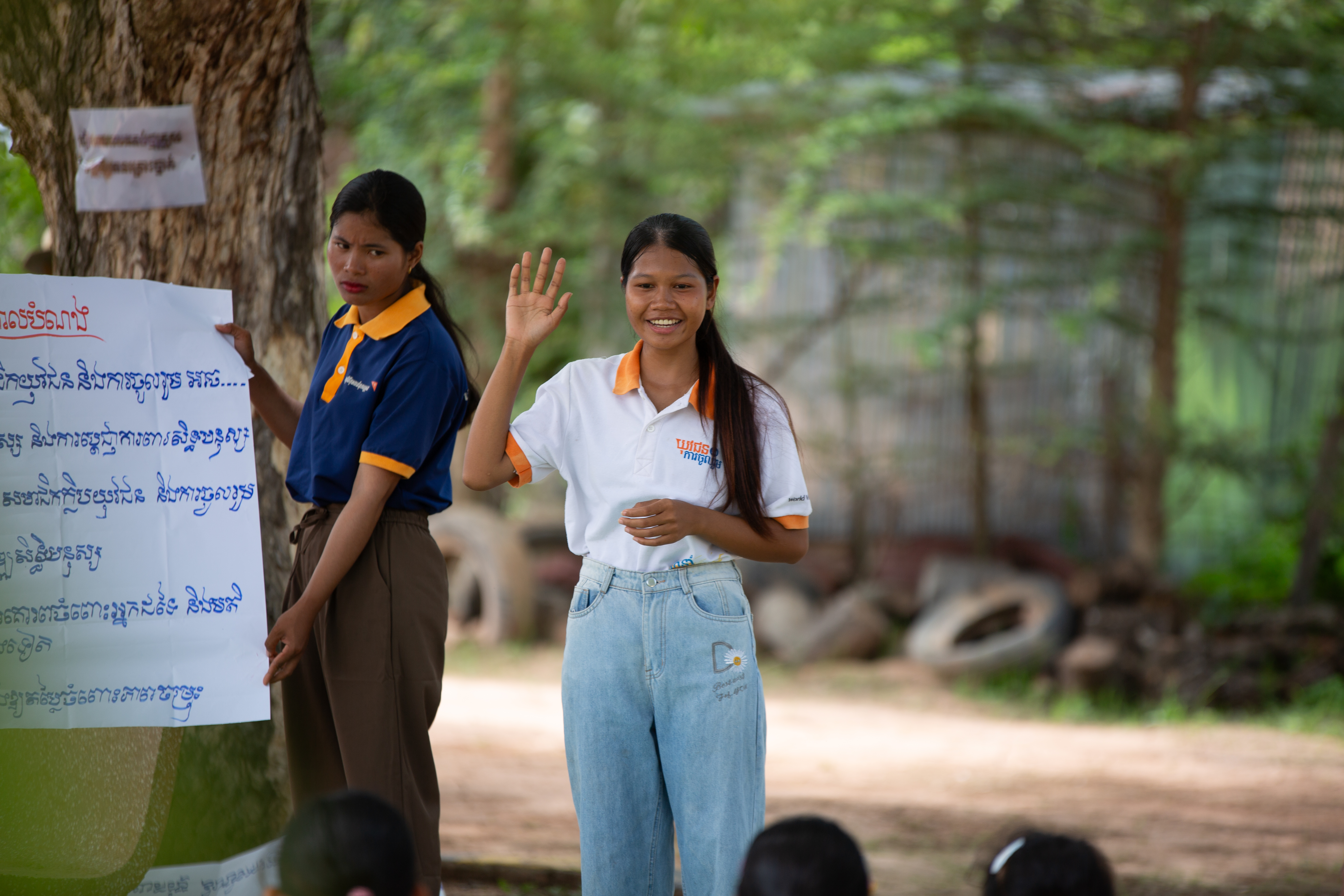
As Ratha grew, so did Chikreng. Across the area programme, years of collaboration between communities, local government, schools, and World Vision produced lasting change. School enrolment rose dramatically, while dropout rates fell to zero. Reading comprehension among Grade 3 students more than doubled, from 39 per cent in 2018 to 89 per cent in 2024.
"The dropout rate has decreased significantly," says Ros Bunthoeun, Director of Thnal Dach School. "World Vision strengthened teachers and encouraged students to stay in school. The difference between the past and today is remarkable."
Health outcomes improved just as dramatically. Early breastfeeding and skilled birth attendance both reached 100 per cent. Households with proper sanitation increased from less than one per cent in 2007 to 96 per cent by 2024.
"Before, people didn't even know how to use toilets," says Commune Council Chairman Taem KimSeng. "We received water pumps, health training, and support for teachers and children. We will continue working to sustain these achievements."
Health Centre Head Somang Phearin witnessed another important shift, the community's growing trust in healthcare. "People used not to bring their children for vaccinations. Now we visit villages every month to raise awareness, and access has completely changed. I am happy to see this transformation." The progress extended beyond education and health.
By 2024, every reported child protection case received follow-up support, compared to just 18 per cent in 2018. More adolescents felt their voices mattered in local decision-making, while young people's self-confidence increased from 20 per cent to 75 per cent. Deputy District Governor Ros Bunthorn believes partnership made the difference.
"Working together with teachers and local authorities strengthened local leadership and improved education throughout the district."
A legacy that continues
After nearly two decades, Chikreng Area Programme is reaching its conclusion. The community it leaves behind looks very different from the one where it began. Ninety-four per cent of schools now meet healthy learning standards. Ninety-five per cent of households treat their drinking water. Nearly every village has disaster risk reduction measures in place. But perhaps the most meaningful change cannot be measured by statistics alone.
It is reflected in people like Ratha. Once a young woman too afraid to speak, she is now helping shape the next generation of leaders in her community.
"I used to think I had no future," she says. "Today, I have courage, knowledge, and the opportunity to serve."
Her dream is no longer about changing her own life. It is about ensuring every child and young person in Chikreng has the confidence and opportunity to lead.
"I want to keep helping children and youth in my community. I want to help them grow into leaders so our community continues moving forward."
Ratha's story is not simply one of personal success. It is the story of what becomes possible when communities invest in their own people, when hope is nurtured, leadership is developed, and change belongs to everyone. Because lasting transformation is never just about better statistics. It is about people who discover their voice and then use it to help others find theirs.