

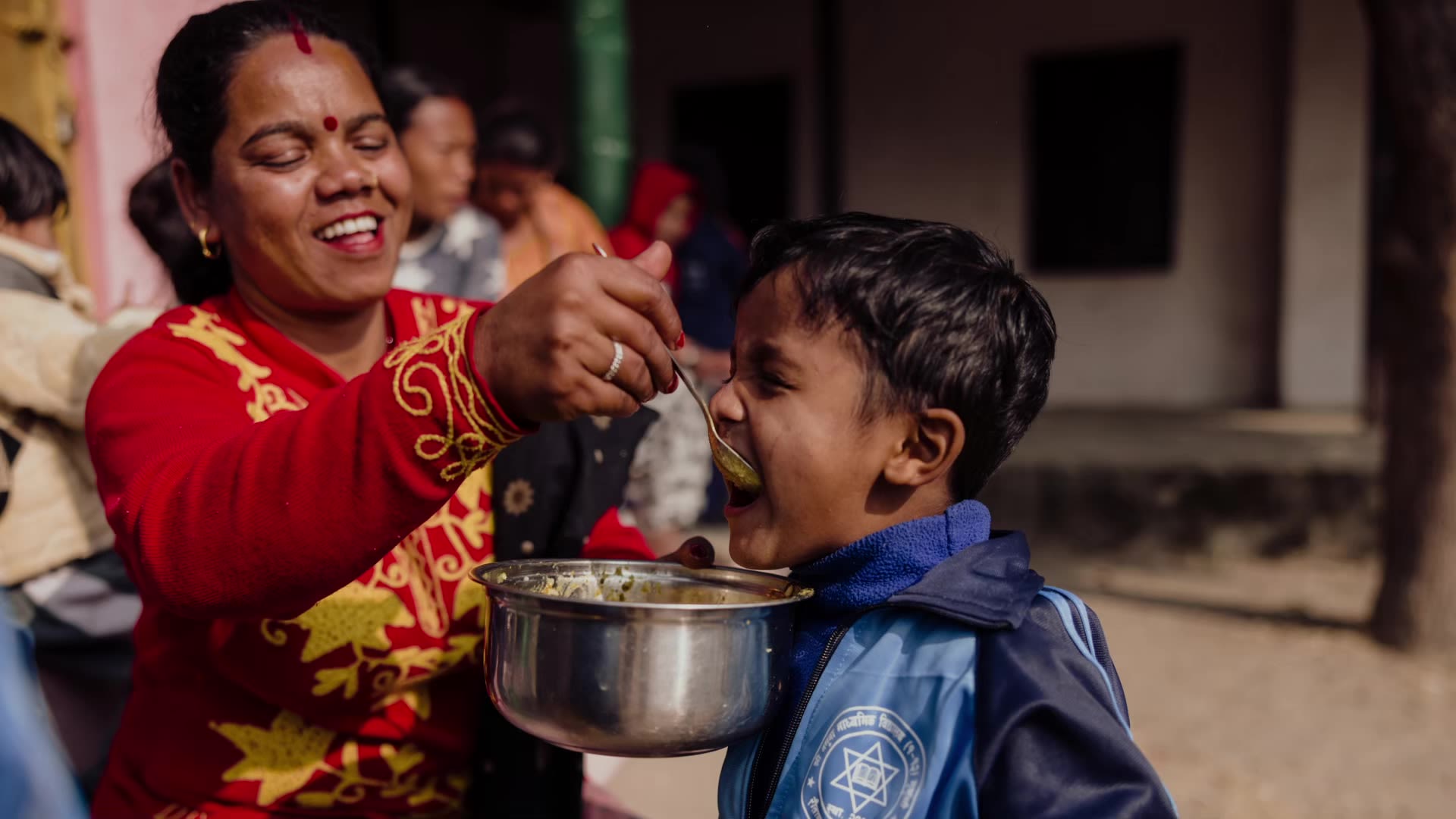
Launched at the United Nations General Assembly in 2023, the ENOUGH Campaign is World Vision’s global effort to end child hunger and malnutrition.
Now active across 81 countries, it brings together children communities, governments, and partners around a shared vision:
A WORLD WHERE EVERY CHILD HAS ENOUGH NOURISHING FOOD TO THRIVE.
The campaign works across health, nutrition, food security, climate resilience, and livelihoods addressing both the immediate needs of children and the underlying systems that drive hunger.
ENOUGH: Reaching Children Across 81 Countries
Africa:
THRIVE 2030: World Vision’s flagship livelihoods initiative supports families to lift themselves out of extreme poverty through savings, enterprise, and market access delivered in partnership with VisionFund, whose microfinance network has already reached 3.2 million children by providing financial services to vulnerable households.
Mongolia
Child-led research: Photovoice research conducted with the Ministry of Health assessed the effectiveness of Multiple Micronutrient Supplementation among adolescent girls, generating evidence to inform national policy on preventing adolescent anaemia.
Romania
The government adopted and expanded World Vision's Bread and Tomorrow school meals model into the National Healthy Meal Programme, with 85% of children in participating schools improving their maths results.
Korea:
Over 74,000 students across 184 schools were mobilised around school meals as a global justice issue, with World Vision's recommendations reflected in Korea's commitments to the School Meals Coalition.
Latin America
- Mini-COPs: More than 260 children and young people across Brazil, Colombia, and Peru developed manifestos calling for clean rivers, living forests, school gardens, safe water, and a place in decisions about their futures, ahead of COP30.
- Your Loaves and Fishes: The campaign mobilised 268 churches and more than 170,000 people across the region in 2025, with plans to scale globally in 2026 in partnership with the Prayer & Action Against Hunger Coalition.
Driving Progress Toward Ending Child Hunger Report
The ENOUGH 2025: Driving Progress to End Child Hunger and Malnutrition Report highlights what is possible when commitment, evidence, and collective action come together. Across countries and communities, the ENOUGH campaign is turning ambition into tangible results for children and driving meaningful progress toward ending child hunger and malnutrition.
In 2025 alone:
World Vision joins the Global Alliance Against Hunger and Poverty
Rio de Janeiro, Brazil.
World Vision became a founding member of the Global Alliance ahead of its launch at the G20 Leaders’ Summit, helping connect global hunger commitments with field evidence and child-focused accountability.
Nutrition for Growth Summit
Paris, France .
World Vision called for stronger health systems, sustainable financing, food regulation, and accountability so children can access essential nutrition and care.
World Health Assembly
Geneva, Switzerland.
Resolution passed to extend the Global Nutrition Targets from 2025 to 2030, supported by WV Advocacy.
School Meals Coalition Global Summit
Fortaleza, Brazil.
World Vision brought children’s evidence and voices into global school meals discussions with governments, ministers, and partner organisations.
COP30
Belém, Brazil.
World Vision brought child hunger evidence and child and youth voices into climate discussions, calling for food systems and climate policy to put children at the centre. Forty-three countries and the European Union adopted the Belém Declaration, placing hunger, poverty, and people-centred climate action at the heart of climate policy.
HOW CHANGE HAPPENS
Change often starts far from the child, in policies, decisions, and budgets. But in 2025, those decisions began to reach further.
Across the ENOUGH Campaign, over 400 policy changes helped expand school meals, strengthen nutrition services, and unlock support for hundreds of millions of children. In places like Romania, a small local programme grew into national policy. More children now have food on their plates and a better chance to learn and grow.
Working Together to Deliver Change
Ending hunger takes more than individual efforts, it takes global cooperation. The Global Alliance Against Hunger and Poverty brings together governments and partners to turn commitments into action. As a founding member, World Vision helps keep children at the centre, ensuring global ambition translates into real results for families.
Holding the Line for Children’s Nutrition
In 2025, millions of children were reached with nutrition support, screened early, treated effectively, and supported to recover through a network of community health workers.
At the same time, global advocacy helped secure renewed commitments, including the extension of nutrition targets to 2030 at the World Health Assembly.
At the Nutrition for Growth Summit in Paris, World Vision influenced nutrition commitments in at least 44 countries - backed by the voices of more than 12,000 people across 54 countries who took part in Nutrition Dialogues ahead of the summit.
Together, these efforts are making a real difference:
- More children are being identified in time.
- More children are recovering.
- And more children are getting a second chance to grow and thrive.
“We wanted the world to hear directly from us because who knows better what a school meal means than the children who eat them every day.”
15-year-old girl in Brazil
A Meal at School Can Change Everything
For more than one million children, a school meal became part of everyday life. Across countries, programmes are feeding children while supporting families and local farmers.
World Vision helped expand programmes and influence policy - while also ensuring children’s voices shaped decisions. What starts as a simple meal becomes something bigger: better learning, stronger health, and new opportunities for the future.
The child-led research report School Meals in Our Words: Choosing Our Future, brought the voices of 1,200 children from 13 countries into the Global School Meals Coalition Summit in Brazil, where more than 80 member states gathered, leading to 40 new government commitments on school meals.
Sudan is now facing a storm of hunger, violence, and trauma. Children are facing acute malnutrition, families are being torn apart… yet the world remains largely silent. Children want the violence to stop; they want to live in peace; and they want to go home and for things to return to normal.
Simon Mane, National Director
World Vision Sudan
Children Caught Between Conflict and Hunger
Some of the most important progress is happening where it is hardest to achieve.
In 2025, much of the support reached children living in fragile and conflict-affected areas places where families have been displaced, markets have broken down, and delivering help is never simple. In fact, 85% of World Vision’s food assistance was delivered in these contexts, underscoring a difficult reality: child hunger is increasingly concentrated in the places hardest to reach, hardest to fund, and hardest to leave.
“In the past, our ancestors knew the seasons of planting and harvesting, but today we do not eat healthy food because we plant, but the climate makes us not harvest at the right time.”
16-year-old girl, in Vanuatu
When Climate Change Means Hunger
As the connection between climate and hunger became impossible to ignore, World Vision brought new evidence to global leaders at COP30 through the Hungry Futures Index, showing how climate change was already shaping children’s access to food.
Children’s voices were also brought into the conversation through initiatives like Mini-COPs, where they shared their realities and called for change. At the same time, action was happening on the ground. Millions of people were supported to adapt, as communities adopted climate-resilient practices to protect their food supply.
Helping Families Put Food on the Table
Ending hunger began with strengthening families. Across communities, livelihoods programmes helped parents build more stable incomes and better provide for their children.
In 2025, World Vision supported over 1.7 million children and more than 700,000 families through economic development programmes. Through Vision Fund, millions more gained access to loans, savings, and financial support, helping families invest in their future.
“Our faith traditions may differ, but we agree that allowing children to suffer from hunger is morally unacceptable.”
Participant, Global Interfaith Nutrition Dialogue
Faith in Action: Communities Leading the Way
In many places, faith communities are at the heart of the response to hunger.
Faith leaders and communities stepped forward supporting families, raising awareness, and calling for change. Global initiatives, including a joint statement on the right to food and nutrition, helped bring greater attention to child hunger and mobilise collective action.
Across countries, Faith-Based Nutrition Dialogues brought people together, strengthening support for vulnerable households and shaping how communities respond to hunger. At the same time, the Prayer & Action Against Hunger Coalition helped turn that momentum into coordinated, sustained action.
“I stopped telling my mother when I was hungry. It made her too sad.”
12-year-old girl in Lebanon.
Progress is real, but millions of children are still being left behind.
Near 1 billion people live in poverty without access to basic needs and more than half of them are children. Today, +150 million children are affected by malnutrition limiting their growth, health, and future potential. And as crises deepen, over 200 million children are expected to need humanitarian assistance in 2026 driven by conflict and rising food insecurity. Climate change is making this crisis worse: hunger could rise by 20% by 2050 as extreme weather continues to disrupt food systems and livelihoods.
“The path ahead is clear: turning commitment into action, and action into lasting change for children. Because ending child hunger is not a question of possibility but priority.”
Elena Gaia, Senior Director, Global Campaigns, Coalitions, and Partnerships. World Vision International.
What It Takes to End Child Hunger
The ENOUGH Campaign has shown that lasting change requires:
- Commitments that translate into real delivery for children
- Strong, locally driven solutions
- Integrated approaches across health, food, climate, and livelihoods
- Partnerships that scale impact globally
We have listened to children. We have worked with families. We have partnered with governments, churches, community leaders, schools, donors, civil society, and multilateral institutions. And together, we have helped move the world closer to a future where every child has the nourishing food they need to thrive.
Andrew Morley, President and CEO. World Vision International.
Our commitment is stronger than ever.
As we look ahead, we remain focused on a bold goal:
to reach 500 million children by 2028, through health, nutrition, climate action, food security, livelihoods, and policy change.
We know that ending child hunger will not happen overnight. It will take sustained effort, stronger systems, accountable leadership, and resilient communities. But with continued commitment and collective actions we can address the root causes of hunger and move closer to a world where every child has enough to eat, and enough to thrive.
 Built with Shorthand