

Local solutions, faster impact: what Ukraine is teaching humanitarian response
Daria Musiienko and Viktor Stepaniuk reflect on how trusted local partnerships can extend reach, improve agility, and deliver support shaped by communities themselves.
June 22, 2026.
Since 2022, the humanitarian response in Ukraine has operated at exceptional scale, with over 10.8 million people, according to UN OCHA’s Humanitarian Action platform, identified as in need of urgent assistance and protection services in 2026. The system has expanded rapidly, bringing together a wide range of international organisations alongside a growing and increasingly capable national civil society to provide necessary assistance to children and other affected people.
Local actors are indispensable to delivery. Yet globally less than 4% of funding reaches them directly, and less than 10% indirectly; in 2024 these figures were 1% direct and 35% indirect to local actors. This disconnect continues to define the limits of localisation.
From participation to influence
A consistent lesson emerging from this response is that participation often stops short of influence. Local organisations are engaged, but not always in ways that shape priorities or programme design. Their insights inform implementation, rather than determine direction.
Shifting this dynamic requires more than consultation. It calls for early, structured involvement of local actors as co-creators. When this happens, programmes are more grounded, more adaptive and ultimately more effective. When it does not, localisation risks becoming procedural, fulfilling expectations without altering outcomes.
“With this project we created something really based on needs, which would have been much harder if you imposed the design on us. Finally, we do a project that we developed for a target group and not the other way round, not looking for a target group for already designed project.” Way Home, Odesa

Delivery is not enough
Over the last three years, about 85% of World Vision’s programmes have been implemented with involving local partners. This has enabled timely and contextually relevant support across diverse regions. However, an internal assessment conducted between 2023 and 2024, based on structured partner engagement, highlighted both the strengths and limitations of this approach. Partnerships contributed to improved technical capacity, stronger internal systems, and increased organisational confidence. At the same time, they revealed where adjustments were necessary to move beyond transactional relationships.
Three priorities emerged. First, earlier and more meaningful partner involvement in programme design. Second, capacity strengthening that is tailored, demand-driven and extends beyond project cycles. Third, funding that reflects the full cost of partnership, including overheads and investment in organisational development.
“Thanks to World Vision’s project we organised for the first time a comprehensive strategic planning workshop, three sessions, three days each. We have 80% new staff and it’s so important for them to understand the organisation, its values and mission, so these sessions were very important for them.” Way Home, Odesa.
These are not incremental improvements. They define whether localisation is sustained or superficial.
Changing how we work
Progress has required internal adaptation. Adjusting partnership models to enable greater autonomy for local actors has introduced complexity, particularly within a system shaped by compliance requirements and risk management.
Yet the outcomes are clear. External evaluations of programmes built on trust-based partnerships and demand-led support show strong performance, high beneficiary satisfaction, and results that often exceed expectations. We see that when local organisations are positioned as equal actors, the quality of response improves.
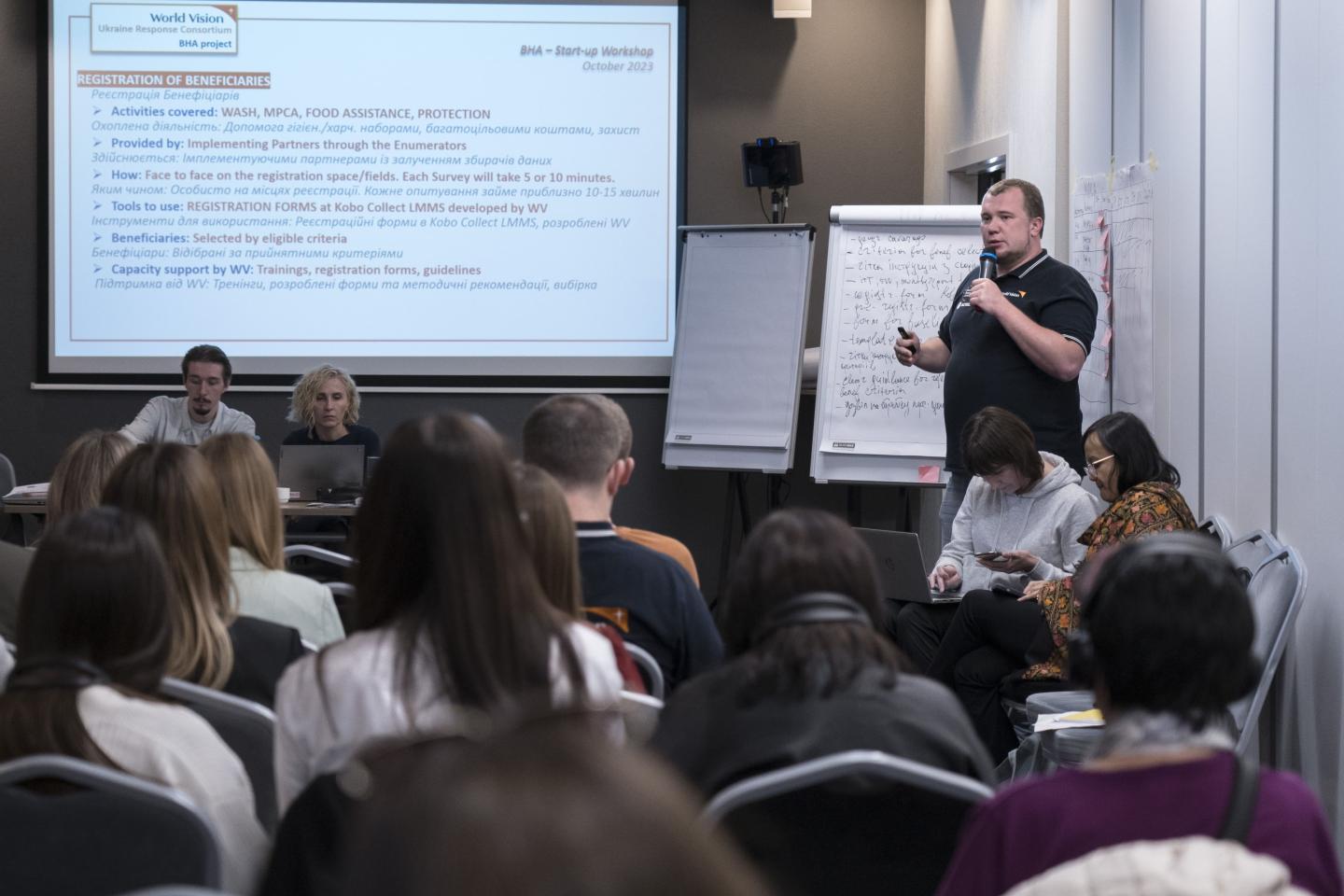
Beyond funding
While access to funding remains a central constraint, experience points to a broader reality. Financial flows alone do not define localisation. The quality of engagement matters as much as the quantity of resources.
Sustained collaboration, including technical guidance, coaching and shared problem-solving, has strengthened organisational capacity in ways that outlast individual projects. These investments, though less visible, are critical to long-term effectiveness.
At the same time, funding conditions set the boundaries. Flexible, softly earmarked funding has enabled adaptation and institutional growth. By contrast, rigid structures and increasing pressure on cost-efficiency risk narrowing the space for long-term capacity building. In this context, donor choices are decisive. They shape not only what is delivered, but how and by whom.
Complementarity is key
By leaning into local partnerships, international actors are redefining their role. And we see this in effect when the most effective contributions are those that complement local leadership, such as interpreting compliance requirements, brokering technical knowledge, providing tailored support, and convening diverse actors.
This approach recognises that value lies in combination, not substitution. Local organisations lead where they hold contextual expertise and access. International actors support where they add specific capabilities and technical unlocks. The balance shifts over time, but the principle remains constant.
A narrowing margin for choice
The broader environment is becoming more constrained. Humanitarian funding is under sustained pressure, while needs remain high. Expectations of efficiency and impact are intensifying. Localisation offers a more grounded and potentially more sustainable model of response. But it requires trade-offs. Investing in institutional capacity may not produce immediate visibility. Sharing decision-making authority may challenge established systems of control.
These are not technical constraints. They reflect choices about how the system defines value and distributes responsibility.
What must happen next
Three priorities should guide the next phase.
- Local actors must be engaged as co-creators from the earliest stages of programme design.
- Funding must support institutions as well as activities, including adequate overheads and sustained investment in organisational capacity.
- Success must be measured not only by outputs delivered, but by the strength, independence and resilience of local organisations.
The remaining question is whether the system is willing to align its structures, incentives. and behaviours to support deeper and broader local leadership, recognising local actors, so that as a whole impact is deepened, sustained and we can reach more children.
Until April 2026, Daria Musiienko was Senior Humanitarian Advisor at World Vision Australia, and is now Director, Humanitarian NGO Platform in Ukraine and Viktor Stepaniuk is Partnerships Manager for World Vision’s Ukraine Crisis Response.
Subscribe to see more content like this
Related Resources

Why Ending Hunger Requires Investing in Children’s Hope

Prioritising Water to Unlock Human Capital
