

Are We Balancing Budgets at Children’s Expense?
Tamara Tutnjevic reflects on why the Financing for Development agenda must confront a critical blind spot: the impact of debt on children.
April 22, 2026.
As global leaders gather this week for the Financing for Development Forum, debt, fiscal space and financing reform are once again high on the agenda. And while this was not the main headline call of the week, one message was clearly heard in the opening exchanges and wider discussions: official development assistance matters, domestic public financing matters, and funding for essential social protection services must be protected.
We enter this Forum at a moment of acute fiscal compression. Global Official Development Assistance fell to USD $74.3 billion in 2025 a 23.1% drop, the largest annual contraction on record. Bilateral aid declined sharply, alongside humanitarian funding. These are not marginal adjustments. They signal a systemic contraction in the very resources that sustain basic services for children.
At the same time, many governments are increasing allocations to debt servicing, often under significant external pressure. The trade-offs are immediate and visible.
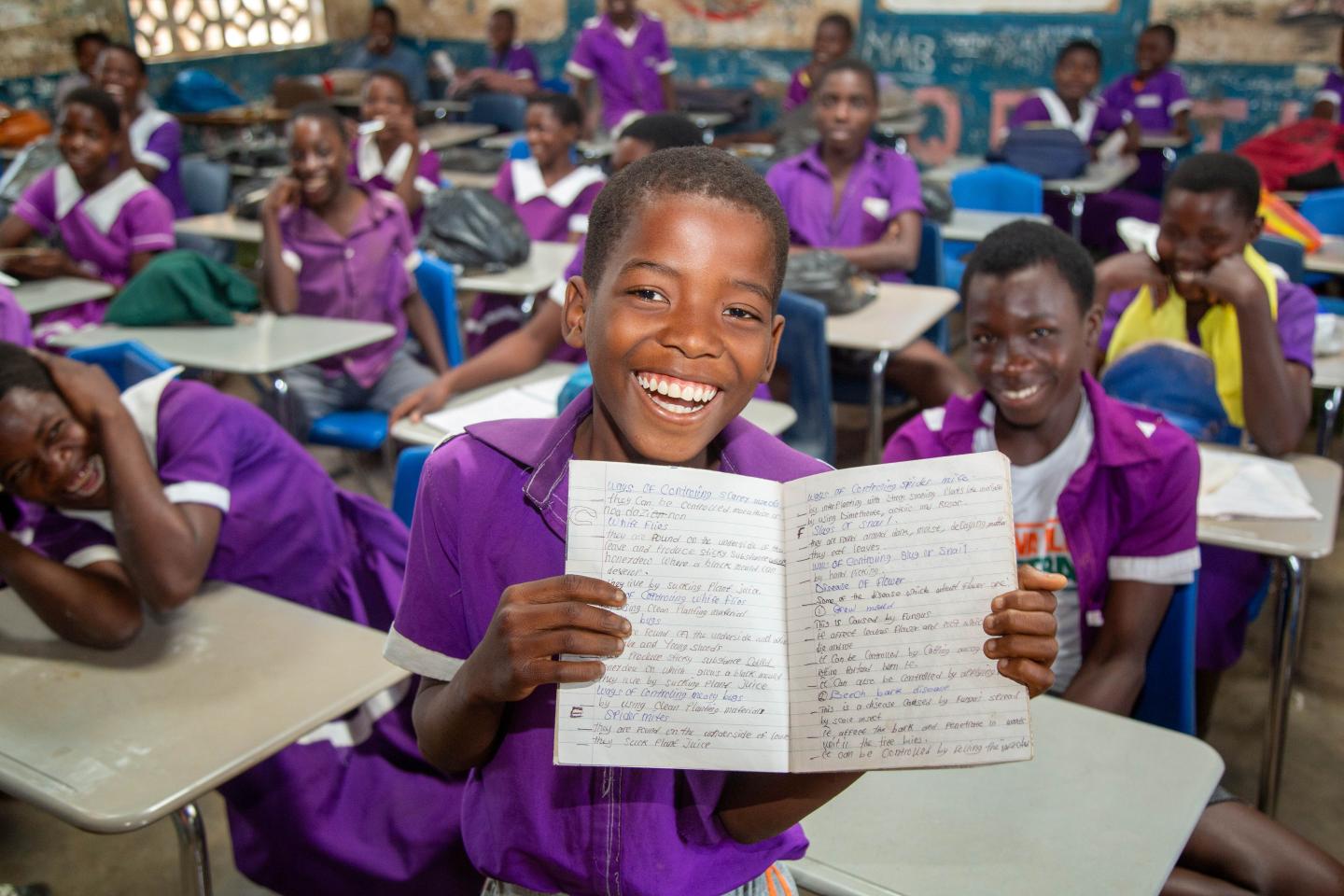
Recently, my 16-year-old daughter returned from a volunteering trip in an African country. She came back with many impressions, but one of the three that stayed with her most was this: in the local school where she volunteered, there were just 17 teachers for 1,000 children.
Because in one stark detail, it captured what fiscal squeeze looks like in a child’s daily life. It means overcrowded classrooms, exhausted teachers and children receiving far less attention, support and quality education than they need. And there was another detail she shared that was just as troubling: teachers used corporal punishment to discipline children. That is never acceptable. But in a school stretched so far beyond any reasonable staffing level, it is also a sign of a system under extraordinary strain.
This is what shrinking fiscal space due to debt servicing, inadequate revenue creation and ODA decrease looks like on the ground. Not only fewer resources, but poorer quality education, weaker protection and diminished chances for children to break cycles of poverty. When public financing systems fail children, the consequences are never confined to one sector. Education suffers. Protection suffers. Health suffers. Hope suffers too.
If fiscal stability is achieved by shifting the burden onto children, then it is not stability at all. It is a false economy. Worse, it creates an intergenerational burden: today’s financing choices are passed on to children who had no say in them, through lost learning, reduced protection, poorer health and fewer opportunities to thrive.
"As I look across the spectrum of global challenges, one truth becomes unmistakably clear: our systems of global problem-solving face a reckoning".
Antonio Guterres, UN Secretary- General.
Children are underfunded by design, not accident
Despite representing 46% of the population in aid-recipient countries, children receive just 5% of aid in programmes directly targeting their needs, with a further 7% indirectly benefiting them, according to World Vision’s Putting Children First for Sustainable Development.
When fiscal space tightens, this imbalance deepens. Children are not a protected budget line. They are, instead, an adjustment variable. This is where the Financing for Development agenda must evolve. Debt is too often framed as a technical challenge centred on repayment capacity, market confidence and risk management. These metrics matter. But they are incomplete. They tell us whether a country can meet its obligations, not whether it is investing in its future.
Children offer a more honest measure. Their wellbeing reflects whether systems are delivering for people, not just for creditors. When children are excluded from education, lack access to healthcare or face increased exposure to violence, the consequences are not only immediate. They are intergenerational, shaping productivity, stability and social cohesion for decades to come.
A false economy at the heart of fiscal policy
From a financing perspective, the logic is clear. Every USD 1 invested in child-focused development generates up to USD 10 in social and economic returns. These gains extend beyond individual outcomes strengthening communities and long-term economic resilience. Cutting such investments to service debt may improve short-term fiscal indicators, but it weakens future stability. This is not discipline. It is deferral transferring costs into the future, often at a higher price.
Encouragingly, discussions within the International Monetary Fund and the World Bank increasingly reference the need to protect social spending. Yet without explicit, enforceable commitments, children remain at risk of being overlooked in practice.
What this Forum must deliver
This Forum presents a critical opportunity to recalibrate not through new rhetoric, but through more precise commitments.
- First, debt sustainability frameworks must incorporate child-sensitive indicators, moving beyond aggregate social spending to assess real outcomes for children..
- Second, debt restructuring agreements should include explicit safeguards for investments in health, education and child protection. These are not peripheral sectors. They are foundational to economic resilience.
- Third, donors and international financial institutions must prioritise predictable, long-term financing that reaches children directly, even in constrained fiscal environments.
The question for policymakers is not whether children matter in development. It is whether we are willing to treat their wellbeing as a core measure of economic success. That is why ODA, domestic public finance and debt servicing policies cannot be treated as separate conversations when it comes to children. Together, they determine whether governments can sustain the systems children rely on and whether the next generation can thrive or is forced to carry the burden of today’s failures.
Tamara Tutnjevic is Senior Director of Public Policy and Influence at World Vision, where she leads the organisation’s global advocacy to shape policies that protect and empower vulnerable children and families. With over two decades of experience in international development and human rights, she is recognised for her leadership in advancing women’s and children’s rights, with a particular focus on preventing violence in childhood. Tamara combines evidence-driven insight with practical, solutions-oriented approaches, championing systemic change that safeguards the most vulnerable.
Subscribe to see more content like this
Related Resources

Justice begins when no child goes hungry

At a Critical Moment for Children, Are We Retreating on Education?
