
Ayman's Story: Finding Confidence and Hope Through Sports, Art and Support

In the Jordan Valley, children grow up in one of the West Bank's most economically marginalised and resource-scarce communities. Restricted movement, limited infrastructure and chronic underfunding of public services mean that many children face significant barriers to education, social participation and wellbeing. For children with disabilities or additional learning needs, these challenges are compounded, the gap between what they need and what is available can be wide, and the risk of falling behind, withdrawing socially or losing confidence is real. In this context, safe, inclusive and psychosocially supportive spaces at school are not a luxury. They can be transformative.
For 12-year-old Ayman, from An Nuwei'ma, school was not always an easy place to fully participate. Ayman has mild cerebral palsy, which affects the movement of his hands and causes some learning difficulties. At times, this made him feel different from other children, especially when he faced difficulty taking part in certain activities or completing tasks as easily as his classmates. "I used to feel shy and afraid to join others, and I found it hard to talk to my classmates," he says.
Before joining World Vision-supported activities at his school, Ayman was hesitant to interact with other children and found it difficult to express himself within the group. Although he wanted to be part of what was happening around him, his lack of confidence often held him back.
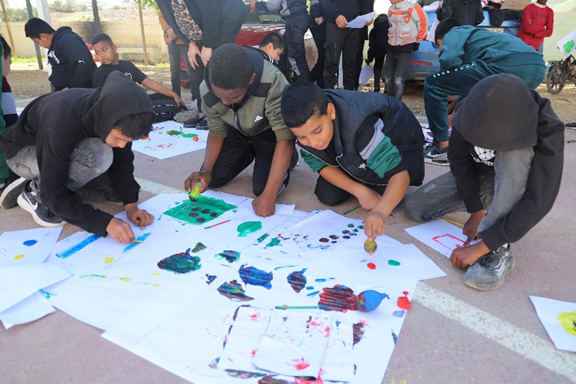
This began to change when Ayman joined structured activities at his school, alongside 50 other children. Through psychosocial support, sports, art and creative activities, he found a safe space to participate, express himself and build confidence.
Through structured sports, Ayman was given equal opportunities to join his peers, experience teamwork and feel a sense of belonging. Participation mattered more than perfection, and that shift made a difference. Art became equally important. Through drawing and creative tasks, he found a way to express feelings he sometimes struggled to put into words, sharing his thoughts, emotions and dreams in a way that felt safe and encouraging.
Slowly, Ayman began to change. He became more willing to join group activities without hesitation and started expressing himself more freely through both speech and creative work. "I started to feel more confident in myself, and it became easier for me to talk and participate with my classmates after these activities," he says.
Those around him noticed. "I observed a clear improvement in Ayman's confidence and level of participation after he joined the activities," says Waleef Al Ghrouf, the school principal. "He became more engaged with his classmates, his communication skills improved, and he showed a greater willingness to express himself and take part in school activities."
Inside and outside the classroom, Ayman began to communicate with greater confidence and take part in activities with less hesitation. The distribution of gifts and stationery, which had both emotional and practical value, added to his sense of being valued and motivated.
Today, Ayman feels stronger and more optimistic. His story shows how inclusive psychosocial support, combined with sports and creative activities, can help children facing additional challenges build confidence, strengthen social connections and feel supported within their school environment. He now believes that disability does not prevent a person from succeeding or achieving their dreams when the right support and encouragement are in place, a reminder that when children are given safe spaces, patient guidance and equal opportunities to participate, they can discover their own strengths and become a source of inspiration for others.
*World Vision's support to the school has also included the provision of a dedicated resource room, rehabilitation of the internal electricity network, installation of air conditioning and bathroom improvements, funded through World Vision US and a contribution from Liza Monory.