
A day in a village with unfathomable destruction

"We will reach Bhimtaar in five minutes," Amul said. As he said this, I started to visualise the disaster images that I was probably going to see that day in one of the most affected areas of Sindhupalchowk.
Amul, the Shelter Project Officer at World Vision's district office for response was my companion for today, who was taking me to Bhimtaar that day which was also a proposed site for World Vision's shelter pilot project. "Here we are," Amul announced and his firm words brought me back to reality.
"As I started to look around, all I could see was the shattered territory in front of me."
As I stepped out of the car, I saw the cloud of dust produced by our vehicle still hovering on the way we passed. It was exhibiting the obvious sign of a huge disaster. And as I started to look around, all I could see was the shattered territory in front of me.
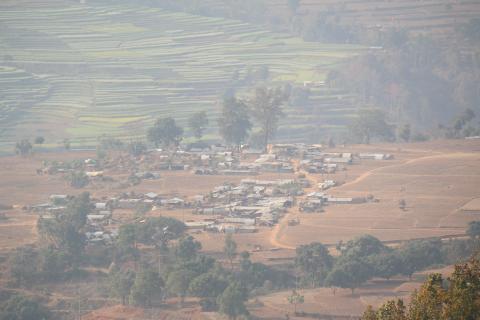
The grim picture of disaster was still very fresh in this 'Majhi' community. The devastating earthquake of 25th April and its subsequent aftershocks had swept away almost every houses mercilessly, leaving nothing behind for these indigenous communities, who traditionally are the fisherman. And all that existed now was the remains of collapsed houses, small makeshift shelters and the alarming need to rebuild houses and lives.
This locality of Bhimtaar was situated in a 'valley-like' location by the side of a river. I could vividly imagine the picture of a beautiful village that it used to be, before it was left in ruins.
"We knew that our daughter was buried under the debris. I was hopeless to see her alive again."
Ganga's family is one among the 152 households in Bhimtaar, who lost their house like majority of her neighbours. She used to have a spacious house enough for her large family of nine, before it was brought down completely by the ill-fated incident. Now, they all accommodate together in a single room, which is all they have beneath their temporary roof.
When I asked Ganga about the difficulties that was faced by her families while living in such condition, she had many reasons to mention. The 45-year-old said, "It's difficult to share room together, especially when you have grown-up children. But, we should accept any situation when there is no second choice."
But, that's not it.
The threat from snakes and other harmful insects is even more threatening for her. "They can enter easily inside from the gaps between the woods and CGI sheets that make our house", she explained. "I'm worried about the safety of my children", the mother said.
Living in a temporary shelter, indeed can be very exasperating, especially for small children. Ganga, like a usual mother, is more concerned to protect her toddlers from upcoming summer, which can be unbearably hot in their Corrugated Galvanised Iron (CGI) shelter. Expressing the challenges of living in such harsh condition, the anxious mother further added, "We just survived the freezing winter and combatting heat and rain is the next."
Ganga, who almost lost her 7-year-old daughter Anjali, also narrated the ordeal when she was trapped for hours in her own house.
She said, "We knew that our daughter was buried under the debris. I was hopeless to see her alive again." After attempting for five hours, Anjali was finally rescued; half conscious. "Her face was blue and swollen and her legs were injured," Ganga recalled.
Before finishing my chat with Ganga, I still wanted to know more about how her family have planned to make a new house. When I expressed her my query, she immediately responded by saying that they were 'clueless'. However, she was clear that they didn't want to make weak house like before that could turn into a grave for her family later. "We prefer living in this temporary shelter rather than making a weak house", she said.
But, it's not just Ganga who is perplexed about the better ways of constructing a safer house in the cost affordable for them. The entire community whose house was made with mortar and stone by untrained masons have the same concern.
Most of the stone masonry houses with mortar and mud have been damaged in the earthquake hit villages of Nepal.
With view that training the local masons with appropriate house building techniques can prevent such calamities in the future, World Vision is looking forward for the possibilities of starting a masons' training center at Bhimtaar. In addition to the training, construction of sample houses and other activities related to livelihood will complement the shelter pilot project here.
By: Ankush Chalise, Emergency Communications Coordinator, World Vision International Nepal