
After the Flood in Guijá, Mozambique: Constância’s Story of Rebuilding

Countless stories of loss emerged after the floods that swept through the southern and central regions of Mozambique last January. Each one carries its own weight of grief. Homes reduced to rubble, fields submerged, dreams abruptly halted. At first glance, it seems as though everyone lost everything, almost in equal measure.
But the truth is, not everyone starts from the same place.
When extreme weather events strike communities already living on the margins, certain groups bear the impact more severely: children, older people and people with disabilities. In such contexts, vulnerability has a face and a name.
In Guijá, in Gaza Province, that name is Constância.
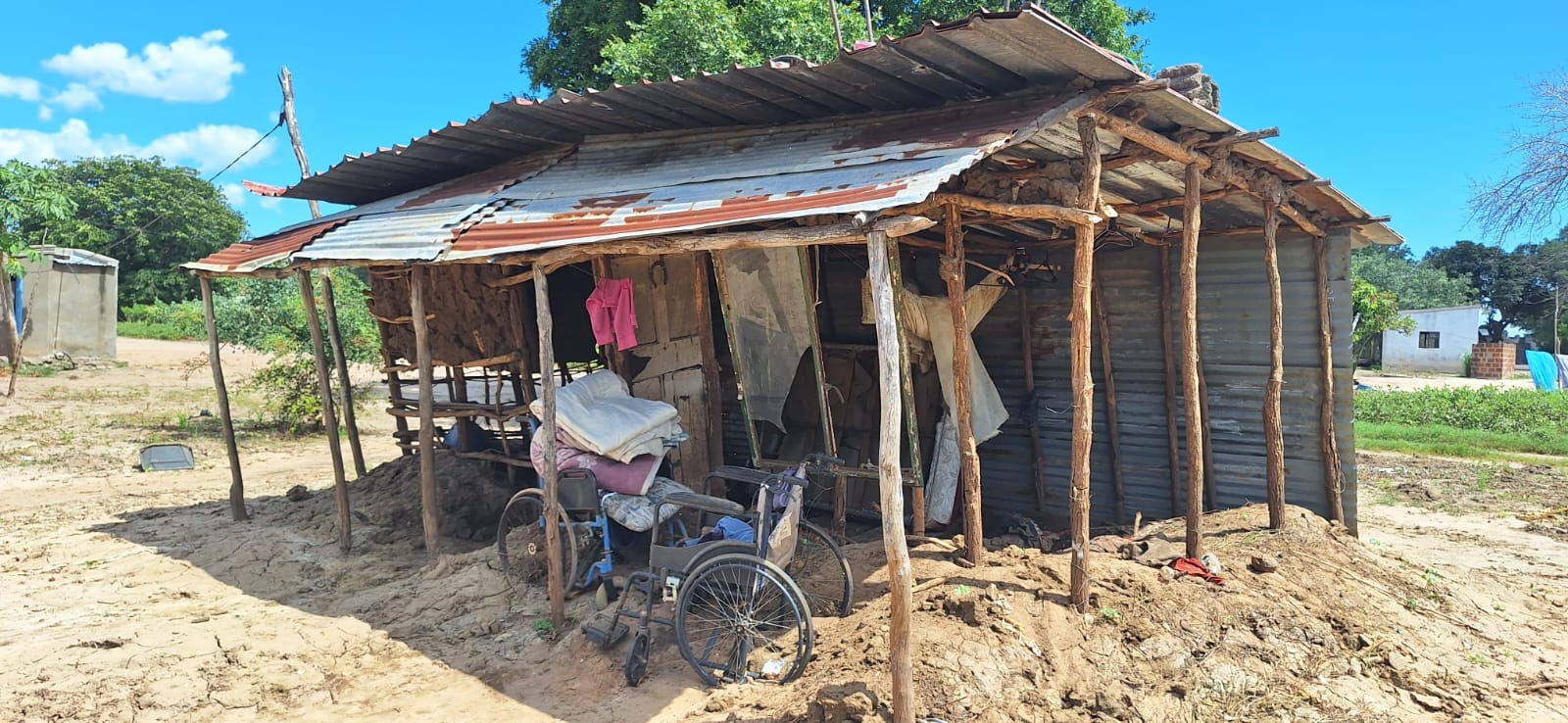
At 42, Constância is a single mother of two. She lived in a house built from fragile materials. Or rather, she lived there, because today only traces remain of what was once her home. The waters spared neither walls nor memories.
With limited mobility, she was unable to flee as the water levels rose. Faced with an impossible choice, she sent her children to stay with relatives in a safer area, while she remained behind.
“I had to send my children to relatives where the water did not reach. I chose to stay here, while I try to see how I can rebuild my life.” She says this calmly, though she does not yet know where to begin.
Like many families in the interior of Gaza Province, Constância depended on small-scale farming and livestock for survival. Despite her disability, she never stopped working to provide for her children. But this time, the floods took everything, her crops, her animals, her means of livelihood. They also swept away the fragile sense of security of someone who had endured other floods before, but nothing like this.
“I have lived through other natural disasters, floods and droughts… but I have no memory of anything like this.”There is pain in her voice. And uncertainty.
Yet there is determination too.
A woman of faith and quiet strength, Constância has begun to put together what little remains. The mud walls of her home were washed away by the current. Only the wooden poles and the roof are still standing, fragile, but upright. And from there, she has chosen to begin again. Rebuilding the mud walls is, for her, more than restoring a structure; it is the start of a new chapter.
“I hope to organise everything this week and bring my children back to live with me. Where they are now, I do not know how they are eating or sleeping. I would rather have them close to me. The difficulties… we will manage.” It is a mother’s love speaking louder than fear.
Stories like Constância’s remind us that in times of crisis, humanitarian response must pay particular attention to those who were already living in heightened vulnerability.
It is in this context that World Vision continues to stand alongside affected communities, providing emergency assistance to the most vulnerable families, including support with shelter, essential household items, water, sanitation and the restoration of livelihoods.
Yet the scale of such disasters demands more than a single response.
It calls for sustained solidarity. For coordinated action between government, partners and civil society. For more actors to step forward and ensure that families like Constância’s do not merely survive but are able to rebuild their lives with dignity.
Because when the water takes everything, starting again should not be a solitary act.
And no one should be left behind.