

Why Financing for Development must reckon with children’s futures now.
What if the greatest threat to tomorrow’s development isn’t a lack of resources but how we manage debt today? Dana Buzducea explores why debt frameworks that overlook intergenerational fiscal equity risk undoing decades of progress.
April 24, 2026.
At this year’s Financing for Development Forum, we are being asked to accept a familiar proposition: that stabilising debt today will secure prosperity tomorrow. And, while technically it may sound about right, it is an incomplete truth. Debt sustainability, as currently defined, measures a country’s capacity to repay. It does not measure what is being repaid with. If the price is a child’s education, nutrition or protection, then we are not stabilising economies. We are deferring risk and transferring it to the next generation.
In his opening remarks at the 2026 ECOSOC Forum, the UN Secretary-General António Guterres put it plainly:
“Crushing debt… is starving investments in health, education and food in many developing countries.”
That warning echoes what many of us working closest to these decisions have witnessed for years. Too often, success in the global financial system is still measured by fiscal ratios that are completely blind to the real world outcomes for people. At a moment when debt distress, climate shocks, and conflict are converging, this gap is no longer a technical oversight it is a political choice.
Debt decisions are child rights decisions.
Across low and middle-income countries, debt servicing is crowding out social investment at scale. Over 60% of low-income countries are at high risk of debt distress or already in it. At the same time, UNICEF estimates that more than 1 billion children live in countries facing severe multidimensional deprivation. These are not parallel crises. They are causally linked.
In practice, this plays out quietly. Budget lines are trimmed. Teacher recruitment slows. Health systems stretch. School infrastructure is deferred.
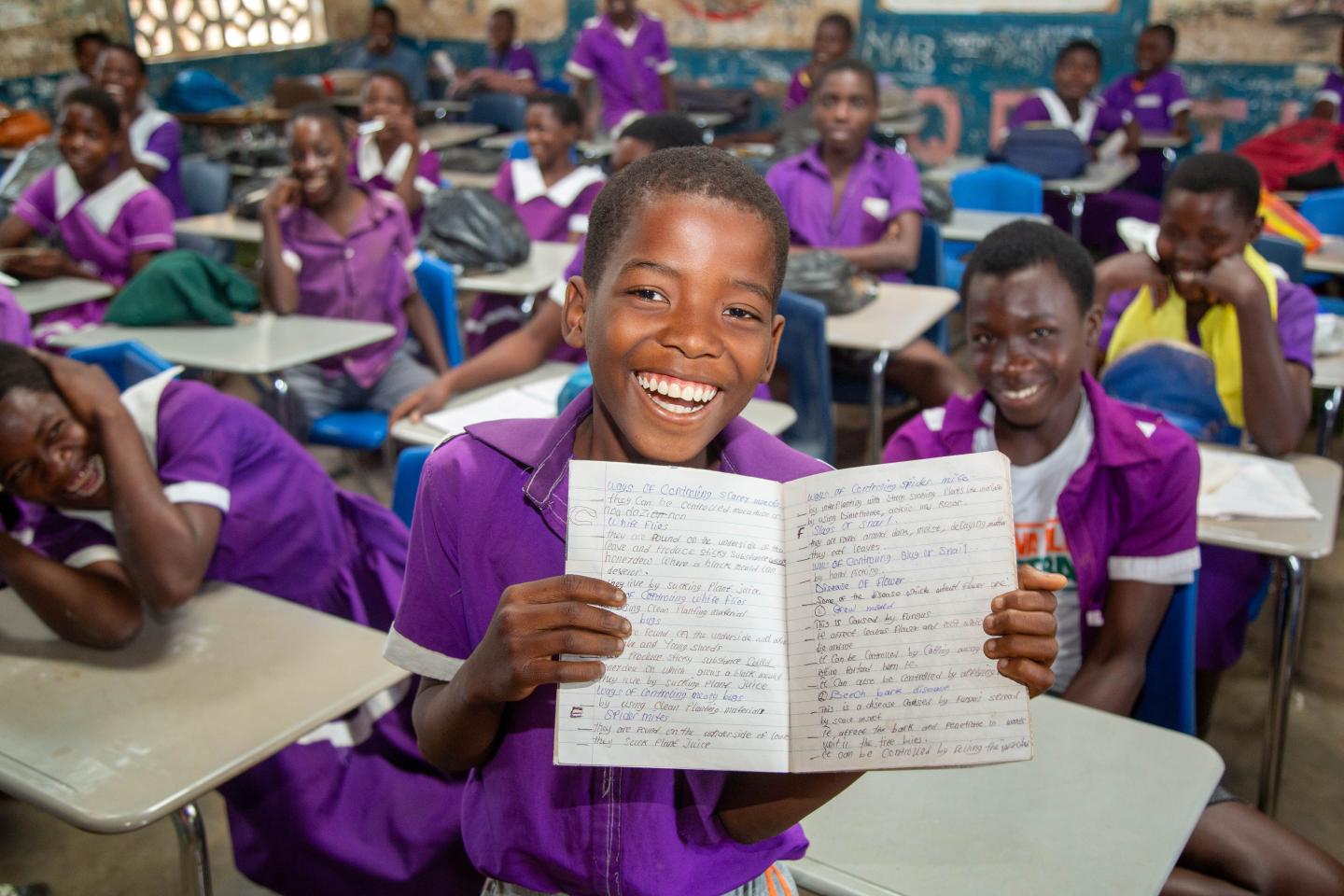
In my work, I often sit with stories from the communities we serve. Stories that stay with you. Lameck’s is one of them. He is 13. He attends a school of more than 1,000 students, where fewer than 70 desks are shared among them. For a long time, he did what many children in under‑resourced schools learn to do without being asked: he wrote on his lap.
“I used to write on my lap… my letters would turn out messy.”
It is easy to see this as a small inconvenience. It is not. Over time, it shapes how a child sees themselves. How they show up. What they believe is possible.
“Lack of desks at this school was holding back my dream of becoming a doctor.”
When desks finally arrived, something shifted. Not only in the classroom, but in him.
“I now write clearly and neatly. Every day, my handwriting gets closer to what a doctor’s should be.”
This is how debt decisions are felt. Not in fiscal frameworks or negotiation rooms, but in moments like this. In the quiet adjustments children make every day, as they navigate systems that are stretched too thin to fully support them.
Fragility, climate and gender risks we are under-pricing
Where debt distress intersects with fragility, the consequences compound. Fragile and conflict-affected states face significantly higher borrowing costs, even as their fiscal space narrows. In such contexts, cutting social spending is often framed as necessary adjustment. In reality, it can entrench instability by weakening the very systems that underpin resilience.
Climate risk sharpens this further. Current debt frameworks assess repayment capacity, not a country’s ability to withstand future shocks. Yet adaptation, social protection and resilient infrastructure all require upfront investment.
The gender dimension is equally clear. Reductions in health, education and social protection disproportionately affect women and girls. Care burdens increase. Girls’ schooling is interrupted. Labour force participation declines. Debt policy, often treated as gender-neutral, is anything but.
The missing link: intergenerational fiscal equity
For all the progress in the Sevilla Commitment, one principle remains notably absent: an explicit requirement to assess how debt choices affect future generations. This is a structural blind spot. Intergenerational fiscal equity would require governments and creditors to ask a different set of questions: not only can a country repay, but what must it forgo to do so, and who bears that cost over time? In the increasing polarization that is being built systematically from early age between children writing on their laps and children using advanced technology, what systems can build bridges so that they can collaborate as adults sharing the resources if the same planet?
There are practical entry points. The emerging discussions on responsible sovereign borrowing and lending could incorporate safeguards for child-related social spending. A strengthened set of principles, including a proposed new standard on intergenerational equity, could anchor this shift. Multilateral development banks and bilateral creditors could align lending frameworks accordingly.
For donors, the case is not only moral. It is strategic. Investments that protect children’s education, health and nutrition reduce long-term fiscal risk, support stability and underpin future growth.

A test of credibility
The Financing for Development (FfD) process has consistently committed to people-centred development and to leaving no one behind. The question now is whether those commitments will be operationalised where it matters most: in the rules that govern debt.
If we continue to define sustainability narrowly, we will continue to produce outcomes that are theoretically sound and socially fragile. The alternative is within reach:
- Embed intergenerational fiscal equity in FfD outcomes.
- Protect social spending that underpins children’s rights.
- Align debt architecture with climate resilience and gender equality commitments.
This is not about adding complexity. It is about correcting course. Because the real measure of sustainability is not whether debts are repaid. It is whether children like Lameck can still imagine and reach, a future beyond them.
With over 30 years of experience, Dana Buzducea is World Vision International’s Partnership Leader for Advocacy and External Engagement, where she leads global efforts to influence child-sensitive policies, strengthen government and multilateral investments and advance both the Sustainable Development Goals and the Convention on the Rights of the Child
Subscribe to see more content like this
Related Resources

Are We Balancing Budgets at Children’s Expense?

Prioritising Water to Unlock Human Capital
