
Panoramic balconies as a model for connecting people with nature and sustainable management of protected areas
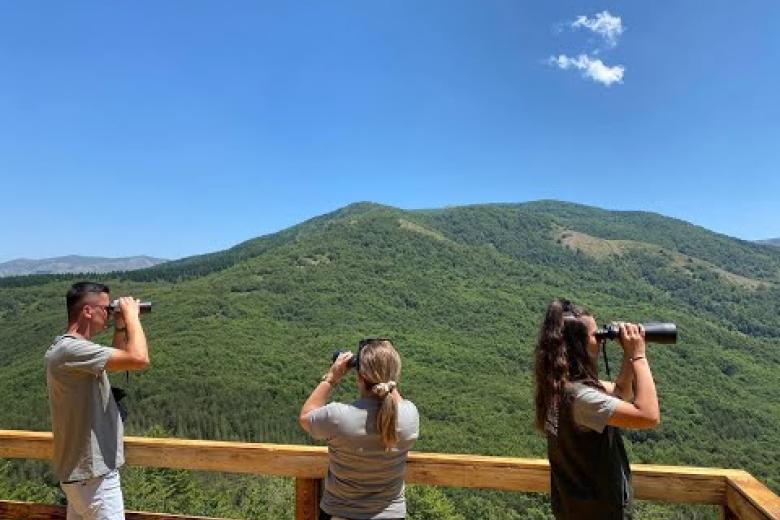
In protected areas, small, well-thought-out infrastructure can have a much bigger impact than it seems at first glance. A cleared path, an information point, an orientation board, or a panoramic balcony is not only an amenity for visitors. They are ways to make nature more understandable, accessible, and protected.
This is the approach that World Vision Albania has taken in the Shebenik National Park and the Korab-Koritnik Nature Park. By building bridges of cooperation among local communities, protected area administrations, youth, tourism businesses, and local organisations; biodiversity conservation is directly linked to sustainable local development. These partnerships seem to breathe life into the living nature and ecosystems, becoming attuned to them.
In this context, panoramic balconies are emerging as a positive practice for promoting and better managing biodiversity in protected areas in Albania. They are not just wooden structures to enjoy the view. They serve as orientation points for visitors, outdoor education spaces, landscape interpretation sites, and observation points for the park administration. This model, which has already been implemented in the Shebenik National Park for a year now, has the potential to expand to other protected areas.
Exactly one year ago, in Qafë Shapka, at an altitude of 1,442 meters above sea level in the Shebenik National Park, two panoramic platforms were built. The initiative was implemented by World Vision Albania, in cooperation with the Regional Agency for Protected Areas in Elbasan, with the financial support of Prespa Ohrid Nature Trust, in the framework of the project “Community Response/Ownership Development for Biodiversity Conservation in Korab-Koritnik Nature Park and Shebenik National Park”, which is implemented during the period September 2023 – October 2026.
World Vision Albania has now also signed a Memorandum of Understanding for the construction of another panoramic balcony in the Korab-Koritnik Nature Park. Alongside, support has been agreed with other local actors for the restoration of an information point in the area of Dorez in the Shebenik National Park. Such interventions show that when carefully planned and in cooperation with protected area administrations and local communities, these can become a sustainable model for nature tourism, environmental education, and biodiversity conservation.
Shebenik National Park is one of Albania’s most precious natural landscapes. It is known for its wildlife, forests, alpine pastures, mountain views, and rich biodiversity. With over 1,460 species of flora and fauna, including rare and symbolic species such as the Balkan lynx, brown bear, wild goat, deer, wild boar, and hazelnut, this park represents an extraordinary natural wealth that has yet to be fully discovered by the general public.
Located in one of the most beautiful spots in the park, these platforms offer visitors the opportunity to stop, see further, and better understand the territory they are in. For tourists, these vantage points make the experience safer and richer. For young people and students, they can serve as outdoor open classrooms. Local tour guides and tourism businesses create a clearer, more appealing product for visitors. Meanwhile, for the park administration, observation points provide vantage points that can help monitor the territory, prevent fires, and identify illegal activities.
One of the most important values of the project is that it does not see the preservation of biodiversity as a process detached from the life of local communities. On the contrary, the project that WVA is implementing aims to build local ownership of nature, including among young people, residents, tourism businesses, local organisations, and public institutions. This approach is essential because protected areas cannot be managed sustainably through rules and restrictions alone. They need communities that understand, value, and protect them.
World Vision Albania’s approach to Shebenik and Korab-Koritnik is based precisely on this idea: nature conservation becomes stronger when the people who live near it feel part of the solution. Through cooperation with Regional Protected Areas Agencies, local partner organisations, youth, and businesses, the project is creating a model in which biodiversity is not only seen as an ecological value but also as a basis for education, local identity, and responsible economic development.
In this sense, panoramic balconies symbolise this approach. They make the park more visible, but not more vulnerable. They bring the visitor closer to nature, but in an oriented and safe way. They create opportunities for tourism while also helping with management and monitoring. They show that infrastructure in protected areas can serve nature if built carefully, with a clear purpose and respect for the landscape.