
They lived in the shadows. Today, they stand in the light.

In the rural commune of Badaguichiri, in Niger, the daily reality of children living with disabilities is often marked by silence, immobility, and social exclusion. Without mobility aids, without adapted infrastructure, and with families already overwhelmed by poverty, children (especially girls) grow up hidden from view, confined to the home, dependent on others for every movement and every need. In many villages, a child who cannot walk is condemned to remain indoors, far from school, far from other children, far from a life of dignity.
This heavy reality is the one that shaped the early lives of two teenage girls: Nousseiba, 14, and Chamsia, 13.
At 60 years old, Ouma, grandmother of Nousseiba, carries years of pain as she recounts the journey of her granddaughter. “A year after she was born, she started fainting,” she recalls, wiping her tears. “At the hospital, they told us she had a problem with her spine. Since that day, she cannot walk, she cannot sit, she cannot speak.”
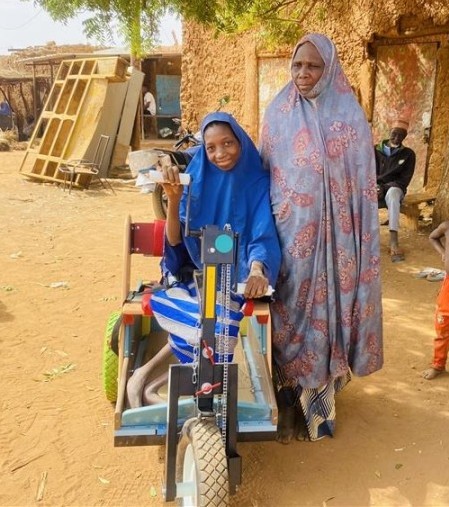
For Ouma, the hardest part has always been the isolation. “She spends her days lying down,” she says. “She never goes out. She watches other children playing from the doorway. It breaks my heart every single day.”
Without mobility, childhood becomes a prison. For years, the family watched helplessly as their daughter grew older without ever stepping beyond the courtyard.
Not far away, another family faces the same struggle. Since infancy, Chamsia did not grow like other children. “She didn’t crawl like other babies,” her mother, Aïchatou, remembers. Massage sessions at the health center brought a little hope at first. “She started crawling a bit… then everything stopped. She cannot walk or speak.”
The weight of daily care rests entirely on her mother’s shoulders. “To wash, to sit, to move—everything depends on me,” she explains. “When I have to go out, I cannot take her with me. She’s too heavy. I leave her with her little sister, but my heart is never at peace.”
For years, Aïchatou lived trapped between her responsibilities, her fear, and her love for her daughter.
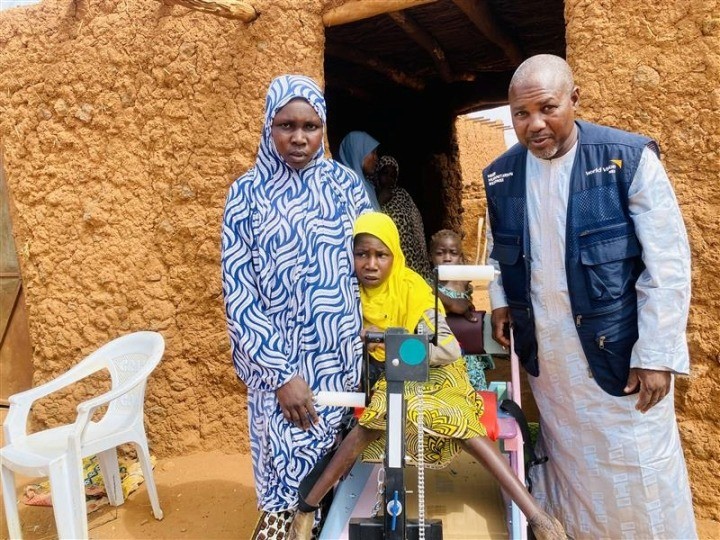
Everything changed the day World Vision Niger brought adapted tricycles to both families.
For Ouma, it was overwhelming. “When I saw this tricycle, I cried,” she admits, her voice trembling. Today, she will be able to move around the courtyard by herself. We now understand why sponsorship is so important. Thanks to it, our girl finally has a chance.”
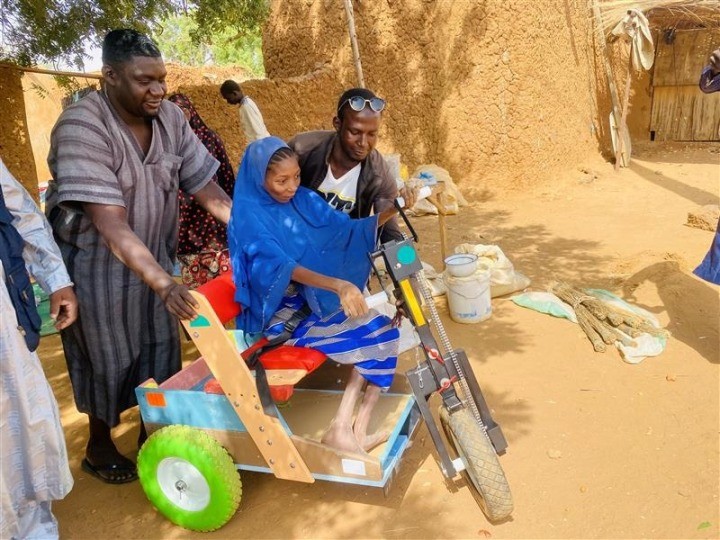
For Aïchatou, the tricycle meant freedom—both for her daughter and for herself. “Now she can come with me wherever I go,” she says with a bright smile. “I will no longer leave her alone at home. May God bless World Vision and everyone who made this possible.”
As Ouma beautifully says: “Our girls can finally move. They can finally live.”
In Badaguichiri, two girls once condemned to silence and immobility now have a chance to participate in family life, to be seen, to belong, simply to exist with dignity. Their lives were transformed not by medicine or miracles, but by a small piece of equipment that unlocked their freedom.
Because in Niger, as in the rest of the world, mobility is not a luxury. It is a matter of human dignity.