
From Floodwaters to Hope: Gwaimaoa Community's Journey to Safe Water and Resilience

For years, the people of Gwaimaoa Community in Central Honiara lived with constant uncertainty. Every heavy rainfall threatened their safety, contaminated their only water sources, and placed families, especially children at risk.
Families relied on muddy ponds and river water for drinking and cooking. During heavy rains, the water turned brown and unsafe, yet parents and children had no choice but to collect it. Children crossed swollen rivers every morning and evening, risking their lives just to bring home water, while many families regularly battled waterborne diseases that led to frequent visits to health clinics.
"We have experienced the impacts of heavy rains, flooding, strong winds, cyclones, and earthquakes," recalls Fr. Selwyn Olisimae, a community leader in Gwaimaoa.
"Many families lost their homes, and some even lost loved ones because we lacked knowledge about disaster risks and how to prepare for them."
For a community of around 600 people, access to safe water had become both a daily struggle and a financial burden. Some households attempted to connect to piped water, but the costs were simply too high. Others continued using contaminated water because it was the only option they could afford.
That reality began to change when World Vision Solomon Islands (WVSI), through the UN Habitat Project, partnered with the community to install rainwater harvesting systems and provide Disaster Risk Reduction and Waste Management training.
Today, the transformation is clear.
Two rainwater tanks now provide safe drinking water for families. Parents can collect clean water close to home, children no longer need to cross dangerous rivers, and households have enough water stored for cooking and drinking. Most importantly, illnesses caused by contaminated water have declined significantly, allowing families to spend less time at health facilities and more time building healthy, productive lives.
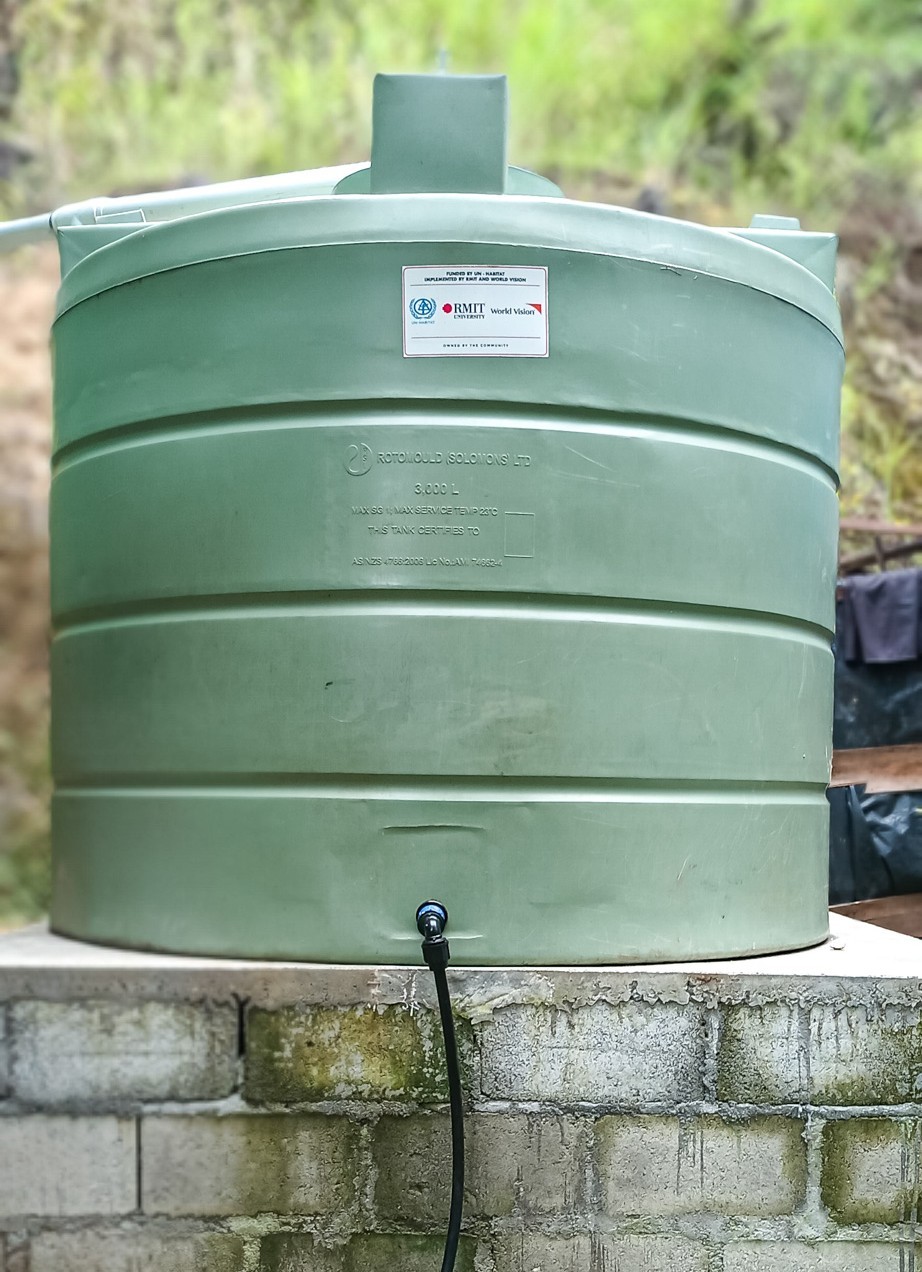
The community has also become more resilient to disasters. Through disaster preparedness training, residents have established a Disaster Risk Reduction Committee, learned how to identify safer places to build homes, and strengthened their ability to respond when hazards strike.
"Since World Vision began working with us, many of our worries and stresses have been reduced," says Fr. Selwyn.
"Our people now understand how to prepare for disasters, and we have moved away from areas that are vulnerable to flooding and landslides. We have not experienced any major disaster incidents recently, and that is a great improvement for our community."
Safe water and disaster preparedness have transformed our lives," he says. "We hope other communities can experience the same change."
What was once a community defined by uncertainty is now one filled with renewed confidence and hope. Clean water is no longer a daily struggle, and knowledge has empowered families to protect themselves from future disasters.
Fr. Selwyn and the community members expressed their heartfelt gratitude to World Vision Solomon Islands and UN Habitat for making this transformation possible, while expressing hope that similar support will reach other vulnerable communities along the river that continue to face the same challenges.