
Fleeing fear and finding home: Julia’s journey to safety from Sudan

Julia Peter Chan, 30, is a mother of six—three boys and three girls. Though her roots trace back to Abyei, she spent most of her life in Wad Medani, in Al Jazirah State, Sudan. It was the only home her children had ever known.
But in late February 2025, that life came to an abrupt end.
As violence escalated across Sudan, Julia and her family were forced to flee. With little time to prepare, they climbed aboard a crowded “Teril”—a large truck packed with families escaping the same danger. They left behind nearly everything they owned.
“We had no choice,” Julia recalls.
Their journey was long and exhausting. After crossing into South Sudan through the Joda border in Renk—alongside nearly 900 others—they stayed there in Renk for two months, waiting and wondering what would come next. From Renk, they traveled by boat to Malakal. Then, they were airlifted to Wau before finally arriving in Aweil in late April—her husband’s home area.
“Since the conflict started in April 2023, life has been difficult,” Julia says. She describes nights filled with fear, when armed groups would enter communities demanding money, valuables, and livestock. Those who could not give were beaten.
“They would even ask for women and young girls,” she adds.
Julia witnessed these acts herself. She, too, was beaten after refusing to hand over money from her small business. That moment became a turning point.
“It was then I knew we had to leave.”
In Aweil, the family found temporary refuge with her husband’s relatives. Life was not easy—crowded, uncertain, and dependent on the support of extended family—but it was safer.
Then, in August 2025, through support from World Vision, funded by the German Federal Foreign Office, Julia’s family received a modest home. Small as it is, the house represents stability—something they had not felt in a long time.
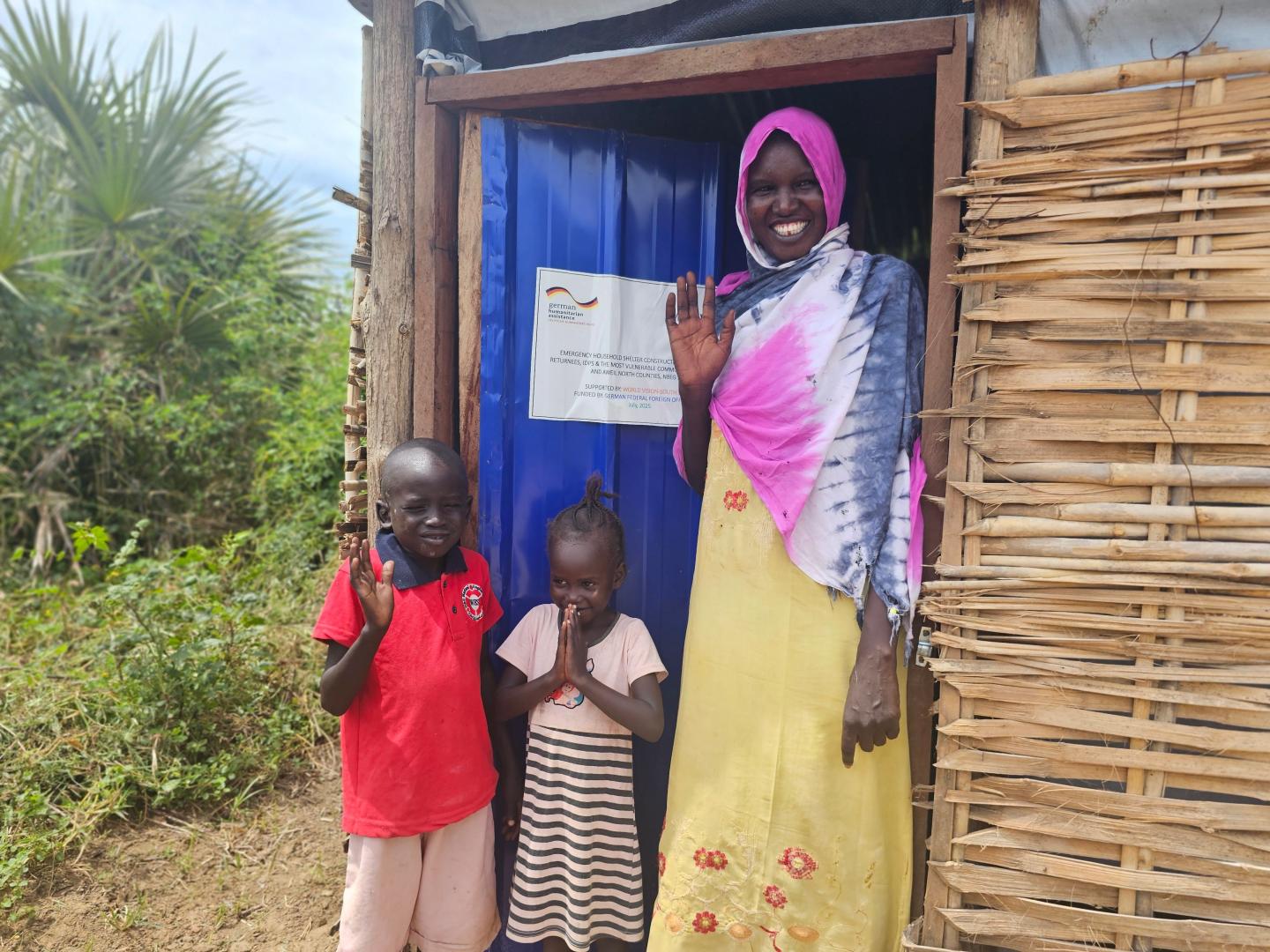
“Not all of my children can stay with us in the house,” she explains. “Some stay with my in-laws. But I’m happy—we finally have a place to call our own, and it is close to family.”
Now, Julia and her husband are beginning to rebuild their lives from the ground up. With limited livelihood options, they are considering farming—something entirely new to them.
“We have never farmed before,” she says, “but we are willing to learn.”
Her children, like many displaced children, have had their education interrupted. Since fleeing Sudan, they have not been able to attend school. But Julia holds on to hope.
“Once we are more settled, I believe they will go back to school.”
Despite everything she has endured, Julia’s thoughts extend beyond her own family. She speaks of others still struggling—those who arrived with them, and many more who remain without shelter or support.
“I’m grateful for the help we received,” she says. “I just hope there is a way for others to be supported too.”
For Julia, the journey is far from over. But in Aweil, with a roof over her head and hope for her children’s future, she is taking the first steps toward rebuilding a life interrupted by conflict.
Story and photos by Diwa Aquino-Gacosta/World Vision South Sudan