
She Thought Marriage Was Her Only Future

By Bright Bhuwa (Advocacy Graduate Intern)
"If there were more skills training opportunities, many girls would never see marriage as their only option." – Tafadzwa
At 17 years old, Tafadzwa believed her future had already been decided.
Growing up in a rural village in eastern Zimbabwe, she dreamed of completing her education and one day working in government. But, after struggling at school and with few opportunities available, that dream slowly slipped away. Like many girls in her community, she entered into an early marriage, believing it was the only path left for her.
Today, at 23, Tafadzwa is a confident entrepreneur, a skilled tailor, a mother of two, and an advocate encouraging girls to stay in school and pursue their dreams before marriage.
Her transformation is more than a personal success story. It is living proof that when vulnerable girls are given practical skills, hope and opportunity, they can break free from the cycle of poverty and child marriage.
When poverty becomes a pathway to child marriage
In many rural communities across Zimbabwe, child marriage is rarely a choice made by girls alone. It is often driven by poverty, limited educational opportunities, harmful social norms and the absence of meaningful alternatives.
Before World Vision Zimbabwe introduced youth skills development programmes in Mhakwe, many girls who dropped out of school spent their days without employment, training or hope for the future.
"Many girls were just roaming around the community with nothing to do," Tafadzwa recalls.
"Because of poverty, some parents could not afford school fees, while others encouraged their daughters to marry into families they believed were financially stable."
Peer influence only deepened the problem.
She remembers one former classmate who got married just before starting Advanced Level studies. After becoming pregnant, her husband abandoned her, forcing her to return to her parents' home where she struggled to survive through casual labour.
"It was painful to watch," Tafadzwa says. "Life in rural areas is not easy."
Stories like these became increasingly common, trapping generations of girls in poverty, dependency and lost potential.
A second chance through skills
Everything changed when World Vision Zimbabwe introduced a Youth Sewing Skills Development Programme in Mhakwe.
Ironically, Tafadzwa almost missed the opportunity.
"When I first heard about the programme, I wasn't interested," she says with a smile.
"But after seeing graduates from the first two groups transforming their lives, I realised this programme was genuinely changing young people's futures. That inspired me to join."
The three-month vocational training became the turning point she never expected.
Her determination quickly distinguished her from the other trainees. Recognised among the top five performers, she was selected for advanced practical training, followed by a year of professional studies and a year of industrial attachment, graduating with distinction.
Beyond learning how to sew, Tafadzwa gained valuable business management, financial planning and entrepreneurship skills that would enable her to build a sustainable livelihood.
"If it was not for World Vision, I would never have discovered that I am good at sewing," she says.
From survivor to entrepreneur
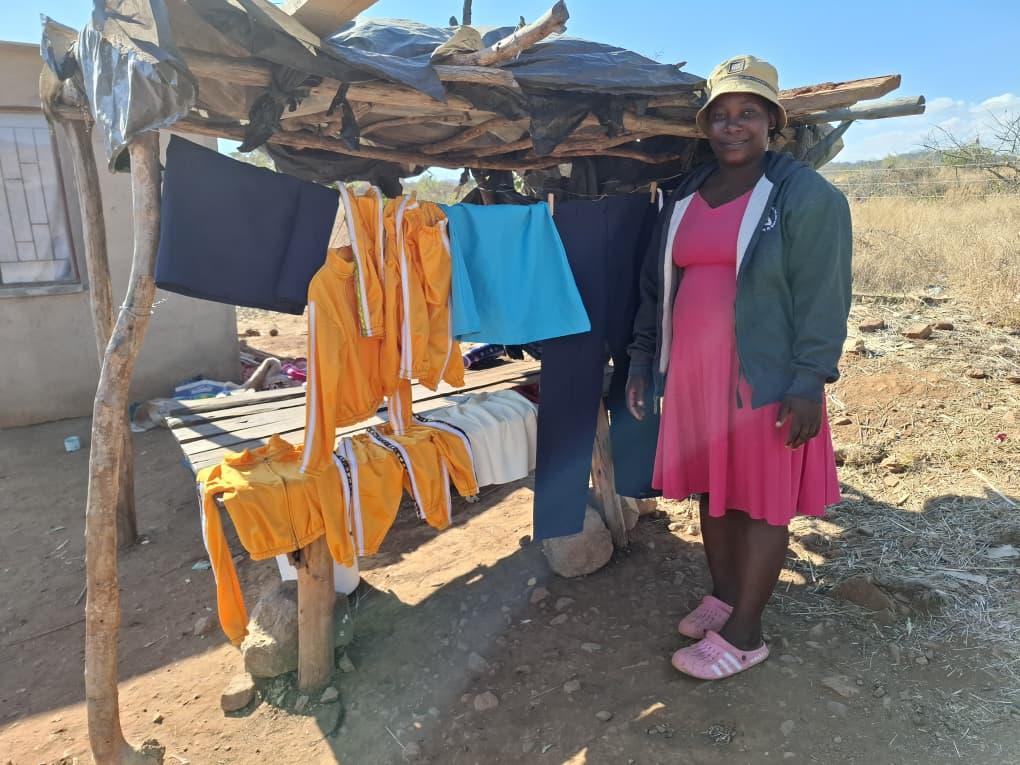
Today, the sound of sewing machines fills Tafadzwa's tailoring shop at a local Business Centre.
She now designs work suits, tracksuits, school uniforms and other garments for customers across her community.
Her business has grown steadily, allowing her to purchase multiple sewing machines, including a heavy-duty industrial machine, while also saving towards buying land where she plans to build her family's home.
Her ambition continues to grow.
Recognising a shortage of quality school uniforms in the area, Tafadzwa recently approached her former High School, proposing to become one of its official uniform suppliers. The school has requested sample garments for assessment, an opportunity that could significantly expand her business while creating a stable income for her family.
Changing more than one life
For Tafadzwa, success is no longer measured only by income.
It is measured by the number of girls who may never have to experience what she did.
"My life has completely changed because of this project," she says.
She now actively encourages parents to keep their daughters in school, even during difficult financial times, and mentors young girls to believe that education and skills can open doors that early marriage never could.
She has also witnessed wider transformation across her community.
"The biggest change is that young people are now occupied with learning skills instead of idling. Girls now understand the importance of education, and more of them are staying in school."
Breaking the cycle of child marriage
Tafadzwa's story demonstrates that preventing child marriage requires more than awareness campaigns alone.
When adolescent girls have access to education, vocational skills, mentorship and economic opportunities, they gain the confidence and independence to shape their own futures.
World Vision Zimbabwe's investment in youth skills development is helping address one of the root causes of child marriage by giving vulnerable young women practical alternatives to early marriage and pathways towards economic independence.
These investments are creating ripple effects that extend far beyond individual beneficiaries. Families become more resilient. Communities begin to challenge harmful social norms. Young girls start imagining futures built on education, careers and entrepreneurship rather than early marriage.
A future filled with possibility
Among eight siblings, Tafadzwa is the only one who has acquired a professional qualification through World Vision's support.
"I am truly grateful," she says. "Since joining World Vision's programme, my life has changed significantly."
Her next goal is to purchase a high-quality industrial overlock machine to improve production and expand her school uniform business.
But perhaps her greatest achievement is the message she now shares with every young girl she meets:
"Learn a skill. Stay in school. Do not think marriage is the only option. Skills can change your life."
For every girl like Tafadzwa who finds opportunity, countless others are still waiting for their own second chance.
With continued investment in education, life skills and youth empowerment, more girls can rewrite their stories—not as child brides, but as confident leaders, entrepreneurs and change-makers shaping a brighter future for themselves and their communities.