publication / March 18, 2026
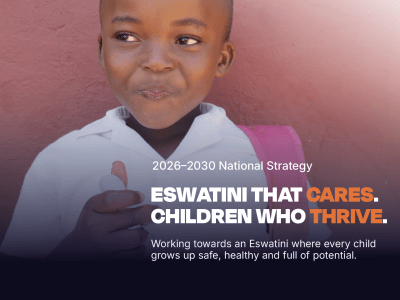
World Vision Eswatini — National Strategy 2026–2030
From 2026 to 2030, World Vision Eswatini is committed to empowering 395,000 of the Kingdom's most vulnerable children with the conditions they need to grow up safer, healthier and more resilient.
article / February 5, 2026
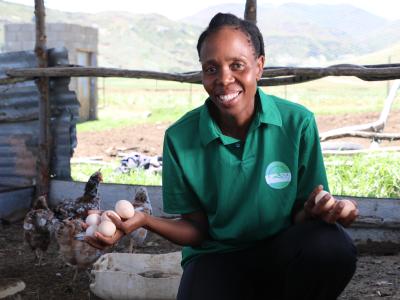
How World Vision strengthened Mountain Kingdom Poultry Cooperative to grow and succeed with the support from SADP II
World Vision support empowered Mountain Kingdom Poultry Cooperative with skills, savings, and market access, enabling families in Mohale’s Hoek to grow sustainable poultry businesses.
article / March 2, 2026
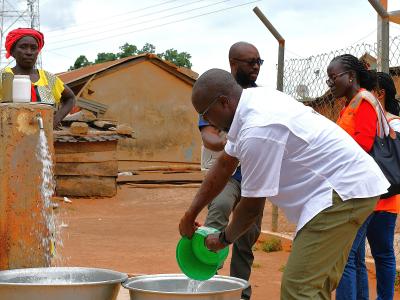
Water : A Powerful Resource that Unites Communities in West Gonja Municipality
In Nabori and Yipala, a World Vision US‑supported mechanised water system transformed life by uniting Muslim and Christian communities. Once divided by faith, families now share clean water, build trust, and collaborate for a better future,showing how water can break barriers and create peace.
article / March 19, 2026
World Vision Eswatini Launches National Strategy 2026–2030 — Eswatini That Cares. Children Who Thrive.
World Vision Eswatini Launches National Strategy 2026–2030 — Eswatini That Cares. Children Who Thrive.

video / March 19, 2026
Child Ambassador Praises World Vision Eswatini's New National Office Strategy
A strategy like this is not just about ambition — it’s about what it will mean in the lives of nearly 400,000 children who will grow, learn, and thrive because of it.
Standing with the team and our partners as this next chapter begins. 👏🏾

publication / March 18, 2026
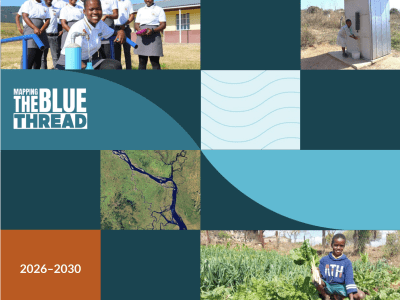
World Vision Eswatini — WASH Business Plan 2026–2030 Mapping the Blue Thread
Our plan is built on five technical priorities — Water Supply and Quality, Sanitation and Hygiene, Governance and Finance, Water Security, and Disaster Management — underpinned by digital innovation through platforms like mWater for real-time monitoring, transparency and accountability at every project site.
article / January 20, 2026
Nyawa District Unites to Strengthen Child Protection By-Laws
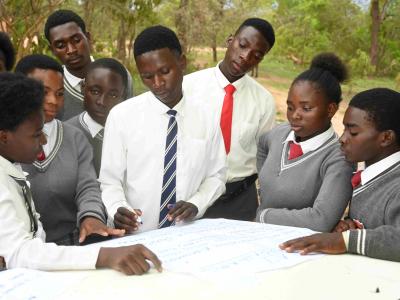
Children in Nyawa District, Southern Province, continue to face risks of violence, neglect, and limited access to safe, child-friendly reporting systems, challenges that are often worsened when their perspectives are not included in community decision-making. To address this, World Vision Zambia facilitated a multi-stakeholder meeting at the Nyawa Palace, bringing together children, civic leaders, men, and women to collaboratively develop Child-Protection By-Laws.
publication / March 24, 2026
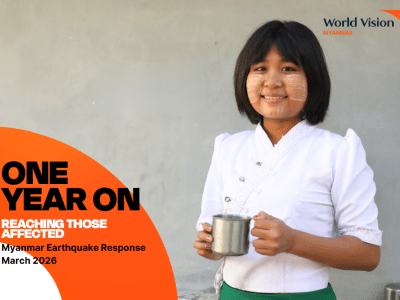
Myanmar Earthquake Response_One Year On Report
Many families continue to struggle to rebuild their lives one year after the devastating 7.7 magnitude earthquake that struck Myanmar on 28 March 2025. UN experts caution that reduced international attention and shrinking humanitarian funding may lead to devastating consequences for Myanmar’s already vulnerable communities. World Vision is providing life-saving relief assistance and recovery support to children and families affected by the earthquake: Through our humanitarian efforts, both immediate relief and long-term recovery, we aim to support 560,353 people, including 172,000 children. As of 18 March 2026, we have reached 581,269 people affected by the earthquake, including 194,748 children (107,016 girls and 87,732 boys).
publication / March 16, 2026
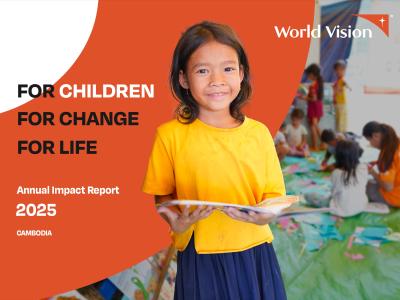
Annual Impact Report 2025
World Vision International in Cambodia’s 2025 Impact Report highlights a year of resilience, adaptation, and collective action amid significant humanitarian and development challenges. In a rapidly changing context shaped by sector‑wide disruptions and escalating border‑related conflict, World Vision Cambodia worked closely with government authorities, partners, communities, and donors to respond to urgent needs while sustaining long‑term development efforts. In 2025, World Vision Cambodia reached 5.4 million people, including 3.1 million children, nearly one third of Cambodia’s population. Humanitarian response remained a critical priority, supporting over 144,000 displaced people across 100 displacement sites, including children and people with disabilities, through life‑saving assistance such as water, sanitation, food and non‑food items, cash assistance, education, health and nutrition services, protection, and psychosocial support. Beyond emergency response, progress was achieved across education, child protection, WASH, nutrition, livelihoods, climate action, social accountability, and inclusive programming. The year also marked 55 years of World Vision’s long‑term commitment in Cambodia, reflecting sustained partnership and a shared vision for every child to experience life in all its fullness.