
The Ravaging Drought

The hot glaring sun beats down on the already dry land. The skies a clear mirror of the ocean blue. Not a cloud is in sight. The strong gusts of wind are passing through like a speeding car with faulty breaks. There are no trees to slow down the wind. It’s all a vast of nothingness except for the shrubs that are also starting to feel the effects of the blazing sun.
In this vast land in Awdal region, Somaliland Abdi Mousse Omar resides. A father of four children, he holds the youngest in his arms with affection. A gesture that is not shown by many men in rural Somalia
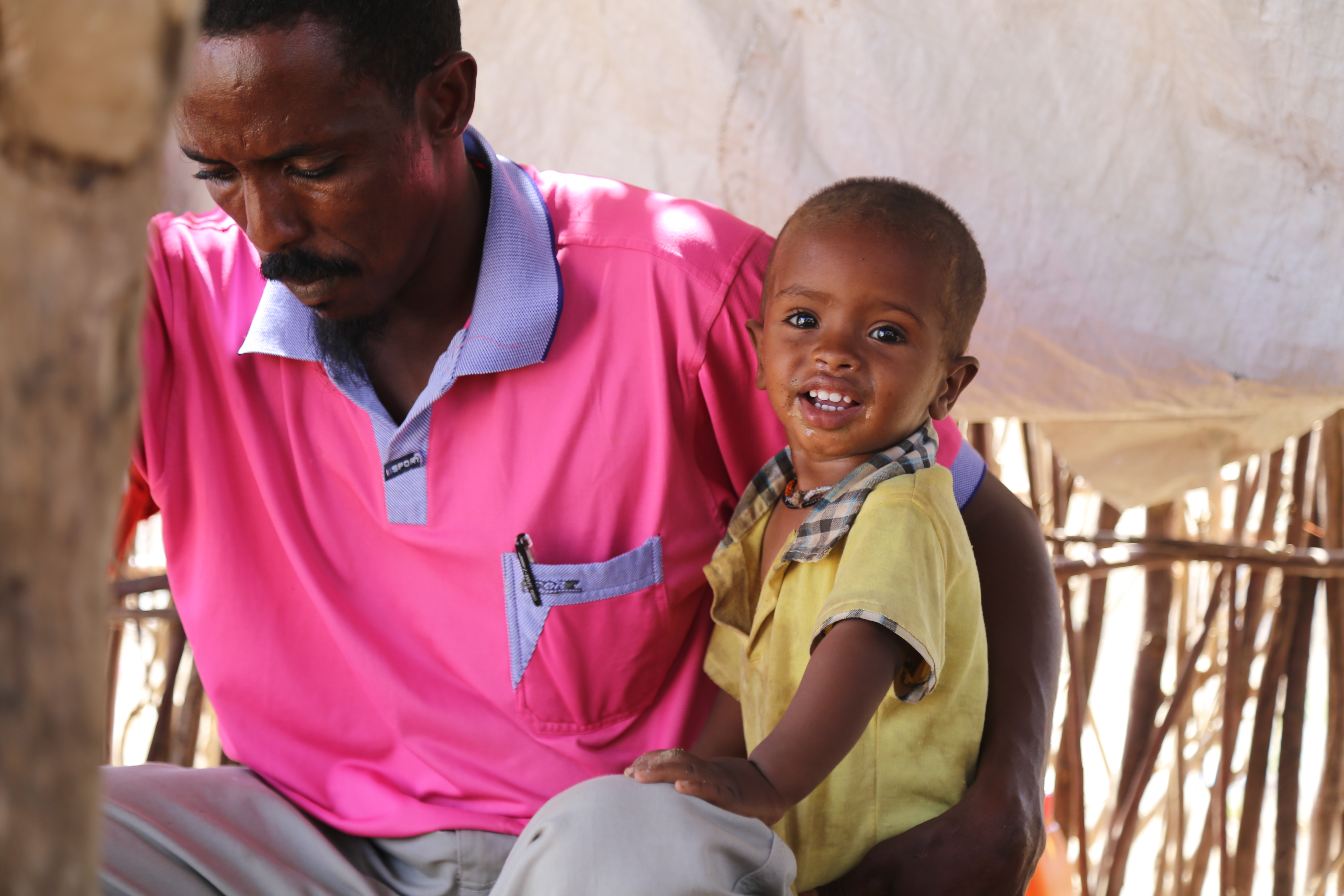
The current drought has had an effect on him and his family as a whole. Previously, a proud owner of hundreds of livestock, today he is left with only a few goats.
“Before the drought, I had over 150 goats and sheep. As the drought progressively worsened, I lost most of my livestock and now I only have 10 goats,” he says pensively.
Over the past months since the drought was first declared by the Somaliland Government in July, 2015, Abid Mousse’s children’s health started deteriorating and the younger one was especially affected. Through World Vision’s nutrition mobilization team, his wife was able to take the child to the hospital. He was identified as malnourished and put on immediate treatment at the Outpatient Therapeutic Programme (OTP). Later when his condition stabilized, he was transferred to the Targeted Supplementary Feeding Program (TSFP).
“During the selection criteria, 26 households were identified based on the TSFP nutrition program. My wife was among the ones selected as my son was already at the TSFP program”
Once families were selected each household was given unconditional cash transfer and goats. “The money was very helpful as I paid all the debt that I had at the local shop where I had taken some foodstuff like flour, oil and rice on credit. I was also able to buy food supplies and other critical needs for my family” says Abdi Mousse
The drought is becoming worse according to him and this is the sentiment that is shared by almost all of the community members in Waraagadicta village, Awdal region. The drought has been persistent for the last few years and this has led to many livestock dying because of lack of water and pasture. As a pastoralist community, they are dependent on livestock and so losing more than one livestock is akin to losing their entire lives.
“We have a nearby shallow well here, though it is not enough as the water is quickly drying. If we don’t get rain soon, then I am not sure how the goats are going to survive,” declares Abdi.
Despite the long dry spell, Abdi Mousse is still hopeful that it will rain soon so that water and pasture can be found for their livestock. He is also grateful to World Vision and what they are doing for the community.
While severe food insecurity and malnutrition is widespread across the country, drought in Puntland and Somaliland is of particular concern. According to the assessment by FSNAU and FEWS NET, erratic rains during the 2015 Gu (April-June) and the Karan (August-September) seasons in Puntland and Somaliland has resulted in a near total crop failure production that was below the estimated average.
The 2015 Deyr rains (October-December) were also below average putting pressure on pasture and livestock. World Vision Somalia’s areas of operation that are affected include Dangorayo and Eyl in Puntland and Awdal in Somaliland. The drought conditions in both Puntland and Somaliland threaten recent gains made towards building household food security. Drought is becoming a more frequent feature in Somalia, challenging efforts to build up community resilience since the famine of 2011.
Through the interventions of Irish Aid; mobile health care, cash transfer and restocking activities are being implemented. However much more needs to be done in areas of WASH, livelihoods, and nutrition especially for children under five, pregnant and lactating women as well as program strengthening in order to reach more people.
More help is urgently needed to support the communities to survive this drought that is ravaging the area. World Vision Somalia targets to reach an approximately 64,000 people during this emergency response.