
Empowering mothers, transforming families, Elgeyo Marakwet County Kenya

Eleven Mothers, One Turning Point
High in the steep slopes and hills of Sambirir Ward, Marakwet East in Elgeyo Marakwet County, eleven mothers made a quiet decision that would change their children’s lives. Every week, without fail, they gathered to learn from one another, not because anyone required it, but because they wanted something better for their families. Could a weekly meeting really shift something as stubborn as childhood malnutrition? A year on, the answer is written in the food on their children’s plates and in the confidence these mothers now carry.
A Community Left Behind
The 2024 BMZ Grow ENRICH baseline assessment conducted in Elgeyo Marakwet County, Marakwet East Sub-County in the wards of Sambirir, Kapyego and Embobut revealed significant gaps in families’ knowledge and skills related to nutrition during the first 1,000 days of life. Beyond limited awareness, the assessment identified structural and behavioural challenges, such as early introduction of complementary foods and mixed feeding among infants below six months of age, contributing to poor maternal, infant, and young child nutrition (MIYCN) outcomes.
The assessment aimed to determine households’ understanding and practices around key areas such as maternal nutrition and health, breastfeeding, complementary feeding, micronutrient supplementation, prevention and management of malnutrition, and hygiene and food safety. Findings showed that only 14.9% of the assessed population met the MIYCN minimum criteria, measured through indicators such as minimum dietary diversity and meal frequency for children, and iron supplementation for pregnant women, highlighting the urgent need for targeted nutrition education and support within the community.
The baseline recorded a 32.9% child stunting rate and a Minimum Acceptable Diet of just 9.1% among children aged 6–23 months compared to 31% at the county level and 22.6% nationally. This was in addition to low antenatal care attendance for women aged 15 - 49 years, with 42.3% of mothers completing four or more visits, lower than the 57.6% reported nationally. Entrenched food taboos discouraging mothers from eating eggs or meat during pregnancy, combined with mother-to-mother support groups that lacked capacity to prevent, monitor and address malnutrition from a gendered lens, meant many caregivers wanted to do better for their children but lacked the knowledge, skills, and structured support to act on it. But change was already taking root, one weekly meeting at a time.
Turning Knowledge Into Action
In response to these gaps, the Grow ENRICH project, funded by the Federal Ministry for Economic Cooperation and Development (BMZ) in collaboration with the County Ministry of Health, supported the establishment of 290 mother-to-mother support groups linked to 29 community health units. These groups are designed to provide nutrition counselling and education while equipping mothers with practical skills in maternal nutrition, early initiation of breastfeeding, and exclusive breastfeeding.
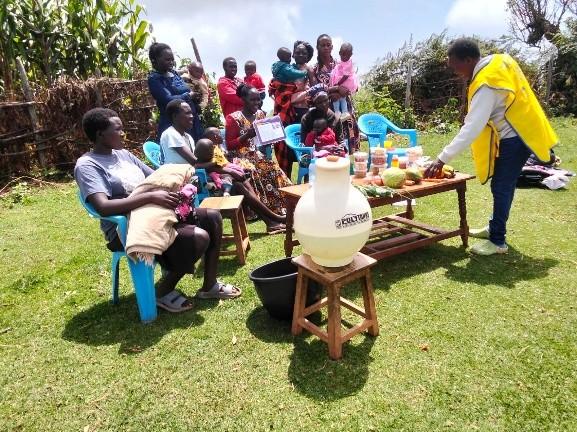
One such group is the Kebirir Mother to Mother Support Group, which was formed in July 2024. The group currently comprises of 11 lactating mothers who, at the start, had limited knowledge of Maternal, Infant, and Young Child Nutrition (MIYCN) and kitchen gardening.
Since its inception, the group has been meeting weekly to share experiences and learn about exclusive breastfeeding, complementary feeding, maternal nutrition, hygiene, kitchen gardening, and growth monitoring, among other topics. The real test, though, was never going to be in the meetings themselves, it was in what happened next, in their own kitchens and gardens.
From Uncertainty to Confidence
Reflecting on how far the group has brought them, one member shared,
We didn’t know how to feed our children with the right foods and frequency, but after attending the meetings, I can now feed my child four of the seven recommended food groups
Another mother, who joined while pregnant, added
I joined the group when I was pregnant and attended all the meetings. I learned how a pregnant and lactating mother should feed and was able to exclusively breastfeed my child.
Since the group began meeting, Community Health Promoters have also observed an increase in antenatal care visits among its members, a sign that the trust and knowledge built through the sessions extends beyond nutrition alone.
The mothers collectively attested that both their children’s and families’ health have improved significantly as a result of the knowledge and support gained through the Mother-to-Mother Support Group.