
Ameer’s* healing journey through displacement and malnutrition

Written by: Joanna Zreineh
In Syria, more than 9 million people are acutely food insecure, many of whom are children as families struggle to secure basic needs following years of displacement and crisis.
Among them is 34-year-old, Reham*, a Syrian mother who has spent the last six long years chasing safety, moving from one shelter to another due to crisis in their area, each time hoping to find safety and stability for her family. Today, she lives with her husband and three children in a single classroom in an abandoned school in North East Syria. A school that’s walls were once filled with the laughter of students now holds the quiet hum of surviving families. “Our situation is very dire. We barely have access to food and even water. We live with many other families in the school and have to share the generator for electricity and even the same bathroom,” she explains. Her husband, a teacher, travels far to earn enough to support them, leaving Reham to care for the children alone.
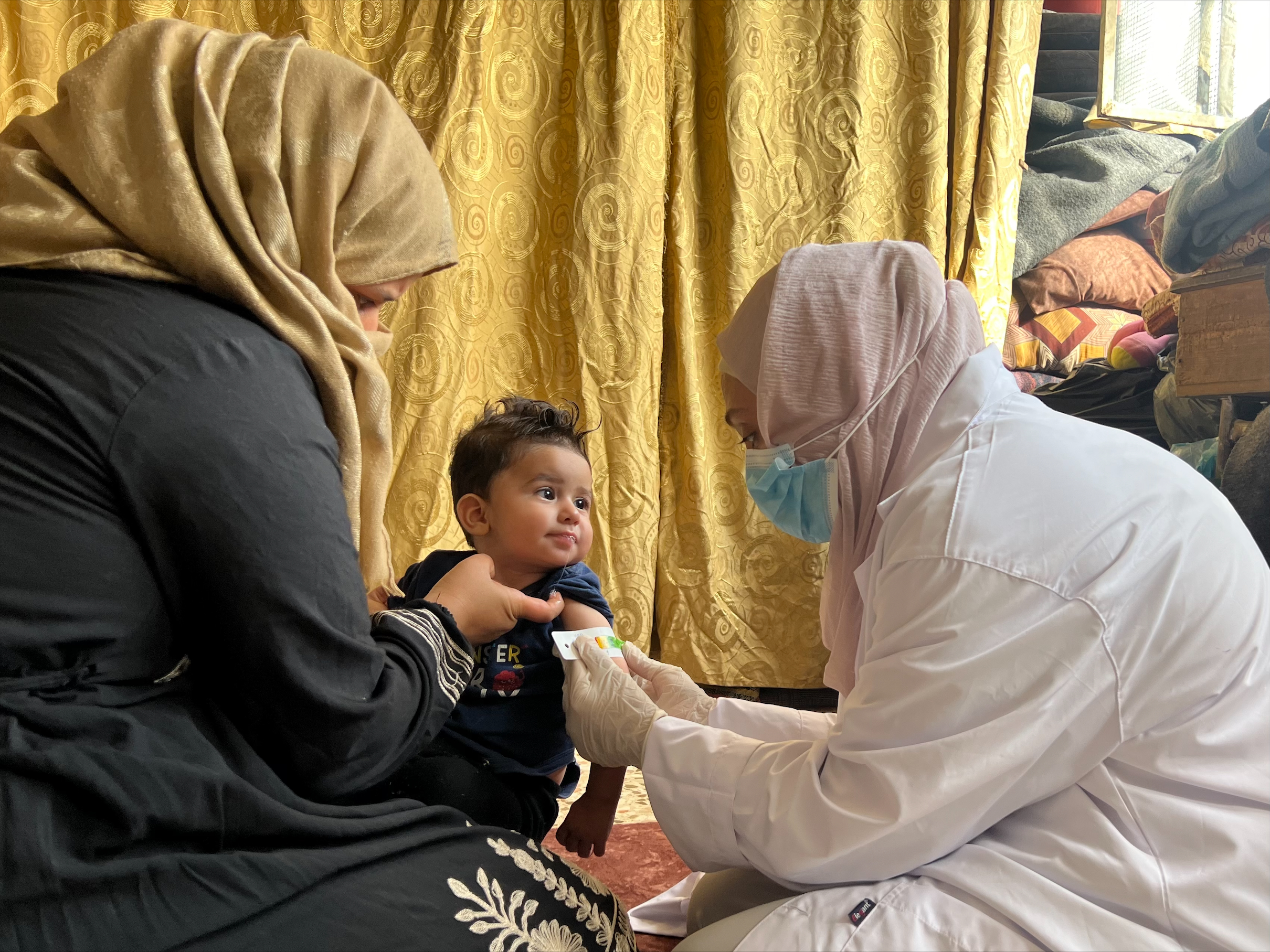
As if displacement and hunger were not enough, her youngest child, 9-month-old Ameer*, was born small and fragile. From the start, Riham sensed something was wrong. “He didn’t sit, didn’t crawl and he wouldn’t eat. I always felt scared for my baby” she recalls. Reham would take Ameer to doctors, but they kept assuring her that his tests were normal and gave her vitamins, but his condition only worsened. Like many mothers in Syria, Reham didn’t know her child was suffering from severe acute malnutrition, a silent crisis claiming thousands of young lives yearly in Syria.
Finally, and after months of panic and uncertainty, hope arrived when World Vision Syria Response’s visited her shelter through the mobile clinic project. After describing her son’s case, the trained nutrition worker measured Ameer’s weight and took his Mid-Upper Arm Circumference (MUAC) measurement. Ameer’s condition was detected, and the team delivered the news any mother would fear to hear. Ameer was severely malnourished and needed urgent care. “My heart sank. I had no idea my child was suffering so much. I felt a deep sadness I can’t describe”, she emotionally reflects.
To support her child, Reham was referred to a specialized center supported by World Vision, where she received therapeutic peanut paste, medicine, and counseling on how to prepare nutritious meals, all free of cost. “They taught me how to make nutritious meals and how to feed Ameer properly,” she shares.
When Ameer first arrived at the clinic, he weighed only 6.2 kilograms, far below the healthy weight for his age. But within just a few weeks, remarkable changes began to show; by the end of his third week of treatment, Ameer had gained 1.2 kilograms, nearly 20% of his original body weight!
He has finally started eating, growing stronger, and responding with joy to his mother’s voice. “Ameer has so much more energy now! It fills my heart with Joy. And thanks to the awareness sessions on malnutrition, I know now how to care for him. I finally understood why he wasn’t growing and know how to prevent it, thanks to the project,” Reham shares proudly.
Ameer’s and Reham’s success story are just one of thousands as 5,000 Syrians benefited from the various health services provided by the clinic, over 800 of which are malnutrition screening. Beyond treatment, over 1300 caregivers and children benefited from psychosocial and protection sessions provided through the project’s awareness component across northern Syria. Children who now can grow and play and mothers who have gained now the knowledge and hope to nurture their little ones.
“In the midst of our hardship, World Vision didn’t just bring nutrition; they brought hope to my child”, she concludes.
*Name has been changed to protect identity