
Health centre bursting at the seams
Sylvia Nabanoba, World Vision Uganda Communications
A middle-aged woman lies on a small mattress on the floor, labour pangs searing through her body. She cries out, and a nurse comes and assures her that she ‘will be okay’. 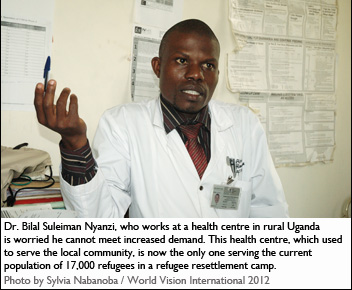
Next to her, a young woman lies on a bed gazing at her newborn baby. She is lucky to be lying on one of the only two beds in the maternity wing.
With five babies delivered here daily, many of the mothers and their newborns have to make do with the floor.
In the next ward, two patients lie on mats on the floor, one — a woman — receives intravenous medication. When the doctor comes to check on one of the patients, she complains that the hard floor is making her uncomfortable.
“That’s all we can manage,” the doctor says.
Outside this clinic in western Uganda, there are scores of people. Mothers, children and men queue in a long line that stretches into the grass. The sound of crying babies fills the air.
Inside a small room facing this reception area, Dr. Bilal Nyanzi attends to the patients.
“We used to get 20 outpatients daily. Now we get 200,” he states. “The situation is difficult to manage.”
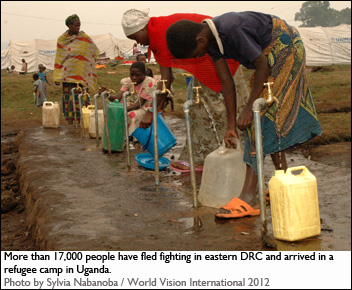
The health centre is the only one serving Rwamwanja resettlement camp. This camp, which covers 41 square miles, has, since April 2012, been home to 17,000 refugees who fled fighting between the M23 rebels and the government army in the Democratic Republic of Congo (DRC). Still more are expected to arrive.
“This health centre was created to handle a small population of locals. Now with the refugee influx, it is completely overstretched,” Dr. Nyanzi says. “The patients we receive are even few compared to the camp population. Because of the long distance from the camp, most of the people who need medical attention do not turn up. We need to carry out health outreaches.”
He is right.
Twenty-four-year-old Salima is one such person. She knows that her two-year-old son is sick, but has not been able to seek medical attention for him.
 “The clinic is very far,” she says. The health centre is nine kilometres from where Salima stays, and, having no means of transport, she hopes her little boy will survive until help comes.
Salima’s son is severely malnourished. His legs are swollen, so is his stomach, and he looks very frail. Clutching him, Salima’s eyes occasionally well up with tears.
“Many of the refugee children are malnourished,” says Dr. Nyanzi. “In the three months from 14h May to 19th July, we have received 197 malnourished children. The parents do not even know that their children are malnourished. Each day we identify six to seven children who are malnourished, but the parents would have brought them for treatment for other medical conditions, not malnutrition. We need to sensitise them about the condition.”
Because of the distance, too, many babies are delivered in the camp as the mothers are not able to get to the health centre in time. This places the babies and mothers’ lives at risk due to the absence of skilled medical personnel at the births.
World Vision Uganda has done an assessment in both the transit and resettlement camps, and is responding immediately. The initial response will include support items to enhance refugees’ health, education and hygiene.