
Water, water nowhere

Twenty years ago, the near-barren land of Birampur, a north-west region of Bangladesh, never produced decent harvests. With no way of irrigating the fields, local farmers struggled from sunrise to sunset to grow rice, wheat and other crops. During the rainy season, a little rice grew, but never enough for their families.
Due to the severe shortage of food, most local children were malnourished.
Babu Lal Das was one such victim.
Every year, the 32-year-old tried to grow rice on the three acres of land he received from his father, but the lack of water always frustrated his efforts. For two decades, their field refused to yield enough for the family.
“Every day, we only had one meal, which was potatoes,” he explains. “We fried them on a fire and ate them. The whole community struggled like that, not only me.”
Due to the severe shortage of food, most local children were malnourished, while disease blighted the village.
After finishing his primary education, Babu Lal married at 17. His new wife, Sumita Das, had no choice but to toil in the infertile field too, as well as taking on the household chores. Then six years ago, Anita was born, but her mother was too weak to produce milk.
Babu Lal says, “I had to buy semolina for Anita, but I didn’t have enough money, so I had to work by the day on other people’s land. I cut rice in the fields, but only got 500 taka [6.50 US dollars].”
World Vision embarked on a food security project in the area, giving cows to selected vulnerable households.
With the people of Birampur living on potatoes, baked rice known as chal vaja and tea, World Vision embarked on a food security project in the area, giving cows to selected vulnerable households. Babu Lal’s family was one.
At that time, the farmer lived in a mud-built home, so it was difficult to provide shelter for the new heifer. That changed when World Vision constructed a house with a toilet for the family.
Yet, all the rice he could grow went to feed his family – there was never a surplus to sell at the market to buy proper food for the cow. As a result, it was a long wait until the animal gave birth to its first calf and started producing milk. And even then, all the milk went to Anita, who was worryingly undernourished.
Since then, Babu Lal has attended World Vision’s training on raising cattle and now has three cows. Meanwhile, local people have dug an irrigation channel from the nearest river to their fields, which means they can harvest three times a year.
“Now we have three cows, two brown and one white. I like the smallest one a lot."
The change is dramatic: in 2011, most households in the community were classified as ultra-poor, but today, there are no families in that classification.
“The cow follows me wherever I go. I just place my hand on her skin. She’s calm when she feels my fingers,” says Anita Rani, a six-year-old who takes part in World Vision programmes.
“Now we have three cows, two brown and one white. I like the smallest one a lot,” adds the first grader, whose school is within walking distance of her house.
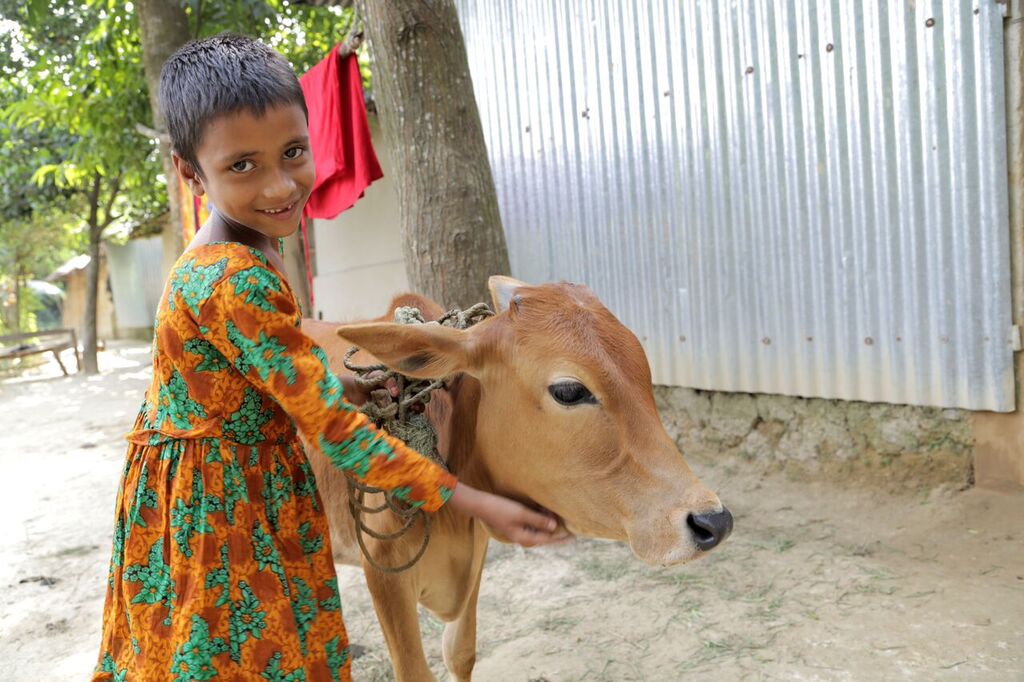
Photo : Anita Rani, 6, daughter of Babu Lal is dreaming to become a school teacher. Now she studies in grade-1.
Babu Lal and his daughter share a dream: for her to be a school teacher. To achieve this, Anita studies hard, helped by three meals a day, while her father is saving small amounts of income.
“Today, we’re having rice, fish and aubergine curry,” Anita says. “I don’t have problems with malnutrition anymore and I have a happy family.”
Story and Photos by Md. Shabir Hussain