
Green Palestine Project Concludes with Lasting Environmental Action and Stronger Community Resilience Across the West Bank

World Vision, in partnership with MA'AN Development Center has successfully concluded the 37-month Green Palestine: Promoting a Sustainable Environment for Children, Their Families and Communities in Areas B and C of the West Bank project, funded by the German Federal Ministry for Economic Cooperation and Development (BMZ).
Over the past three years, the project has worked alongside communities across the West Bank to strengthen resilience to climate change and environmental challenges through practical, community-led solutions. By combining environmental action, local leadership, child participation and institutional capacity strengthening, the initiative has laid the foundation for more sustainable and resilient communities.
The project supported the identification and assessment of environmental and climate-related hazards in 40 communities across Areas B and C of the West Bank. This process enabled communities to better understand the environmental risks affecting their surroundings and to identify practical, locally appropriate measures to reduce vulnerability and improve resilience.
“Through innovative climate-smart interventions, environmental protection campaigns, and child-focused environmental activities, Green Palestine transforms challenges into opportunities, building more resilient communities across 40 targeted locations,” said Saher Khoury, Project Manager.
A major milestone was the establishment of 22 Green Committees, bringing together approximately 520 members (49% male and 51% female). The committees included representatives from village councils and municipalities, youth groups, environmental leaders, farmers, community-based organisations and other active community members. Through targeted capacity-building activities, members strengthened their skills in assessing environmental risks, identifying mitigation measures and developing locally driven environmental action plans.
Building on these locally identified priorities, the project implemented 40 community-based environmental interventions addressing key challenges while promoting sustainable practices. The interventions included solar energy solutions, waste management initiatives, water conservation measures, electric vehicle charging stations and other environmentally responsive actions identified by the communities themselves.
To complement these efforts, the project delivered 80 environmental awareness campaigns that reached more than 92,000 children, caregivers and community members. These campaigns promoted environmental protection, climate change awareness, responsible waste management, water conservation, sustainable use of natural resources, recycling, tree planting and environmentally responsible behaviours.
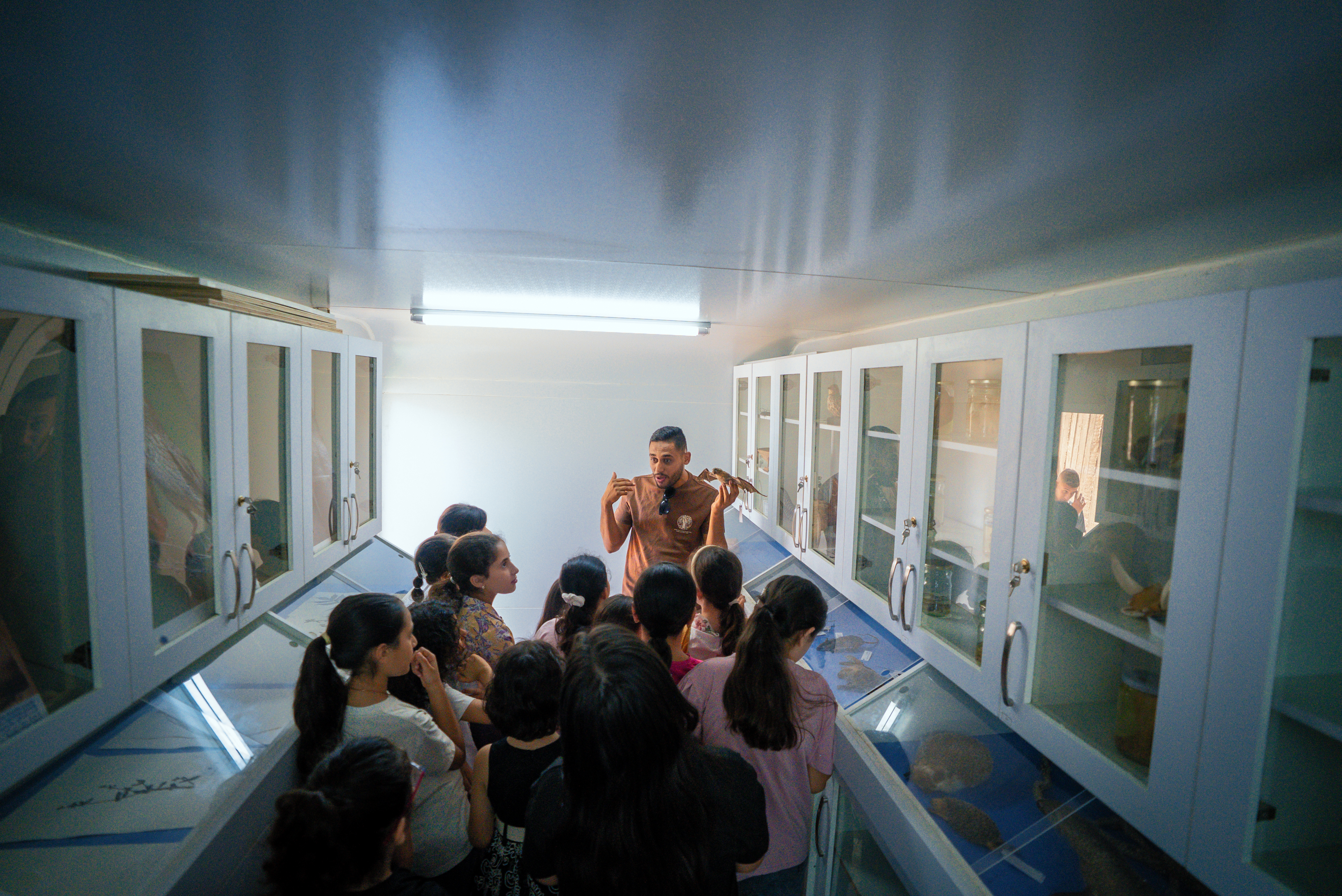
Children remained at the heart of the initiative. Through 80 child-focused environmental activities, children developed knowledge and practical skills related to climate change, environmental hazards and sustainable living. Activities included visits to mobile environmental museums, which engaged approximately 10,000 children, alongside interactive learning sessions and participatory environmental activities that encouraged children to become active ambassadors for environmental protection within their families, schools and communities.
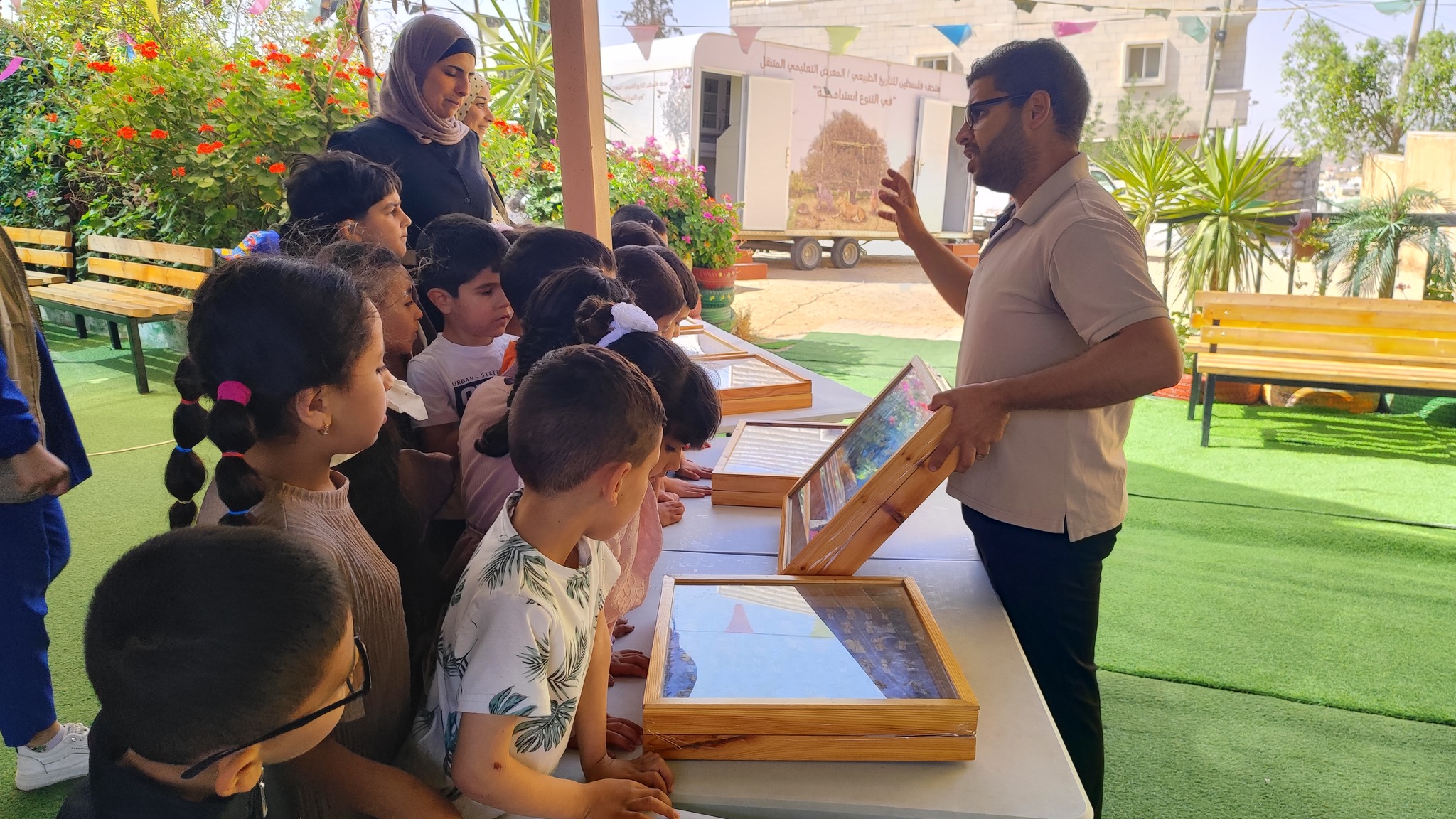
For many of these children, the experience left a lasting impression. "I didn't know we have so many animals and plants in Palestine. Now I want to protect them," said a 12-year-old girl from Nablus governorate who visited the mobile natural history museum (University of Bethlehem). "The museum made me want to plant trees at home," added a 14-year-old boy from Hebron governorate.
Reflecting on the importance of connecting environmental action with children's wellbeing, Raffi Doudaklian, National Director at World Vision Jerusalem – West Bank, said:
"Protecting the environment is no longer a choice, but a necessity for securing a better future for generations to come. Protecting children begins with ensuring that every child can grow up in a safe, healthy and sustainable environment."
Beyond community interventions, the project strengthened the institutional and technical capacity of MA'AN Development Center to sustain environmental programming beyond the project period. Capacity-building support included training on environmental assessment methodologies such as the NEAT+ tool, carbon footprint calculation and the development of Monitoring, Evaluation, Accountability and Learning (MEAL) systems to support evidence-based environmental programming.
The project also supported MA'AN in strengthening its internal systems through the development and updating of organisational policies, digitising and enhancing procurement processes, establishing a security policy and emergency management committee, and developing a comprehensive set of Standard Operating Procedures (SOPs). These improvements have enhanced operational efficiency, accountability and organisational readiness for future environmental and humanitarian programming.
Highlighting the importance of local ownership and the project's longer-term contribution, Sami Khader, General Director of MA'AN Development Center, said:
"Green Palestine was not simply a collection of activities or initiatives; it was a model of participatory development that placed local communities at the heart of the change process. The project demonstrates that investing in the environment is not a luxury, but an investment in resilience, food security, public health, the local economy and the future of generations to come."
Young people were equally central to this local ownership. Bushra, 20, an active member of her village's Green Committee, described how the project changed her community's approach to environmental challenges: "The Green Palestine project isn't just about the environment – it's also an educational and life-changing experience. It helps our community understand the environmental risks we face and work together toward a greener, more sustainable future. As young people, we play a crucial role in building a better future."
Throughout its implementation, Green Palestine was guided by strong partnerships between local communities, Green Committees, children, caregivers, local institutions and a multi-sector Steering Committee comprising representatives from the Palestinian Ministry of Agriculture, the Palestinian Energy and Natural Resources Authority, the Environment Quality Authority and other technical stakeholders.
As the project concludes, its achievements demonstrate the value of investing in community-led environmental action, strengthening local institutions and empowering children and communities to play an active role in protecting their environment. The knowledge, partnerships and local structures established through Green Palestine will continue to support environmental stewardship and climate resilience across the targeted communities, contributing to a more sustainable future for generations to come.
Notes to Editors:
About World Vision Jerusalem – West Bank: World Vision is a Christian relief, development, and advocacy organisation dedicated to working with children, families, and their communities to reach their full potential by tackling the root causes of poverty and injustice. World Vision serves all people, regardless of religion, race, ethnicity, or gender. World Vision began working in Jerusalem and the West Bank in 1975. In 2025, its programmes in the West Bank reached more than half a million people, including 346,000 children.
About MA'AN Development Center: MA'AN Development Center is an independent, non-governmental, nonpartisan Palestinian development and training institution established in 1989 and registered by law as a non-profit organisation. MA'AN's work is informed by the necessity of creating independent, self-reliant initiatives that contribute to sustainable development and strengthen human resources through the values of self-sufficiency and self-empowerment.
For more information, please contact: Mathieu Andre, Communications & Advocacy Manager at World Vision Jerusalem - West Bank, Mathieu_Andre@wvi.org | +41 78 242 92 44