
World Vision Ghana Champions Agroecology and Landscape Restoration at CIRAWA Conference 2026

World Vision Ghana Champions Agroecology and Landscape Restoration at CIRAWA Conference 2026
Accra, Ghana
How can Africa restore degraded landscapes while producing enough food for a rapidly growing population? This question was at the heart of the CIRAWA Agroecology Conference 2026, held in Accra from 1–3 July, where policymakers, researchers, development partners, private-sector actors, civil society organizations, and farmers came together under the theme "Agroecology and Nature-Based Solutions for Sustainable Food Systems in Africa."
Among the organizations helping shape this conversation was World Vision Ghana, which showcased a decade of practical experience restoring degraded landscapes, strengthening climate resilience, and improving rural livelihoods through the Regreening Africa Project.
Bringing Landscape Restoration to the Centre of the Conversation
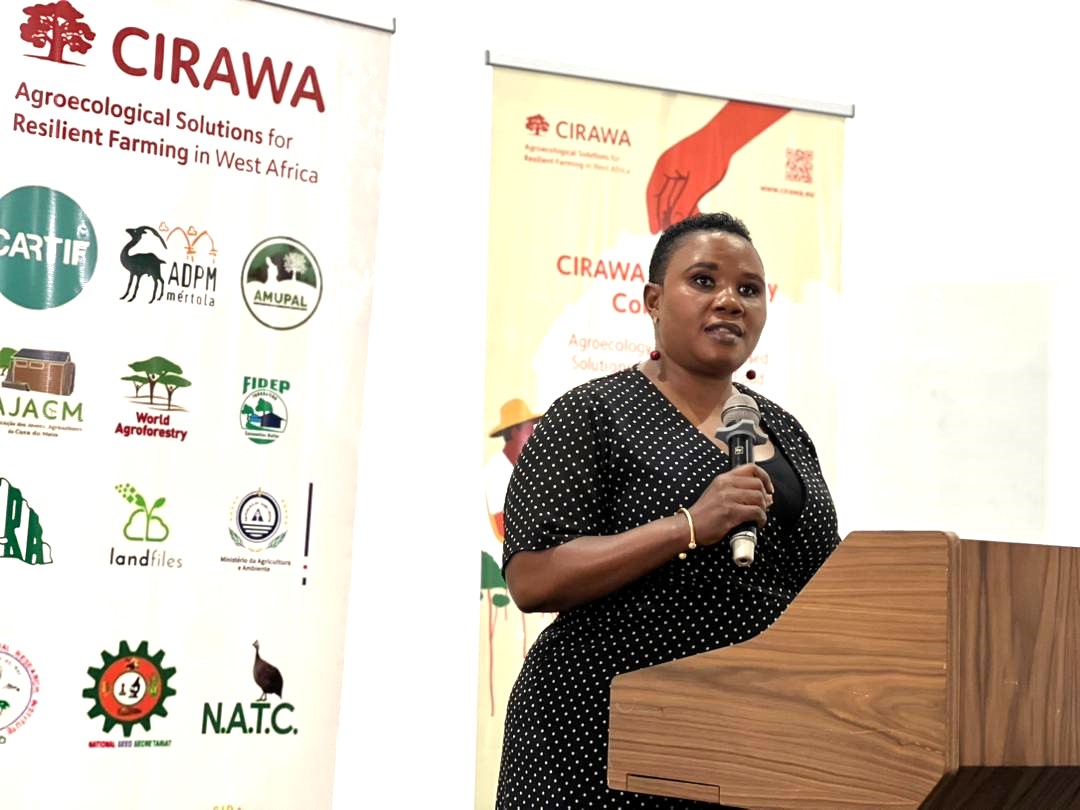
Opening the conference, World Vision Ghana's National Director, Dr Tinah Mukunda, described agroecology and nature-based solutions as a practical expression of World Vision's core value: “We are Stewards.”
Dr Mukunda reminded participants that “scaling agroecology requires more than introducing sustainable farming practices but rather strong partnerships, supportive policies, local innovations, community ownership, and effective knowledge sharing among researchers, practitioners, governments, and farmers.”
In her closing remarks, Dr Mukunda thanked World Vision’s donors, government ministries and agencies, research institutions, private sector partners, civil society organizations, traditional authorities, and, most importantly, the farmers and communities driving the adoption of agroecological practices across Ghana. “Let us strengthen our collective commitment,” she said, “to promoting indigenous knowledge, restoring degraded landscapes, scaling nature-based solutions, and building resilient food systems that benefit both people and the planet.”
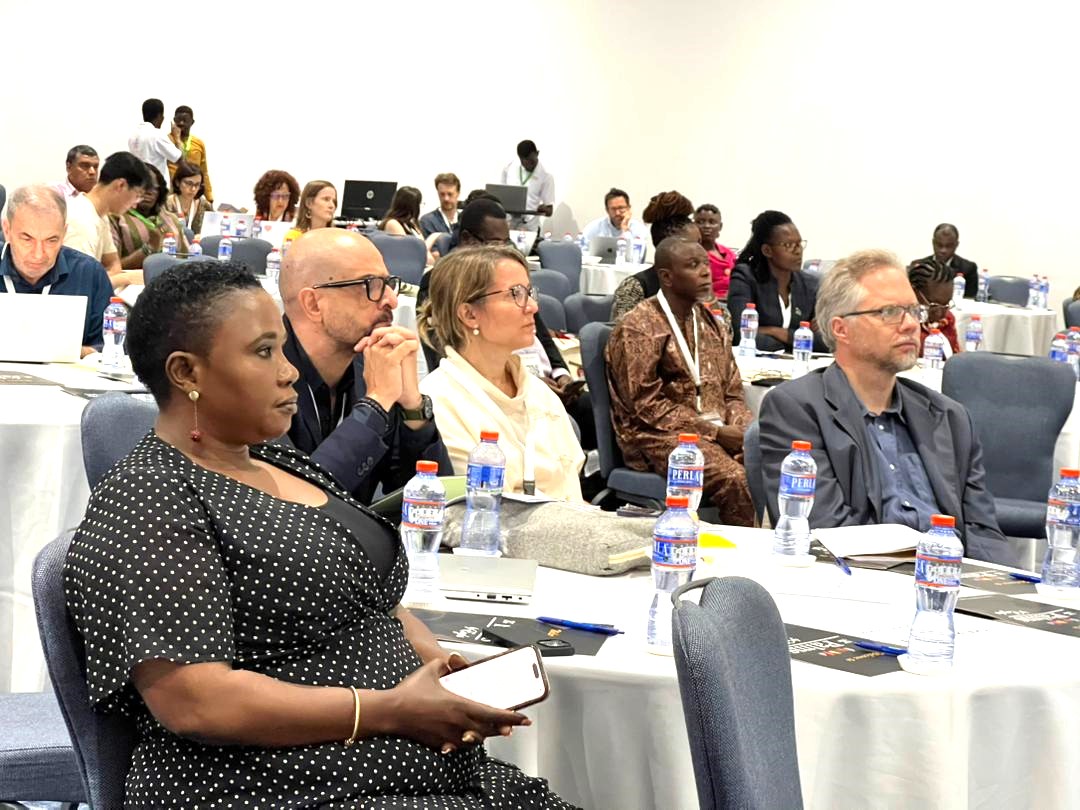
World Vision participation continued on day 2 and culminated with a workshop on 3 July, titled “Operationalizing Agroecology at Scale: Insights from the Regreening Africa Project in Ghana,” presented by Richard Appoh, World Vision Ghana’s Regreening Africa Project Manager, with co-authors from World Vision Ghana, Catholic Relief Services, the Forestry Research Institute of Ghana, and CIFOR-ICRAF. The session framed regreening as a socio-ecological transformation process, examining how FMNR, agroforestry, and soil and water conservation align with agroecological transition pathways and what it will take to scale community-led restoration responsibly.
Three papers were further presented by World Vision Ghana at CIRAWA’s scientific sessions. Maxwell Amedi and Prince Addey Owusu shared on the contribution of World Vision Farmer Managed Natural Regeneration (FMNR) approach to improved agricultural productivity and food security.
The second paper led by Maxwell Amedi, Technical Lead, Food Security & Livelihood for World Vision Ghana, focused on ‘’Beyond Dependence on Donor Grants: Understanding Communities’ Contribution to Climate Change Adaptation -Evidence from FMNR‑Based Landscape Restoration Project in Ghana. Two major issues came out clearly: increasing climate vulnerabilities and declining donor funding. The question then posed was: How do we address rising climate risk amidst declining donor funding? Communities definitely have a role to play in terms of climate adaptation. He shared on how community members contributed to restoration by participating in the FMNR‑Based Landscape Restoration Project in Savannah Agroecological Zone of Ghana, using a participatory, interpretive framework that mirrors project‑cycle approach, tracing engagement from design and planning through implementation, monitoring and evaluation, and eventual closure.
The 3rd paper titled ‘’Measuring What Matters: Developing a Holistic Metrics Framework for Farmer Managed Natural Regeneration as a Nature-Based Solution for Sustainable Food Systems in Northern Ghana led by Messrs Dr Mary Crossland, Dr Gloria Kukurije Adeyiga and Maxwell Amedi of CIFOR-ICRAF, FORIG and World Vision respectively used the TRANSITIONS Metrics Meta-Framework to review FMNR indicators with World Vision Ghana stakeholders, identifying gaps in governance, policy, and market measures and producing a refined indicator set spanning social, ecological, economic, and governance domains.
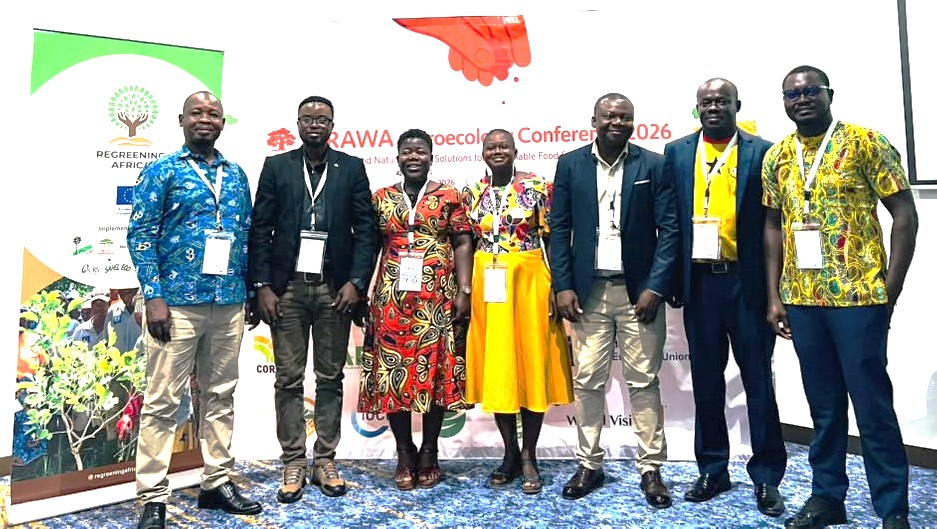
Regreening Africa: Evidence for the Agroecology Transition
Regreening Africa is a United Nations World Restoration flagship project, recognised for embodying the ten Restoration Principles of the UN Decade on Ecosystem Restoration. Funded by the European Union and implemented by CIFOR-ICRAF with World Vision, Catholic Relief Services, CARE, Sahel Eco, and Agronomes & Vétérinaires Sans Frontières, in Ghana, Somalia, Ethiopia, Nigeria, Mali, Senegal, and Niger.
Phase I (2017 to 2023) supported over 600,000 households and brought nearly one million hectares under restoration across eight countries. In Ghana, the project reached 98% of its household target and exceeded its restoration area target by 136%, with more than 35,000 households across Bawku West, Garu-Tempane, and Mion restoring over 35,000 hectares.
Phase II (2025 to 2028), with a budget of €2 million, is underway, with World Vision Ghana implementing alongside CRS in Bawku West, Garu, Tempane, Binduri, Yendi, and Mion of Ghana. The project targets to work with 60,000 households to restore 100,000 hectares of degraded land through training farmers in FMNR, agroforestry, soil and water conservation, and bushfire management, and supporting tree-based value chains such as shea butter and honey through lead farmers, eco-clubs, savings groups, and fire volunteers.
Contributing to Global, Regional, and National Climate Goals
Regreening Africa’s work directly supports Ghana’s commitments under the UNFCCC and the Paris Agreement, the Sustainable Development Goals, and the UN Decade on Ecosystem Restoration. Regionally, it supports the Great Green Wall’s vision for the Sahel and continental efforts such as AFR100. Nationally, outcomes from the six project districts feed into Ghana’s Nationally Determined Contribution and the Northern Ghana Restoration Initiative, a multi-stakeholder platform planned to sustain restoration financing and coordination after the project ends.