
No longer relying on food aid

After about five years of free food, under World Vision's general food distribution programme in partnership with the World Food Program, residents of a village in Baringo grew tired of just receiving food. They wanted a more long term project that will address their food and poverty problems in the long term. World Vision empowered and supported the community to begin an irrigation project.
Marigat district, with a population of about 73,000 people, is semi-arid, and unlike other areas where rains are experienced twice a year. Here, it only rains once a year and even then the rains are very unreliable.
Currently, farmers are preparing the lands in readiness for the rains that are expected in the month of March. According to the area district official Saul Moywaywa, “More than half the population- with the exception of the people living around the irrigation settlements and small scale business owners within town - are in dire need of food support.”
More than half this population, Saul says, relies on food aid from aid agencies and the government. “I wish there was keen investments in large scale irrigation projects and water harvesting structures to improve access to food in the area, whose lands are very productive but untapped,” he says.
But not everyone is waiting on the rains. About 50 kilometres away from Marigat is a village called Mukutani. Originally pastoralists, the residents have been empowered to practice agriculture to try and address their acute food problems.
Before August 2010, residents depended on relief food provided under the general food distribution that is supported by World Vision in partnership with the World Food Program.
“Initially, this was very critical because it was meeting our immediate food needs, but after almost five years of free food community members felt the need to have a more long term solution to their growing needs,” explains Selina Lekichep, a beneficiary of the food program.
In the August of 2010, World Vision introduced the food for assets project (FFA) project. The community, with the support of World Vision, settled on rehabilitation of community land that was once under irrigation but due to water, financial and commitment challenges, the project collapsed.
According to James Wakiaga, a World Vision technical officer in-charge-of the FFA project, the community driven project involved bush clearing, removing stumps from the land, digging trenches and canals.
World Vision provided the residents with assorted tools like hoes, machetes, shovels and wheelbarrows and work began. “In addition, we also trained the farmers on canal excavation and the scheme management,” James says.
The land was then subdivided for each household to get an acre and began preparing the land for planting. “We did not have seeds but World Vision provided all the farmers with seeds,” explains Simon Lenapunya, vice chairman of Lendorok irrigation
With rain water not reliable, the local Murat River, a permanent river, irrigates the lands; the water is channeled from the river - about 400 metres away - through the primary canals to the fields.
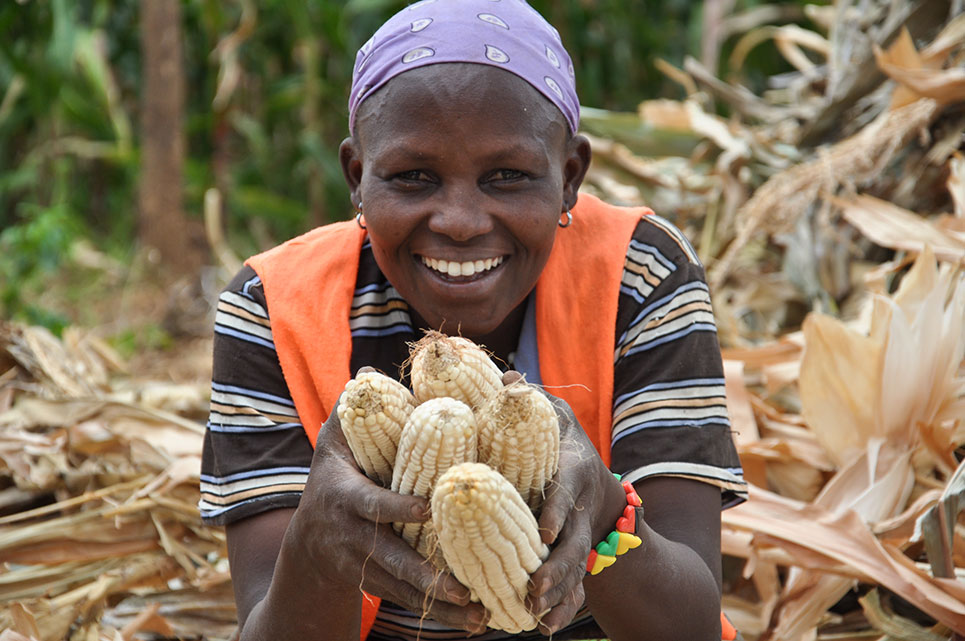
Margaret, 40, a mother of 5 children and an orphaned and abandoned child, says "Most of us have no education, have no jobs and we lost our livelihoods in the clashes in 2005, the maize irrigation scheme is empowering poor community members to have a permanent source of livelihood." Photo by Lucy Murunga
A total of 105 households are currently benefiting from the FFA project that is now called the Lendorok irrigation scheme. More land is to be developed soon and that will see an increase to the number of beneficiaries.
The beneficiaries are full of hope. Selina, a beneficiary, has one acre piece of land in the scheme. “I am hoping to harvest about nine 90kgs of maize,” Selina says optimisticly.
Christine Lechuta, a mother of five, was displaced in 2005 and fled to a distant town about 300 km away from the village. In 2008, she decided to return home. “I know that through this one acre piece of land I have in the scheme, my children will go to school,” she says.
Christine just harvested 10 bags of 90kgs of maize. “I believe one day, this community will become fully food sufficient,” Christine adds.
Margaret, also a beneficiary and taking care of an orphaned child who was abandoned, hopes the project will eradicate extreme poverty in the community. “Most of us have no education, have no jobs and we lost our livelihoods in the clashes, this project enables us to pick up the pieces.”
But what the farmers worry about most is the potential of being exploited by the middle men. “We lack access to the markets because of the poor roads, we are far removed from the main road and town,” Simon laments.
A bag of maize currently retails at 52 US dollars market price, but due to market inaccessibility, the farmers stand at a loss. They are faced with the question: should they sell to the middle men, whose price is 20 US dollars per 90 kilogram bag.
World Vision plans to support the farmers in linking them to markets so that they can sell their produce at better market prices.
“We are encouraging the farmers to form groups so that when the middle men come they sell their produce as a group, instead of individually where they stand even higher chances of being exploited,” James explains.
“Every month Selina, Christine, Simon and hundreds of other households receive the monthly food rations while they continue to build the community assets through the irrigation scheme, that is the whole concept behind the FFA project,” James explains.
According to the beneficiaries of the food aid programme, the monthly food rations on average last a family about two weeks; this means by the third week, the food stocks are depleted.
But residents reckon this will change soon. “With harvests from the farms households will have a whole month’s supply of food and children will never go hungry like in the past. Furthermore, some surplus will be left which can be sold and we can educate our children and meet other needs,” Christine explains.
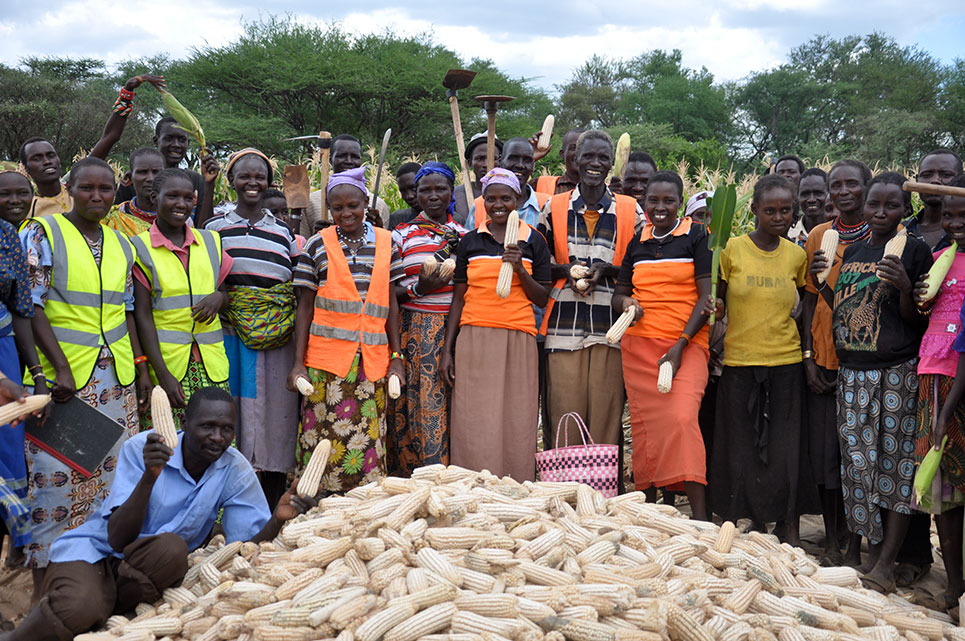
Beneficiaries of food for assets (FFA) project supported by World Vision in partnership with World Food Program pose in front of some of their members harvests. Photo by Lucy Murunga
With the FFA project, hope is being renewed in this once hopeless village, and the one thing that resonates among all the residents is that, the FFA project is more sustainable.
“At first, the people had become used to free food that they disliked the idea of having to work for the food. But later after World Vision empowered us with the benefits of building our own assets while receiving food, we realised that it was a good project and we therefore embraced it.
“We realised the need to have a sustainable project so that even if World Vision decided to leave this area, we would still have a means of supporting ourselves,” Selina explains.
World Vision supported the farmers with 544kgs of assorted certified seeds like maize, beans, green grams, finger millet, sorghum and grass seeds.
A project which began with just meeting the immediate food needs of hungry and poor residents is slowly empowering the community to own their own development and using the available resources. Once dry and abandoned fields are now lush green fields flourishing with crops.
Residents still recall the clashes in 2005 that robbed their village of their source of livelihood, then led to the difficulties of accessing food. It is a painful memory.
“I recall long hours spent outside the district commissioner’s office waiting for food, sometimes we would be turned away because there was no food. Hopefully, with this irrigation project, we will not have to relive those agonizing moments,” Selina says.