
Running towards Olympic dreams
By Lucy Murunga, WV Kenya Communications
"Welcome to the home of champions," reads a sign as you enter a small town in Kenya’s Rift valley.
This village has produced some of the world’s most respected runners; like Pamela Jelimo, who won a gold medal in the 800-meter race in 2008, and Wilson Kipsang, the second fastest marathoner of all time. He recently won the London marathon, is a 2012 Olympic gold medal contender, and is a native of Suleiman’s village.
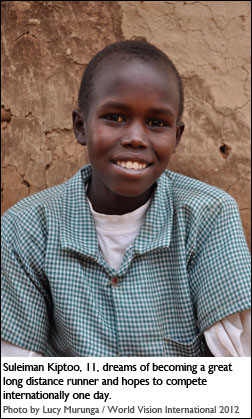 “One day I want to become a Wilson Kipsang,” says Suleiman Kiptoo, 11. “He is my role model.”
Unlike most of his peers who have more “normal” dreams, such as being a doctor, a lawyer, or a pilot, Suleiman wants to be a runner.
“I want to become a successful athlete and world champion someday,” he says.
Hard work and dedication
Suleiman starts his day at 6 a.m.
“It is difficult to train, especially in the early mornings,” he says. “Without shoes, the sharp stones prick my feet, and with only a light t-shirt and shorts, it is usually very cold.”
But neither the cold nor the terrain discourage Suleiman, whose love for athletics began at the age of six.
“My father always tells me that my village has some of the best athletes that have competed and won big marathons and the Olympics. This makes me also want to be like them,” he says.
Suleiman’s father, Thomas Kurui, 32, is also a marathon runner. His passion ignited Suleiman’s interest in athletics. But the many athletes who frequently train in the hilly area have fueled Suleiman’s passion.
Off to a good start
Recently Sulieman took his first steps toward future success, winning second place at a district race.
“The competition made me believe in myself,” he says. “As I approached the finishing line, I wished I could sprint and surpass the boy who was ahead of me.”
Even though he didn’t win, Suleiman is happy with the outcome. “I feel I performed well, it was the first time I was competing in a 10 km race,” he adds.
Not only does Suleiman run before he gets ready for school, he also uses the 7.5-mile distance from home to school and back as an opportunity to train.
“I always choose to run instead of walking,” he says.
The missing element
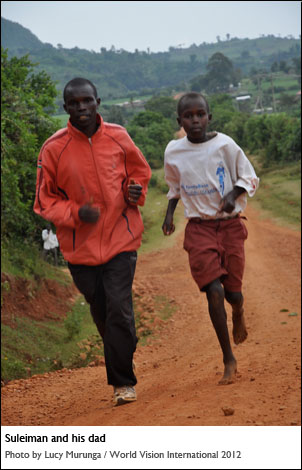 “I feel bad when I do not have money to buy my son training gear to enable him train comfortably,” says Evelyn, his mother.
Suleiman understands this well and copes with the challenging conditions.
“My father told me, ‘endurance is part of athletics’ and always reminds me that most of the successful athletes started without shoes. This gives me hope,” he says.
Suleiman’s family is very proud of him. “I will support my son 100 per cent,” Thomas says. “I have seen he loves to run, and he is very talented. I want him to prosper.”
The real reason to run
Suleiman has another objective. He runs in order to help support his family.
“I want to improve our shelter, because the house my family and I sleep in leaks when it rains. I also want to run and win money and educate my three siblings,” he says.
Even though he does not have a television or radio to follow the upcoming London 2012 Olympic games, one day he hopes to represent his country.
“I will work hard and run up to the Olympics someday and bring home a gold medal and support my family,” an enthusiastic Suleiman says.