
Learning Has No Age: A Grandfather's Journey with Positive Discipline

Across the West Bank, families are navigating growing pressures from violence, movement restrictions and economic hardship, alongside the everyday work of raising children. Grandparents often play a central role in this, offering care, guidance and the wisdom of years of experience. Through Positive Discipline in Everyday Parenting (PDEP), an evidence-based model World Vision uses to help caregivers move away from punitive practices and towards non-violent, relationship-based discipline, one grandfather in Qalqilya Governorate discovered that even a lifetime of experience can leave room for learning something new.
Khaled is a retired teacher, grandfather and current imam from Qalqilya Governorate. When he joined World Vision's Positive Discipline programme, he wasn't looking to change the way he interacted with his family. He simply wanted to fill some of his free time, learn more about World Vision and meet new people. Having already raised his own children, he was now watching them raise families of their own.
Khaled joined a group of 16 fathers and 11 adolescents aged 14 to 17 — an intergenerational space for learning, reflection and exchange. He expected little from it, until the first session.
“From the first day, something drew me to the topic and the way it was presented. I became so interested that I started waiting eagerly for the next session.”
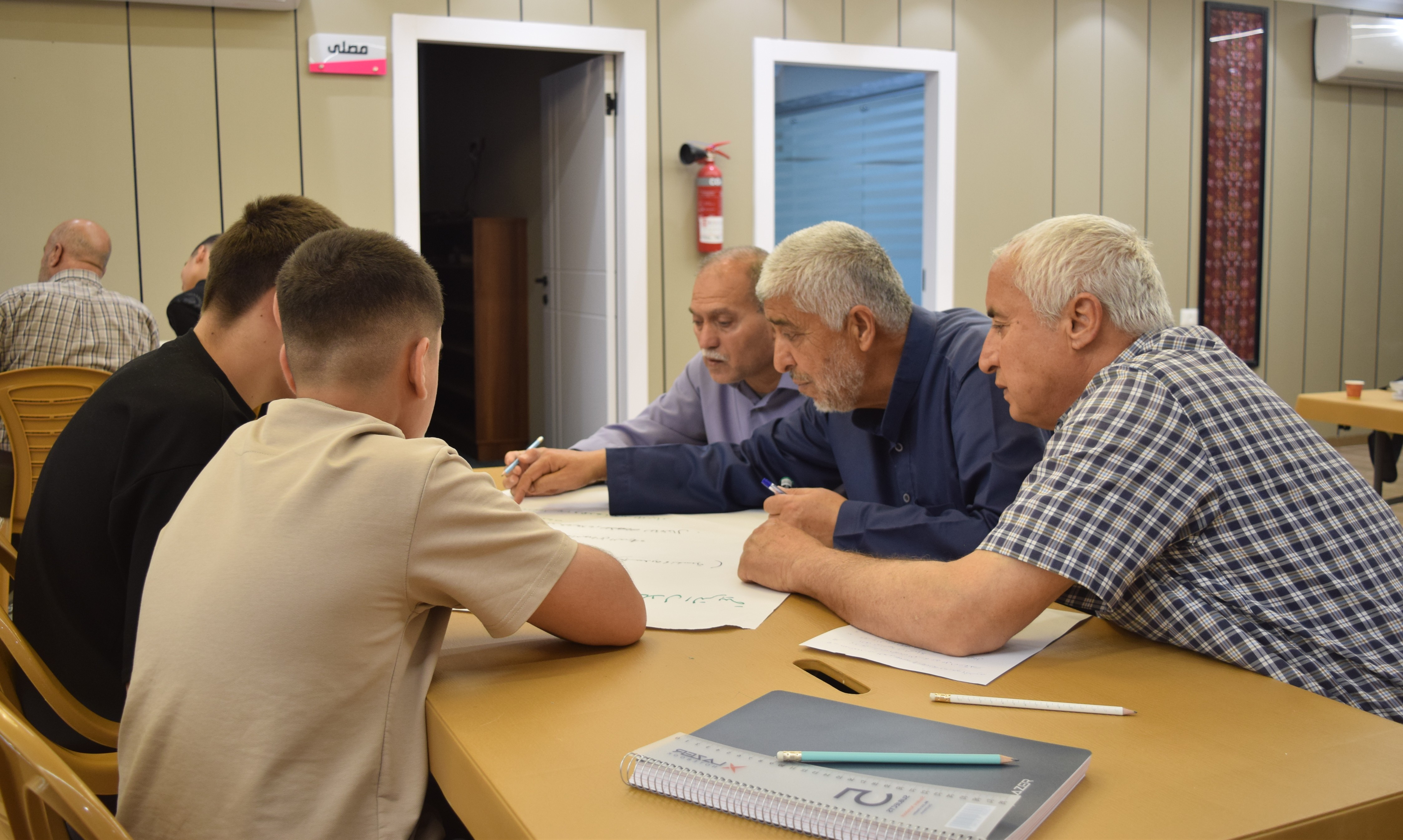
Session after session, Khaled began looking at familiar family moments differently. He thought about his grandchildren, his adult children, and how he responded when a child made a mistake or behaved in a way he didn't understand. Despite decades of experience as a father and grandfather, he realised there was still more to learn.
One lesson that stayed with him was warmth — showing children love and support even when their behaviour needs correcting. Khaled learnt something simple but powerful: to pause, take a deep breath and manage his own reaction before responding.
“I already knew the importance of love and support, but I needed a practical way to apply it. I learnt to control my reaction and respond in a way that makes the child feel cared for, while still helping them understand what was wrong.”
Positive Discipline in Everyday Parenting is grounded in an understanding of how children's brains, emotions and social skills develop over time, helping caregivers respond to a child's stage of development as a mentor rather than as a source of punishment. Research on this approach and related positive-discipline approaches has linked practices such as warmth and verbal reasoning to better outcomes for children and to calmer, more connected family relationships.
Alongside warmth, Khaled learnt about structure: not simply telling a child that something is wrong, but helping them understand why, and guiding them towards a better alternative. This gave him a new way of looking at discipline — one focused not only on correcting behaviour, but on teaching and guiding.
One of the most meaningful shifts came in how Khaled began to see his teenage grandchildren. “I began to understand some of my teenage grandchildren's behaviour differently. Sometimes what we see as rebellion is actually part of a young person trying to become independent.”
Group discussions also showed Khaled that there is rarely one right answer to a parenting challenge. Listening to other participants' experiences and perspectives helped him see the importance of looking beyond a child's behaviour to understand the reasons and needs behind it.
By the end of the programme, Khaled was no longer the grandfather who had joined simply to fill his free time. He left with something unexpected: new ways to connect with his grandchildren, and knowledge he could pass on to his own children as they raise the next generation.
“Being older does not mean that we know everything. I realised that I still had things to learn. What I learnt can help me with my grandchildren, and I can also pass it on to my children.”
For Khaled, Positive Discipline became more than a training programme. It became a reminder that supporting children is a journey that continues across generations, and that it is never too late to listen differently, understand more deeply, and grow alongside the people we love.
World Vision Jerusalem – West Bank integrates Positive Discipline in Everyday Parenting into its wider child protection programming, working with caregivers like Khaled to help shift the attitudes and behaviours that contribute to violence against children. In 2025, the organisation engaged more than 1,300 caregivers through this model, part of a broader effort to reduce reliance on physical punishment and strengthen protective, non-violent relationships between parents, grandparents and children.
Between baseline and endline assessments, the proportion of mothers believing in physical punishment fell from 88% to 38%, and the proportion of caregivers who used physical punishment and/or psychological aggression dropped from 89% to 44%. Alongside the complementary Celebrating Families model, which brings caregivers and faith leaders together to promote nurturing parenting, this work is helping families build the warmth and resilience they need during one of the most difficult periods children in the West Bank have faced in decades.