
More Than Paper: A Space Where Every Child Belongs

Born with a congenital condition affecting her hand, nine-year-old Watan has never allowed her disability to define what she can create or achieve.
In the West Bank, 50% of children with a disability have no access to safe places to play (Source: World Vision 2026 Multi-Sectoral Needs Assessment). Insecurity, risks of violence and movement restrictions are creating additional barriers to the participation and inclusion of children with disabilities.
Curious and enthusiastic, Watan took part with 15 other children in the 'From Paper to Art' initiative to transform discarded paper into works of art. Based in Tammun in the West Bank, the initiative provided a safe and inclusive space where every child could participate, express themselves and be recognised for their abilities.
Through practical sessions, the children learned about recycling and protecting the environment before using their imagination to give discarded paper a new purpose.
When the activities were under way, the room soon filled with colours, conversation and laughter. Children exchanged ideas, helped one another and watched ordinary sheets of paper take on new shapes in their hands.
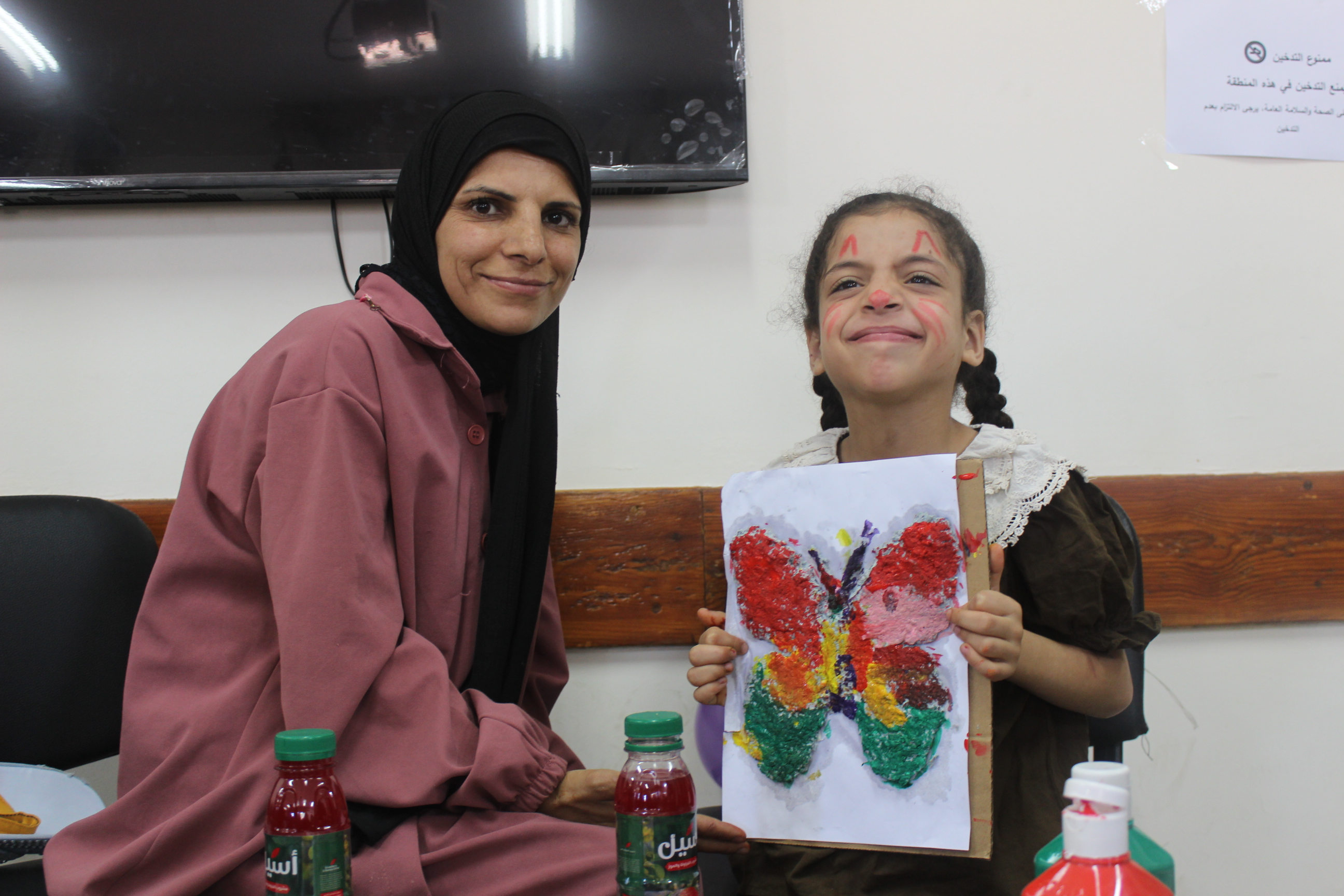
Watan participated eagerly, creating her own artwork alongside the other children. For her, the activity was not only about what she made. It was about being part of a group, enjoying the experience with her peers and having the freedom to show what she could do.
“I was very happy with the activity, and I would love for it to happen again and again,” Watan said. “We love learning new things and having fun too.”
Around her, other children were experiencing that same sense of acceptance. Among them was a nine-year-old boy with autism. His mother had often struggled to find community activities able to accommodate his needs.
In some previous activities, he had been unable to participate because organisers did not know how to support him. This time, the experience was different.
“This was one of the few activities that included children with autism,” his mother said. “It brought joy to our children and gave them an opportunity to enjoy themselves and interact in a safe and supportive environment.”
Other participating children had visual impairments or were living with the effects of serious injuries. Yet, inside this space, they were not defined by their medical conditions or the challenges they had experienced. They were artists, friends and children excited to learn and create.
The impact followed them home. One mother recalled how her children continued talking about the activity long after it had ended. They described the games they had played, shared what they had created and repeatedly asked when they could return to draw again.
Another mother captured her son’s excitement in just a few words: “My son is happy. Every day, he tells me, ‘I want to go.’”
On the final day, the children displayed their creations in an exhibition attended by their families, community members and representatives of local institutions. The sheets of paper they had carefully transformed now hung proudly before the people who had gathered to see their work.
The children stood beside their artwork, not waiting for others to speak on their behalf, but proudly presenting themselves what they had created.
The exhibition offered the community more than a collection of handmade pieces. It offered a different way of seeing the children: not through the barriers they face, but through their imagination, determination and potential.
What began with discarded paper became a powerful lesson in inclusion. The paper was given a second life, while the children were given something that should never be rare: the chance to participate, to be seen and to belong.
For Watan, the artwork she carried home was evidence of something she had always known about herself, that she is capable, creative and has something valuable to contribute.
'From Paper To Art' was organised through a partnership between World Vision's IMPACT+ Club in Watan's village in the north of the West Bank, the Municipality of her village and the Environmental Quality Authority.
In 2025, World Vision engaged close to 6,300 adolescents through 19 IMPACT+ clubs across the West Bank, strengthening their skills in active citizenship, employability, social entrepreneurship and leadership, and supporting them to design and lead initiatives that respond to priorities in their communities.