
When livelihoods collapse overnight, can education hold on?

A reflection by Dan Mtonga, Programme Quality & Impact Director, World Vision East Asia
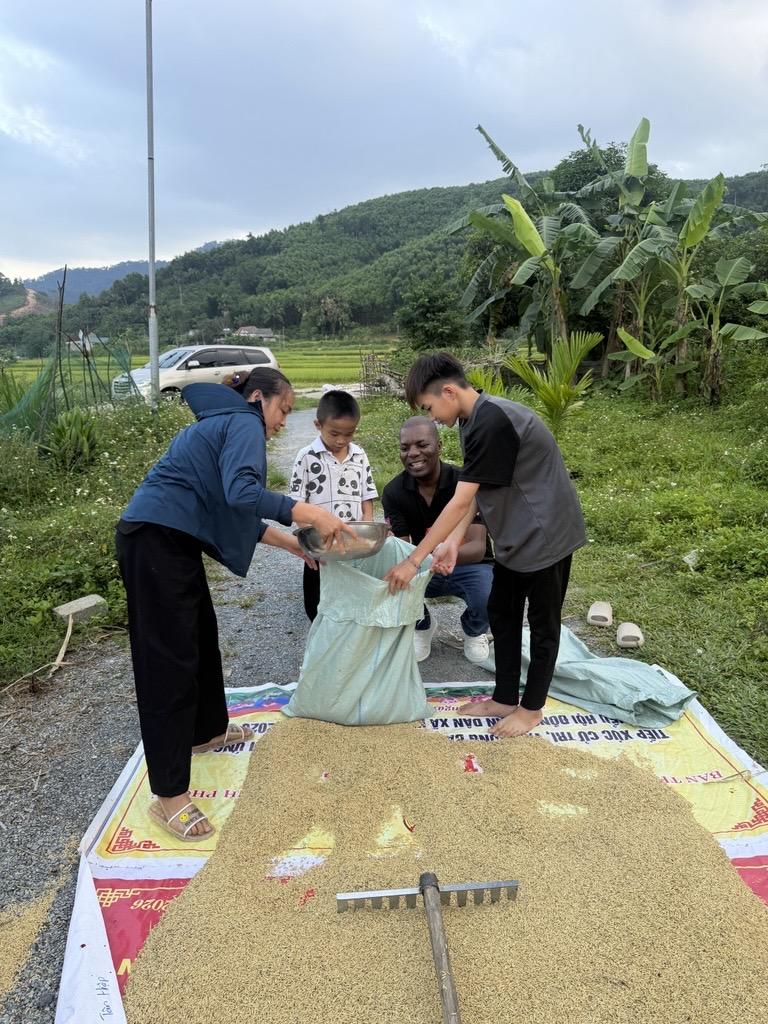
Recently, I travelled with a team of passionate colleagues from our office in Vietnam. Together, we visited a community in Thanh Hóa Province, a community where we have never worked before, and where we are now in the early stages of co‑creating a development programme with the local government, partners, the community itself, and supporters from Singapore.
In one village, I met a mother whose quiet courage has stayed with me.
She is 42 years old. She has two sons, one 16, and the other 9 (in Grade 3). As she spoke, her voice trembled at one point. She said she felt embarrassed by her situation. Not because she has done something wrong, she hasn’t, but because poverty has a way of making people carry shame that never belonged to them.
Her husband left several years ago to work in Hà Giang Province. He has never returned. He has never sent money home.
For a long time, she kept her family going through the small income she earned raising pigs and ducks, just enough to put food on the table, just enough to keep tomorrow from collapsing into today.
Then, in March, everything fell apart.
A disease swept through her animals. She lost all eight pigs, each weighing about 60–90 kg, a loss she estimated at 30,000,000 VND (about US$1,140). She also lost her 30 ducks, worth around 5,000,000 VND (about US$190). In a matter of days, what she had built with years of effort disappeared.
Now she survives through small piecework, when it comes, if it comes.
And still, in the middle of all this, she holds on to one thing with fierce determination: her sons’ future.
Her older son once dropped out in Grade 9 because the pressure at home was too heavy. He travelled about 250 kilometres away to Bắc Ninh Province, hoping to earn something by working in a restaurant. He stayed for a month. He was not paid at all. When she realised, she called him back home.
Today, he is back at his desk, studying hard for the exam that could allow him to enter Grade 10.
But passing the exam is not the end of the struggle. It may be the beginning of a new one.
If he is accepted into high school, she estimates the costs will include 800,000 VND per month for transport (about US$30), and 700,000 VND per month for lunch (about US$27). On top of that, from 2026, she expects to pay 700,000 VND per month in school fees (about US$27). She explained that the government is subsidising the rest, because if it was last year she would be paying around 2,000,000 VND per month (about US$76).
She is not asking for luxury. She is trying to secure something most of us would consider basic: the chance for a child to stay in school, to keep learning, to keep believing that effort can still lead somewhere.
And beside him is her younger son, nine years old, still meant to be in the safest years of childhood, yet already living with the daily consequences of scarcity.
As I left, I found myself holding the weight of questions that are not theoretical for her. They are immediate. They are pressing. They are about tomorrow morning, and next month, and next year.
If one illness can erase a family’s only income overnight, what will it take to make sure her 16‑year‑old’s education does not become an impossible dream, and her 9‑year‑old does not grow up believing that hunger and dropped hopes are simply his inheritance?